Biologicals R&D Up 43% at Largest Crop Protection Companies, Chemical Down 9%
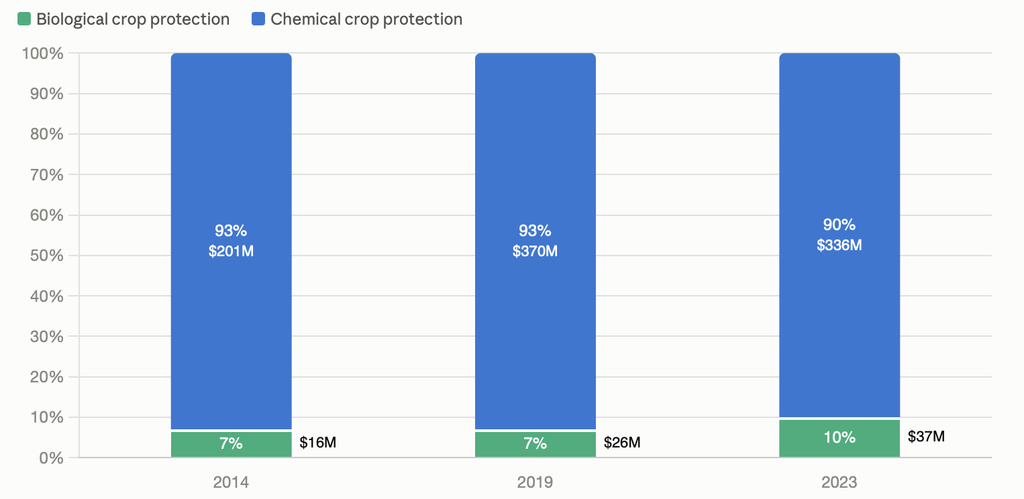
30 October 2026, Brussels: The largest crop protection companies are moving a growing share of their research money into biologicals. Between 2019 and 2023, average spending on biological crop protection R&D at five leading companies rose 43.4% to $37 million per company. Over the same period, spending on conventional chemical R&D fell 9.3% to $336 million. The figures come from a survey carried out by AgbioInvestor on behalf of CropLife International and published in May 2026. Biologicals now take 10% of the companies’ combined chemical and biological R&D budgets, up from 7% in both 2014 and 2019.
The survey was conducted during 2025. BASF Agricultural Solutions, Bayer Crop Science, Corteva, FMC and Syngenta reported their 2023 R&D budgets, which were compared with earlier editions covering 2014 and 2019. Respondents split their spending between chemical and biological products across research, development and product launch, with stewardship costs left out of the split. For the study, biologicals cover microbials, natural products (including those made by fermentation), semiochemicals such as pheromones, and biostimulants, but not biofertilisers or macrobials such as beneficial insects.
Over the decade the direction is clear. Average biological R&D per company was $16 million in 2014, rose to $26 million in 2019 and reached $37 million in 2023, more than doubling over the period. Chemical R&D grew from $201 million in 2014 to $370 million in 2019 before turning down. The combined budget also shrank, falling 5.9% from $396 million in 2019 to $373 million in 2023. Biologicals grew even as the overall budget contracted, so their larger share reflects new money committed to the category rather than a statistical effect of chemistry spending falling.
Where the money is going
The report’s charts by function suggest the extra money is pushing biological candidates further down the pipeline, not just funding early discovery. Spending on research into new biological actives rose to almost $15 million per company in 2023, from roughly $11 million in 2019. Development of new biological actives roughly doubled to around $13 million, making it the fastest-growing line. Product launch and development held broadly steady at about $9 million. A small monitoring and stewardship line for biologicals, around $1 million, appears in the data for the first time, a sign that more biological products are reaching the market and now need ongoing regulatory support.
Chemical spending is moving the other way. Across the full R&D budget, which averaged $444 million per company in 2023, spending on developing new active ingredients fell 16.8% to $130.3 million. Product launch and development fell 17.9%, and stewardship fell 24.4%. The one area of conventional R&D that grew strongly was research into new active ingredients, up 9.8% to about $139 million. That suggests companies are still hunting for new chemistry but are more selective about which candidates they carry into costly development.
The report does not directly attribute the move into biologicals to any single cause, but its wider findings describe the pressure on conventional chemistry. Taking one new chemical active ingredient to the US and European markets now costs an average of $307 million and takes about 11.4 years from first synthesis to first sale. The report notes that growing regulatory data demands have raised both the time and cost of registration. As a result, companies are concentrating resources on fewer candidates, and fewer new substances are clearing approval. The same companies have also increased spending on off-patent products, which the report reads as a defensive move to protect earnings as patents on existing molecules expire.
What the shift means for the industry
Despite the growth, conventional chemistry still takes 90% of the combined budget. The report also cautions that respondents were mainly the leading crop protection companies, some of which have bought positions in the biocontrol sector, and that many other biocontrol companies were not surveyed. The figures therefore track the strategy of the largest originators rather than total industry investment in biologicals, which is likely to be considerably higher.
For agri-input companies in South-Asia and other developing markets, the direction matters more than the current scale. As multinationals put more development money behind microbials, natural products and biostimulants, a steadier flow of biological products is likely to reach growers. Indian companies with fermentation, microbial strain or formulation capabilities may find licensing, contract manufacturing and co-development opportunities with originators building out their biological pipelines.
At the same time, generic chemical makers face multinationals investing in off-patent chemistry on one side and in biologicals on the other, which changes where competitive pressure will come from. Latin America also stands out: Central and South America was the only region where the companies’ regionally targeted R&D spending grew, rising to $56 million. That figure covers all R&D, not just biologicals.
Taken together, the survey shows an industry adjusting to the rising cost and slower pace of chemical discovery rather than abandoning it. The largest companies are protecting existing chemistry threw off-patent investment, being more selective about which new molecules they develop, and building biological pipelines that broaden their portfolios. With biologicals at a tenth of R&D budgets and growing faster than any other product category in the survey, the next edition will show whether this is a lasting reallocation or a cyclical bump. For now, the money is pointing in one direction.
Also Read: India Tops $4.39 Billion Emerging-Market AgTech Funding
Global Agriculture is an independent international media platform covering agri-business, policy, technology, and sustainability. For editorial collaborations, thought leadership, and strategic communications, write to pr@global-agriculture.com