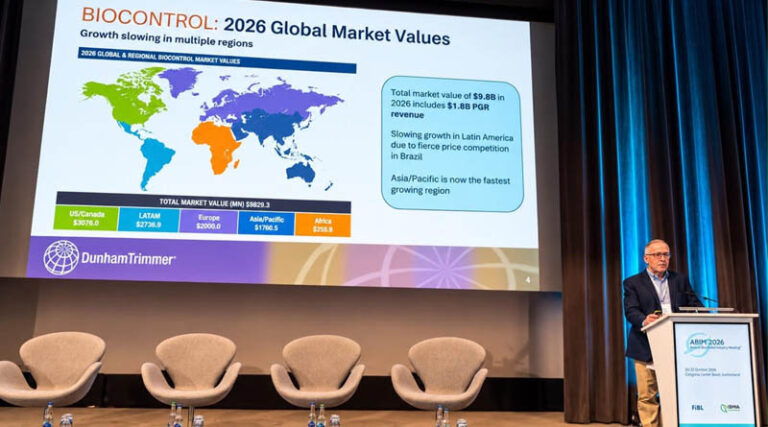
26 October 2026, Basel: The global biocontrol market is projected to reach US$14.97 billion by 2032, up from an estimated US$9.83 billion in 2026, representing a compound annual growth rate (CAGR) of 7.3%, according to the latest Global Biocontrol Market Report from consulting firm DunhamTrimmer. Released during the Annual Biocontrol Industry Meeting (ABIM) 2026 in Basel, Switzerland, the report provides market projections through 2032, with analysis by region, country, crop, product category and company.
Although the industry continues to expand, growth is slowing as mature markets enter a new phase characterized by intensifying competition, business consolidation and greater pressure to demonstrate the economic value of biological technologies.
“We are entering a phase in which understanding differences between markets, identifying where growth is actually occurring and assessing companies’ competitiveness will become increasingly important for decision-making in the biocontrol industry,” said Mark Trimmer, Ph.D., president and founding partner of DunhamTrimmer.
Latin America accounts for 28% of the global market
Latin America stands out as a major market for biological crop protection. The region is expected to generate approximately US$2.74 billion in 2026, equivalent to around 28% of the projected global market, according to the report.
Only the United States and Canada combined represent a larger regional market, at an estimated US$3.08 billion. Europe follows with US$2 billion, while Asia-Pacific is projected to reach US$1.76 billion. Africa accounts for approximately US$260 million.
The figures underscore the importance of the Americas to the biological crop protection industry and highlight Latin America’s potential, supported by large-scale agriculture and opportunities to integrate biological solutions into pest and disease management programs.
Brazil’s strategic position
Brazil occupies a strategic position in the Latin American market, supported by its agricultural scale, expanding adoption of biological inputs and evolving regulatory framework.
The country is also included in DunhamTrimmer’s expanded regulatory analysis, which covers 27 markets and examines regulatory agencies, data requirements and product registration procedures. Argentina and Kenya are among the markets added to the expanded coverage.
Regulatory developments are particularly relevant to manufacturers and technology developers because registration requirements and commercialization rules directly influence product launch timelines and companies’ ability to expand their businesses.
For manufacturers and investors, the combination of agricultural demand, market access and regulatory predictability is an important factor in determining growth opportunities.
Innovation and competition reshape the industry
The report divides the market into four product categories: microbial products, biochemicals, macro-organisms and other solutions. It also examines five application segments: bioinsecticides, biofungicides, bionematicides, bioherbicides and plant growth regulators.
Consumer demand, resistance management, product commoditization and corporate consolidation are among the factors shaping the industry’s development. Emerging technologies, including artificial intelligence, RNA interference (RNAi), peptides and precision application, are also expanding the range of potential biological solutions.
As the technology landscape becomes more diverse, competition increasingly depends on companies’ portfolios, international presence, innovation capabilities and revenue. DunhamTrimmer assesses 217 companies using its Consolidated Strength Rating (CSR) system, which groups businesses into four competitive tiers.
Biocontrol gains attention as a trade enabler
Beyond market growth, the role of biological crop protection in international agricultural trade was another focus at ABIM 2026. Trimmer addressed the subject during a panel titled “Biocontrol as a Trade Enabler,” examining how biological inputs could help exporters navigate maximum residue limits (MRLs) and phytosanitary requirements in destination markets.
Using data from the new report, Trimmer discussed regions and countries with expansion opportunities and examples in which integrating biological solutions into crop management programs helped address trade-related challenges.
“Beyond its agronomic role, biocontrol can contribute to export-oriented production strategies, helping growers manage risks associated with residues and the requirements of destination markets,” Trimmer said.
However, quantifying these benefits remains a challenge. According to the points raised during the panel, systematic studies measuring avoided shipment rejections and the economic value generated by biological technologies remain limited.
Building a stronger evidence base, including residue data from exported agricultural products, records of MRL-related incidents and quarantine requirements, could help establish the commercial benefits of biocontrol more clearly.
DunhamTrimmer also used ABIM 2026 to meet clients, partners and other stakeholders at its exhibition stand, presenting findings from the new report and discussing opportunities, trends and challenges in an industry that continues to grow, albeit at a slower pace than during earlier stages of its expansion.
Global Agriculture is an independent international media platform covering agri-business, policy, technology, and sustainability. For editorial collaborations, thought leadership, and strategic communications, write to pr@global-agriculture.com