Pamela Afokpe Wins 2026 Borlaug Field Award for Advancing African Indigenous Vegetables
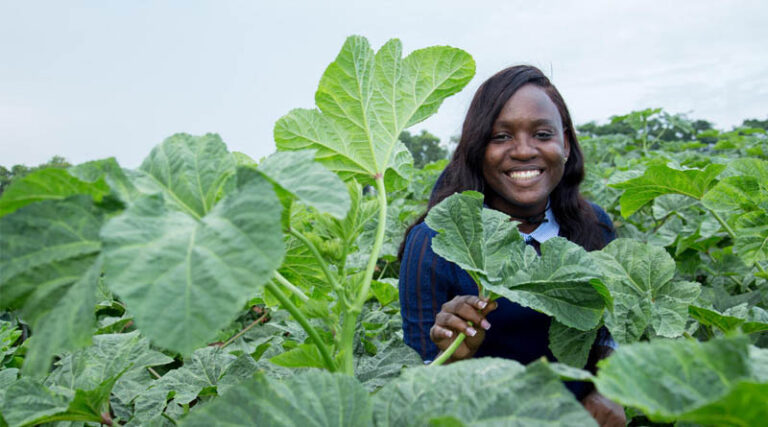
21 October 2026, Cotonou, Benin: Plant scientist Pamela Afokpe, R&D Operations Manager at East-West Seed West Africa, has won the 2026 Norman Borlaug Award for Field Research and Application for her work on improving African indigenous vegetables and developing commercial opportunities for smallholder farmers.
Afokpe received the award on October 20 at the World Food Prize Foundation ceremony in Des Moines, Iowa, United States. Endowed by the Rockefeller Foundation, the award recognises outstanding field-based scientific achievements by individuals under the age of 40.
Her research focuses on crops such as Gboma (Solanum macrocarpon), amaranth and jute mallow (Corchorus olitorius), which have long been important to African diets but have received limited investment from the formal seed sector. Through crop research, improved seed varieties and market-oriented interventions, Afokpe has worked to strengthen the commercial viability of these vegetables across West and Central Africa.
Improving Indigenous Vegetables Through Plant Research
Afokpe established a regional research platform at East-West Seed’s research hub on the campus of the International Institute of Tropical Agriculture in Benin. Starting in 2017 with a rented field and manual irrigation, she developed the programme to collect and evaluate more than 2,000 regional crop accessions from across West Africa.
Her work challenged the assumption that farmers would continue using farm-saved seed for indigenous vegetables regardless of the availability of commercial alternatives. Instead, her research highlighted the lack of suitable improved seeds as a key factor limiting the adoption of commercial varieties.
One of the programme’s significant outcomes is Sika, a Gboma variety developed to address challenges affecting vegetable production. The variety offers intermediate tolerance to bacterial wilt caused by Ralstonia species, a disease associated with severe crop losses, alongside improved post-harvest shelf life.
These traits are intended to help farmers reduce production risks while improving the marketability of their produce.
Alongside her operational responsibilities, Afokpe secured a competitive Wageningen Graduate School Sandwich PhD scholarship at Wageningen University & Research in the Netherlands. Her doctoral research has produced peer-reviewed findings on the genetic diversity and pest resistance of jute mallow, linking plant science with practical crop improvement.
Linking Seed Quality with Market Demand
Afokpe’s work extends beyond variety development to address the practical barriers that influence adoption by farmers and traders.
She introduced more precise nursery management practices as an alternative to traditional seed broadcasting, reducing farmer input costs by 40%, according to East-West Seed.
To assess the commercial value of Sika, she also conducted shelf-life demonstrations with female market traders. The demonstrations showed how lower post-harvest spoilage could improve daily earnings and household margins for retailers.
The resulting market demand became strong enough for some female retailers to pre-book harvests directly from farmers’ fields before production began.
According to East-West Seed, Sika generated more than 3,000 tonnes of produce equivalent during its first three years, reaching tens of thousands of smallholder farmers and female retailers across West and Central Africa. Afokpe’s research achievements were also recognised through the company’s global Platinum Helix R&D Award in 2025.
Indigenous Crops and Climate-Resilient Food Systems
The award highlights the growing importance of indigenous and underutilised crops in efforts to strengthen food security, dietary diversity and agricultural resilience.
Afokpe’s research aligns with the objectives of the Vision for Adapted Crops and Soils (VACS) initiative, a partnership involving the US Department of State, the Food and Agriculture Organization of the United Nations and the African Union. The initiative promotes the development and use of crops with potential to improve nutrition, strengthen resilience and support more sustainable agricultural systems.
Indigenous vegetables can contribute to these objectives, particularly when improved varieties, reliable seed supply and stronger market connections make their cultivation more commercially attractive to farmers.
“African indigenous vegetables belong at the center of the global food security map,” Afokpe said in her acceptance remarks. She added that applying scientific research to traditional crops can help smallholder farmers and market women develop commercially viable value chains when they have access to quality seed genetics.
Prof. Eric Schranz, Chair of the Biosystematics Group at Wageningen University & Research, said Afokpe’s work combines advanced scientific research with practical benefits for farming communities. He highlighted the research platform she had established and its contribution to transforming indigenous vegetable production systems across West Africa.
Advancing Women’s Participation in Agriculture
Afokpe is also a One Planet Fellow, recognised for her work addressing agricultural challenges associated with climate change. Her career has involved balancing field research, doctoral studies and regional operations while navigating gender-related barriers in agricultural fieldwork.
Her recognition highlights the contribution of women scientists to crop improvement and the development of agricultural value chains, including activities that connect seed research with farmers, traders and consumers.
The award also carries a connection to East-West Seed’s founder, the late Simon N. Groot, who received the World Food Prize in 2019. Afokpe accepted the 2026 honour at the same Des Moines event, seven years after her mentor’s recognition.
Groot’s emphasis on making high-quality seeds accessible to smallholder farmers through affordable seed packages has influenced the company’s approach to agricultural development.
As East-West Seed expands its operations in West Africa, Afokpe’s work provides a foundation for further research into indigenous crops and the development of improved varieties suited to regional farming conditions.
East-West Seed’s inclusion in Fortune’s 2026 Change the World list further reflects the company’s focus on social impact through its business activities. Afokpe’s award brings additional international attention to the role that indigenous vegetables, improved seed genetics and market-oriented research can play in building more resilient African food systems.
Also Read: USDA Reports Record Soybean Yield, Bigger Corn Crop in October Forecast
Global Agriculture is an independent international media platform covering agri-business, policy, technology, and sustainability. For editorial collaborations, thought leadership, and strategic communications, write to pr@global-agriculture.com