Bridging the Confidence Gap: Advancing the Use of Non-Animal Methods in Pesticide Toxicity Assessment
Ankita Pandey, PhD, Senior Scientist and Research Policy Advisor, People for the Ethical Treatment of Animals (PETA), India.
30 October 2026, New Delhi: Agriculture in India is rapidly embracing innovation. From precision farming and drones to artificial intelligence and data-driven decision-making, new technologies are changing how crops are grown and protected. The science used to evaluate the potential toxicity of crop-protection products is evolving just as rapidly. As a major producer and exporter of pesticides, India has a strong stake in keeping pace with advances in toxicity assessment.
At the core of this shift is the growing use of non-animal methods (NAMs)—a broad range of approaches that generate toxicity information without the use of animals, including human cell- and tissue-based models, in vitro and in chemicoassays, computational models and integrated testing strategies.
As the limitations of animal toxicity tests in predicting human outcomes become clearer, the need for more informative and efficient approaches is growing—particularly as the number and complexity of chemicals requiring timely assessment increases. NAMs can help meet this need by generating mechanistic and more human-relevant information that strengthens toxicity assessment decisions while streamlining and accelerating regulatory evaluation. But scientific capability alone does not guarantee regulatory uptake.
The Next Challenge: Building Confidence
Scientific progress has brought many NAMs to the point where they can support regulatory decisions. As outlined in our recent review, “Redefining pesticide toxicity assessment: An approach to incorporating non-animal strategies in India,” the country’s pesticide regulatory framework already provides a foundation for the use of NAMs. Through its 2017 and 2023 guidelines, the Central Insecticides Board and Registration Committee (CIB&RC) allows scientifically valid NAMs to be considered on a case-by-case basis for the toxicity assessment of chemical pesticides and biopesticides.
But between scientific acceptance and routine regulatory application lies an essential step: confidence. Regulators need confidence to evaluate and interpret NAM data, while the pesticide industry needs confidence to generate and submit those data for regulatory consideration. Traditional animal tests, despite their well-recognised scientific limitations, benefit from decades of regulatory familiarity. This long history can create a natural tendency to rely on established pathways even when newer, scientifically robust approaches are available.
A non-animal method may be scientifically valid, included in an OECD Test Guideline and accepted elsewhere, yet its wider use in India still depends on confidence in how the data will be interpreted and applied. Unclear guidance or limited reviewer familiarity can make companies hesitant to submit existing NAM data or invest in generating new data. Applicants may therefore default to traditional testing pathways, leaving regulators with fewer opportunities to gain experience reviewing NAM-based submissions.
This self-reinforcing cycle is the classic confidence gap that has slowed wider uptake of these approaches in India. Bridging this gap requires more than scientific acceptance alone. Familiarity with the methods, exposure to real data and case studies, and opportunities to build experience in reviewing and applying the evidence can all help turn scientific acceptance into routine practice.
Putting Modern Science into Practice
Globally, pesticide regulation and guidance are moving towards greater use of non-animal approaches as part of a wider shift towards more efficient and science-driven toxicity assessment. Regulators in the US, Europe, Canada and the UK are developing roadmaps, work plans and implementation strategies to help move these methods from scientific acceptance to regulatory practice. The focus is increasingly on building confidence through successful regulatory case studies, clearer guidance on where NAMs can be applied, assessor training, and continued dialogue with industry and scientific experts. This reflects a broader recognition that successful uptake depends not only on having robust methods available, but also on creating the conditions for their consistent and confident use.
This momentum is particularly relevant to pesticides, for which products are often assessed across multiple jurisdictions. Greater alignment around internationally recognised methods can reduce duplicative testing, make better use of existing data, and allow regulators and industry to draw on experience generated across regulatory systems.
For India, the next step is to translate its regulatory flexibility into practical guidance and greater transparency.Clear, publicly available information on the acceptance and application of specific NAMs and the evidence expected to support a submission would give both applicants and assessors a more predictable pathway. Publishing case studies, regulatory decisions and lessons from successful submissions would further clarify expectations, reduce uncertainty and help ensure that case-by-case flexibility leads to consistent and reproducible regulatory practice.
Practical experience is equally important. Regulators and applicants need opportunities to understand how the methods work, examine the evidence they generate, and see how that evidence can inform regulatory decisions. In India, capacity-building efforts have progressively moved in this direction. Earlier webinars and technical discussions organised by PETA scientists have introduced regulators and industry scientists to internationally accepted NAMs and their applications within the pesticide regulatory framework. More recently, this engagement has become increasingly hands-on.
In October 2026, regulatory and industry scientists participated in practical training at Jai Research Foundation on OECD Test Guideline non-animal approaches for selected toxicity endpoints.
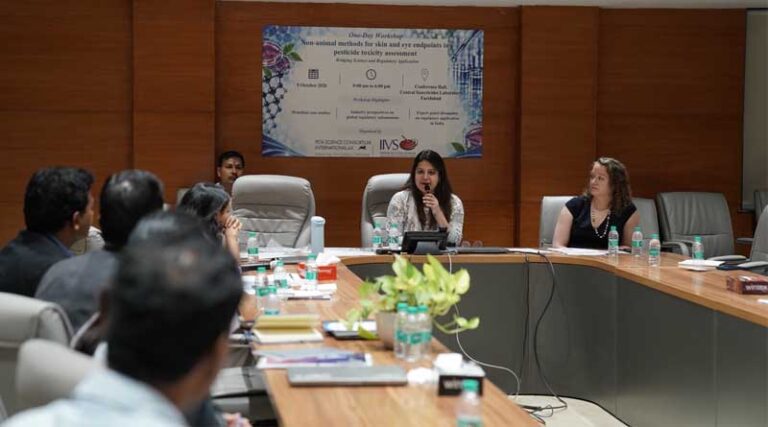
This training was followed by a scientific workshop at the Central Insecticides Laboratory in Faridabad, bringing together regulatory experts, industry scientists and international specialists. The workshop provided a platform to examine pesticide-specific case studies, industry experience across regulatory jurisdictions and examples of successful regulatory applications. Exposure to real-world evidence and international experience can reduce uncertainty and strengthen confidence in the interpretation and use of NAM data.
The Strategic Opportunity for India
India’s crop-protection sector operates in an increasingly global scientific and regulatory environment. Maintaining competitiveness requires not only innovation in the products reaching farmers but also regulatory systems that evolve with scientific advances and enable decisions based on the most relevant and reliable evidence.
As the scientific toolbox expands and international regulatory experience grows, India has an opportunity to build on the momentum already underway. This means ensuring that regulatory frameworks keep pace with scientific advances and that industry and regulators are equipped to apply and analyse these approaches with confidence.
The transition can follow a practical pathway: from awareness, to familiarity, to experience, to confidence, and ultimately to routine use. Continued knowledge-sharing, practical experience, transparent guidance and demonstrations of successful regulatory applications can help translate the current momentum into wider uptake.
For India, this is also a matter of regulatory preparedness. As international expectations continue to evolve, the ability to evaluate and use emerging scientific approaches will become increasingly important for regulators and companies operating in global markets. Building this capability now can help India keep pace with global advances while strengthening scientific credibility and regulatory efficiency.
Bridging this confidence gap could help India translate its global strength in crop-protection production into leadership in modern pesticide toxicity assessments.
Also Read: India Tops $4.39 Billion Emerging-Market AgTech Funding
Global Agriculture is an independent international media platform covering agri-business, policy, technology, and sustainability. For editorial collaborations, thought leadership, and strategic communications, write to pr@global-agriculture.com