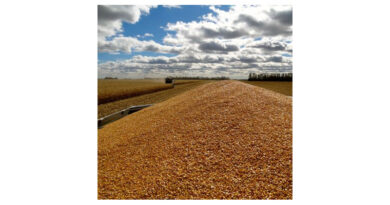
30 October 2026, Washington, D.C: The US Department of Agriculture raised its forecast for the 2026-27 US corn yield to a record 181.2 bushels per acre in its October World Agricultural Supply and Demand Estimates (WASDE) report, up 2.7 bushels from September and well above the trade’s pre-report average of 177.6 bushels. The upgrade adds to already-swelling global grain stocks and has pushed farmgate prices lower just as harvest wraps up across the US Corn Belt.
USDA’s report, published October 9, pegged total US corn production at 16.03 billion bushels, up from 15.80 billion projected in September, though still below last year’s 17.02 billion bushels because harvested acreage fell to 88.5 million acres from 91.3 million a year earlier. The higher yield more than offset the smaller planted area. Ending stocks for the 2026-27 marketing year were raised to 1.85 billion bushels from 1.57 billion in September, and USDA trimmed its farmgate price forecast to $4.70 a bushel, down 10 cents from the prior month. Globally, USDA lifted world corn ending stocks to 280.4 million metric tons from 272.1 million the month before.
Soybeans and wheat also move higher
Soybean yields were raised to 53.1 bushels an acre from 52.8 in September, roughly matching last year’s 53.0 bushels, while production climbed to 4.56 billion bushels from 4.54 billion in September and well above 2025-26’s 4.26 billion bushels, helped by a jump in harvested area to 85.9 million acres from 80.4 million a year earlier. USDA held its soybean farmgate price forecast steady at $12 a bushel, and world soybean ending stocks edged up to roughly 124.3 million metric tons. Wheat production was nudged up slightly to 1.534 billion bushels, with ending stocks rising to 740 million bushels from 717 million in September, even as the farmgate price forecast slipped to $6.30 a bushel from $6.40. World wheat stocks fell slightly to 276.0 million metric tons.
DTN’s lead grain analyst, Rhett Montgomery, and livestock analyst ShayLe Stewart both noted that the larger-than-expected US corn crop, combined with rising global stockpiles, is likely to keep pressure on prices through the rest of the marketing year, even as strong export demand from China and other buyers provides some support.
The monthly WASDE is the closest thing global grain trade has to an official scoreboard. Commodity traders, feed compounders, biofuel producers and government buyers around the world use its yield, production and stock estimates to set positions and plan purchases, so a surprise of this size, nearly three bushels above trade expectations, tends to ripple through futures markets within minutes of release and through physical grain and feed prices over the following weeks.
Why the numbers matter beyond the US
A bigger US corn crop and higher global stocks generally mean cheaper feed grain and a bit more breathing room for countries that import corn for livestock and poultry feed, including several in Latin America and Asia. It also complicates the outlook for competing exporters: Brazil and Argentina, both expecting large harvests of their own in the coming months, will be selling into a market where US supply is larger than traders had priced in, which tends to cap the premium their grain can command. For India, which is largely self-sufficient in cereals but imports edible oils and, in some years, pulses, the more direct read-through is on soybean meal and vegetable oil markets, where a larger US soybean crop adds to the global supply cushion and can soften import costs for domestic crushers and poultry feed manufacturers.
Global Agriculture is an independent international media platform covering agri-business, policy, technology, and sustainability. For editorial collaborations, thought leadership, and strategic communications, write to pr@global-agriculture.com