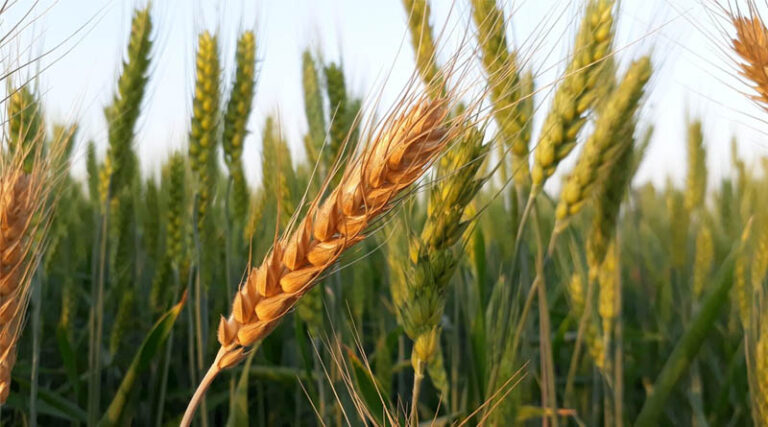
30 October 2026, New Delhi: India’s wheat acreage for the 2026-27 rabi season is expected to stay broadly stable near last year’s 33.6 million hectares even though the June-to-September monsoon came in 13 percent below normal nationally, according to agriculture ministry data and crop scientists’ assessments published October 24. The government is targeting record production of 121 million tonnes for the season, slightly above last year’s record output of 120.7 million tonnes, betting that irrigation infrastructure in the country’s main wheat belt will absorb most of the rainfall shortfall.
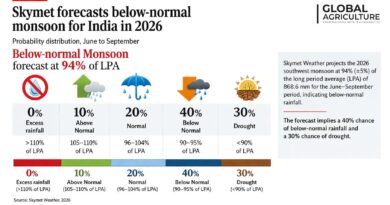
The monsoon deficit was uneven across regions, with northwest India coming in 6 percent below normal and central India 3 percent below. Early rabi-season rainfall has been more mixed: in the first half of October, northwest India received 12 millimetres against a normal 13.1 millimetres, a modest 9 percent deficit, while central India received just 1.9 millimetres against a normal 37.3 millimetres, a steep 95 percent shortfall. Rain later in October helped replenish soil moisture in parts of Uttar Pradesh, Punjab and Haryana, the states that account for the bulk of India’s irrigated wheat area.
M L Jat, Secretary of the Department of Agricultural Research and Education and Director General of the Indian Council of Agricultural Research, said irrigation availability in the major wheat-growing states should limit the impact of below-normal rainfall on farmers’ sowing decisions this season. Wheat is typically sown across India between October and November and harvested in March and April, so the next several weeks of soil moisture and canal or groundwater availability will be the deciding factor in whether the ministry’s acreage expectations hold.
Comfortable stocks give the government room to manage
Backing the government’s confidence is a comfortable buffer stock position. Central pool wheat stocks stood at 47.44 million tonnes as of September 16, well above the mandated buffer requirement of 27.58 million tonnes for that time of year. That cushion gives the Food Corporation of India more flexibility to release grain into the open market if prices spike during the sowing or lean season, reducing the political pressure that has, in past years, prompted export restrictions.
On the price-support side, the Union Cabinet has set the wheat minimum support price at 2,610 rupees per quintal for the 2027-28 marketing season, the season that will cover the crop now being sown, up from 2,585 rupees the previous year. The main wheat-growing states to watch this season remain Punjab, Haryana, Madhya Pradesh, Rajasthan, Uttar Pradesh, Bihar and Gujarat, which together account for the overwhelming share of national output and where irrigation coverage is highest.
India is the world’s second-largest wheat producer and consumer after China, and its domestic acreage and stock decisions ripple well beyond its own borders. A stable or growing Indian wheat crop reduces the likelihood that India will need to import wheat or restrict exports, which in turn keeps more supply available on global markets at a time when Black Sea exports from Russia and Ukraine remain exposed to conflict-related disruption. For international agri-input suppliers, seed companies and crop nutrition firms operating in India, a steady acreage outlook supports continued demand for certified seed, balanced fertiliser packages and irrigation equipment across the wheat belt, even in a season with an underwhelming monsoon.
The real test will come in the next six to eight weeks, as sowing progresses and the government’s weekly acreage bulletins start to show whether farmers in rain-deficient central India are shifting area toward wheat, which can be irrigated, or away from pulses and oilseeds that depend more heavily on residual soil moisture from the monsoon.
Global Agriculture is an independent international media platform covering agri-business, policy, technology, and sustainability. For editorial collaborations, thought leadership, and strategic communications, write to pr@global-agriculture.com