30 October 2026, United Kingdom: A London-based agricultural robotics company has started shipping a field robot that kills weeds with short bursts of concentrated light instead of chemicals, and says early customers are already looking at a payback period of one to three years.
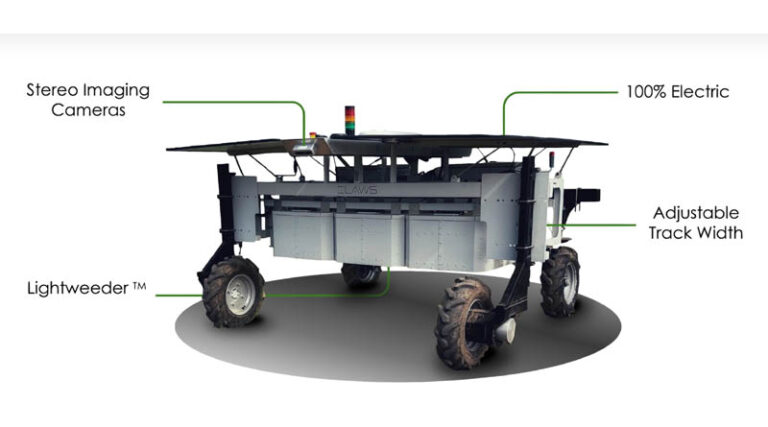
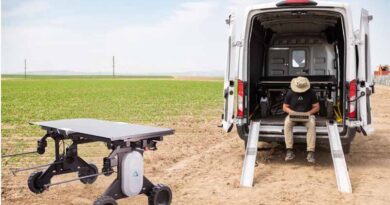
Earth Rover, founded in 2017, builds a machine called CLAWS, short for Concentrated Light Autonomous Weeding and Scouting. The robot drives itself through rows of vegetables such as onions, carrots and brassicas, using cameras and artificial intelligence to tell crop plants apart from weeds. When it spots a weed, it fires a brief pulse of concentrated light at the plant’s growing point, heating it enough to kill the weed without disturbing the surrounding soil or crop roots.
The company has sold 10 units so far, with 15 more under construction, according to Earth Rover chief executive James Miller. Unlike a laser, which stays focused as a narrow beam over long distances and can pose an eye-safety hazard, CLAWS uses light that converges and then spreads out again, so it becomes safe to the eye beyond a set distance from the robot. That design choice, Miller said, was central to getting the machine approved for use around farm workers in open fields.
How the robot performs in the field
Each CLAWS unit runs for up to 16 hours on a single battery charge, which the company tops up with onboard solar panels; Earth Rover said one unit ran through the entire 2026 summer growing season without a battery swap. The chassis track width adjusts between 1.5 and 2 metres, letting growers configure the same machine for different row spacings. Earth Rover designed the robot for vegetable operations of roughly 100 hectares carrying dense weed pressure of 60 to 100 weeds per square metre, a level at which hand-weeding or repeated herbicide passes become expensive.
Beyond killing weeds, the robot’s front and rear cameras double as a scouting tool, logging plant counts, crop position and a vegetation health measure known as NDVI, or normalized difference vegetation index, a camera-based way of estimating how green and vigorous a crop canopy is, as it passes through the field. That turns every weeding run into a data-collection pass as well, giving growers a per-plant record of how the crop is developing without a separate scouting trip.
Earth Rover has priced early units at around 150,000 British pounds, or roughly 190,000 US dollars at current exchange rates, with a discount for growers willing to be early adopters. The company has funded development through a mix of equity investment and grants from Innovate UK, the British government’s innovation agency, and the Forestry Commission. It is now preparing a Series A funding round for next year to expand the robot’s design beyond vegetables into broadacre row crops such as cereals and oilseeds.
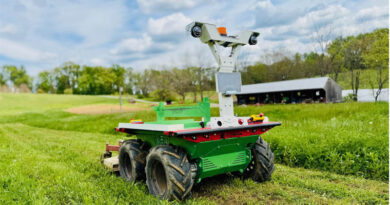
Interest in non-chemical weed control has grown as regulators in Europe and elsewhere tighten approvals for herbicides, and as weeds develop resistance to existing chemistries faster than new active ingredients reach the market. Laser and light-based weeders, along with mechanical and electrical weeding robots from other companies, have emerged as one response, aiming to cut herbicide use, reduce the labour bill for hand-weeding, and sidestep resistance problems by relying on a physical rather than chemical kill mechanism. For vegetable growers in particular, who often grow crops too delicate for aggressive mechanical cultivation and too high-value to risk herbicide drift or residue issues, a precision tool that can work close to the crop row without touching it has obvious appeal.
Global Agriculture is an independent international media platform covering agri-business, policy, technology, and sustainability. For editorial collaborations, thought leadership, and strategic communications, write to pr@global-agriculture.com