Tireless Robot Joe Takes The Pressure Off Summer Weed Spraying
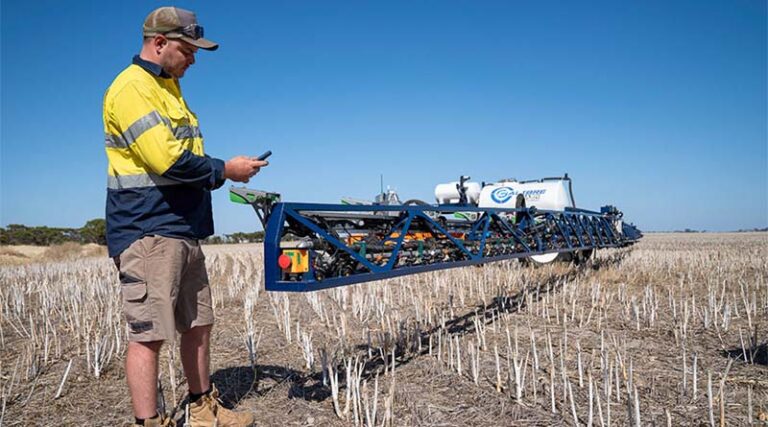
23 March 2026, AU: A grower and an operations manager from Scaddan, Western Australia, have switched to a SwarmBot with the capacity for green-on-brown spot spraying to manage summer weeds.
When it came to buying a new system equipped with cameras for green-on-brown spraying, Scaddan, Western Australia, grower Karl Raszyk and his operations manager, Tom Miles, decided to invest in automated spraying technology.
Karl and Tom had considered buying a 41 m trailing boomspray fitted with a Weed-It camera sprayer but decided on an autonomous alternative.
“We compared the cost of the trailing boomspray, which included a driver and the depreciation on a tractor in front of it, versus the SwarmBot fitted with a Weed-It Quattro camera sprayer on a 27.2 m wide Calibre Swarm Series boomspray,” Karl says. “It was cheaper to purchase the robot.”
Automated sprayer
The robot named Joe (after Karl’s father) arrived at Karl’s Scaddan farm shortly after harvest was completed in December 2023.
Tom says that mapping the boundaries of each paddock was an essential first step in putting Joe to work. “Once you’ve done that accurately, everything else is easy.”
He says most growers will already have their paddock boundaries mapped through their GPS for spraying or seeding. “Provided they are accurate, you can use those. They transfer easily to the SwarmBot app.”
The main teething problems encountered were the sensors causing the robot to stop for overhanging trees in paddocks. These have since been trimmed.
Initially, Joe also stopped for uncut canola plants; however, Karl and Tom manually overrode that with a button in the associated app. “The radar on Joe has since had a frequency upgrade, which allows it to look through plants now,” Karl says.
Top speed
Tom says Joe travels at a top speed of 10 km/h. “While that is slow compared to conventional spraying at 18 km/h, it is perfect for spot spraying.
Realistically, you’re looking at covering 250 ha a day, but this depends on the weather. It’s very accurate at picking up the weeds. We rarely see escapes.
Joe’s target weeds include volunteer canola, wheat, marshmallow, wireweed and melons after summer rains.
Since buying the automated spraying solution, Karl says summer weed control is now easier on staff, with Joe working around the clock if required. Savings include significantly fewer staff hours on machinery and less depreciation on big machinery.
“The guys no longer have to spend nights doing the summer spraying,” he says. “Our two 41 m tug-a-long boomspray units and 55 m self-propelled sprayer stay in the shed. Joe does it all.”
Two passes
Tom says Joe usually does a couple of passes across the farm each summer.
We program Joe to work according to the data from the weather station. If the temperature or the wind speed is too high, he will stop work and check the weather station once every 30 minutes until the temperature or wind speed drops and he can start spraying again.
“It’s all related to the Delta-T or the rate of water evaporation from spray droplets. The Esperance region is windy during summer, and so there’s lots of advantage in having Joe just chip away day or night as the windspeed goes down and allows him to spray.”
Initially, Karl allocated 2 hours a day for one of his full-time workers to service, fill or refuel Joe. However, the job has proved to be much faster. For example, using a fast-fill system, Joe can load herbicide in 15 minutes.
Over the past 2 years, Karl says, drier summers have meant the boomspray has only had to spray 4 to 5% of his cropped area. Some paddocks might only require 1% sprayed, while others have required up to 7%.
Cost savings
Karl says Joe has not only saved herbicide, but also labour, depreciation, water and diesel. “It’s about 0.5 L/ha less diesel than running a large tractor.”
With the robot and boom being manufactured in Australia, he says he can speak directly with engineers for backup and service.
He says the SwarmBot does approximately 40 hours on a 120 L tank of diesel, although it is usually topped up every time herbicide is refilled.
In the future, Tom says Joe could be used to apply bait for snails or mice. “It could also be used for variable-rate spreading of urea.”
Also Read: India Issues Draft Rules for Amendment to Its Insecticides Rules, 1971
Global Agriculture is an independent international media platform covering agri-business, policy, technology, and sustainability. For editorial collaborations, thought leadership, and strategic communications, write to pr@global-agriculture.com