Farmer Field Schools Strengthen Red Palm Weevil Management In The UAE
08 August 2026, UAE: Farmer Field Schools are bringing science and farmers together to tackle Red Palm Weevil in the United Arab Emirates (UAE). Through pilot farms and hands-on demonstrations, ICARDA, through C4RPWC, is testing integrated pest management technologies while helping growers adopt practical solutions to protect their date palms.
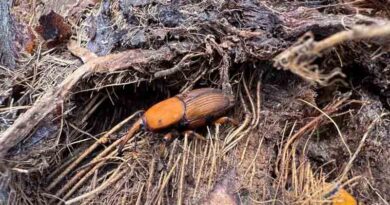
For generations, date palm farmers have faced the same challenge when managing the Red Palm Weevil (RPW): by the time visible symptoms appear, it is often too late. Hidden inside the trunk, the pest can remain undetected for months, silently damaging palms before the problem becomes apparent.
Across the Middle East and North Africa, where around 90 percent of the world’s dates are produced, RPW continues to threaten one of the region’s most valuable crops and the livelihoods of an estimated 50 million people. Agricultural research often takes years before new solutions reach farmers. The Consortium for the Red Palm Weevil Control Program (C4RPWC) is taking a different approach.
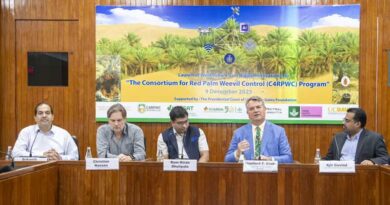
Led by ICARDA with financial support from the International Affairs Office at the Presidential Court of the UAE and the Gates Foundation, the Consortium is developing and evaluating an integrated RPW technology bundle while engaging farmers throughout the research process. Every field activity serves two purposes: generating the scientific evidence needed to strengthen RPW management while giving participating farmers the opportunity to learn, evaluate, and apply practical solutions under real farming conditions. With global RPW losses estimated by ICARDA at around USD 2 billion annually, translating research into practical solutions has never been more important.
This approach was put into practice during the Consortium’s first Farmer Field School (FFS), held at a pilot farm in Ras Al Khaimah, the first of nine Farmer Field Schools planned this year.
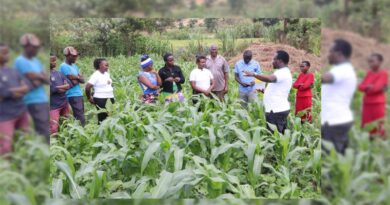
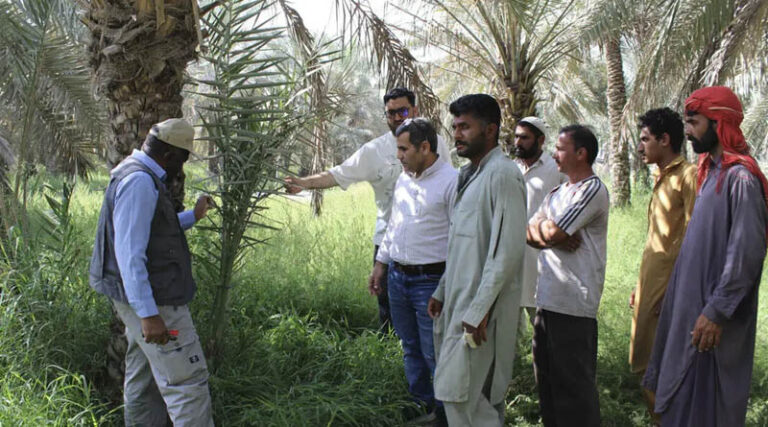
Organized in collaboration with the Ministry of Climate Change and Environment (MOCCAE), the Farmer Field School brought together growers, farm foremen and extension specialists to explore the integrated technologies currently under evaluation. Participants observed advanced dry traps, RPW repellents, regular visual inspection, the PalmEar acoustic detection device and Aretor injection, while learning how these technologies work together as part of an integrated management approach.
What began as a field demonstration soon became a conversation. Gathered around the demonstration palm, farmers compared experiences, asked questions, and explored how the different technologies could fit into their own farming practices. Researchers, in turn, gained valuable feedback on how the technologies performed under real farming conditions.
Reflecting on the demonstration, one neighboring farm foreman explained:
“Seeing the system directly on the farm made it much easier to understand how traps, repellents and regular inspection can work together to protect palms. I heard from Aziz Rahman that the system has worked very well on his farm and that he is expanding it. I am also planning to use these traps on my farms.”
For Aziz Rahman, whose farm is part of the pilot program, the early results have reinforced his confidence in the integrated approach.
“Compared with the same time last year, we have seen much less RPW infestation on the farm. These new traps are very effective, and I would like to add more traps across the farm. I am also inviting my neighboring farmers to come and see the system.” – Aziz Rahman, farmer.
Following the FFS, Aziz invited six neighboring farmers to visit the pilot farm and observe the integrated management approach firsthand. By the end of the visit, two neighboring growers had expressed interest in joining the project, illustrating how farmer-to-farmer engagement can complement scientific research and encourage wider participation.
“This is the first time I have seen the PalmEar device being used to support early detection of RPW. It is a very useful technology, and I would appreciate the opportunity to receive training and access to the device for field use,” – Eng. Mohamed Morsi Zeyada, Extension Agent, MOCCAE.
The Ras Al Khaimah pilot farm is one of 37 established across all seven emirates under the Consortium’s field validation program. Working with MOCCAE, the Abu Dhabi Agriculture and Food Safety Authority (ADAFSA) and other national partners, C4RPWC is evaluating integrated RPW management under local farming conditions. Over the life of the program, around 460 farms across the United Arab Emirates and Egypt will contribute to generating the scientific evidence needed to strengthen future Red Palm Weevil Integrated Pest Management (RPW-IPM) recommendations.
The Consortium was established on the principle that farmers should be at the center of everything we do. By bringing together the expertise of our partners as One Consortium and working directly with farmers, we are generating the scientific evidence needed for long-term solutions while ensuring that farmers already benefit from improved knowledge and integrated management approaches.” – Dr. Mojeeb Stanikzai, C4RPWC Program Manager and Interim UAE Country Coordinator, ICARDA.
As C4RPWC continues expanding its field activities, every pilot farm is helping generate the scientific evidence needed to shape the future of RPW-IPM while giving participating farmers the knowledge and practical experience to better protect their palms today. By bringing science and farmers together from the very beginning, the Consortium is laying the foundation for more effective and sustainable Red Palm Weevil management across the region.
Also Read: Syngenta Appoints Eladio Robles as India Managing Director
Global Agriculture is an independent international media platform covering agri-business, policy, technology, and sustainability. For editorial collaborations, thought leadership, and strategic communications, write to pr@global-agriculture.com