Empowering Women And Youth For Sustainable Agriculture Through Farmer Field Schools
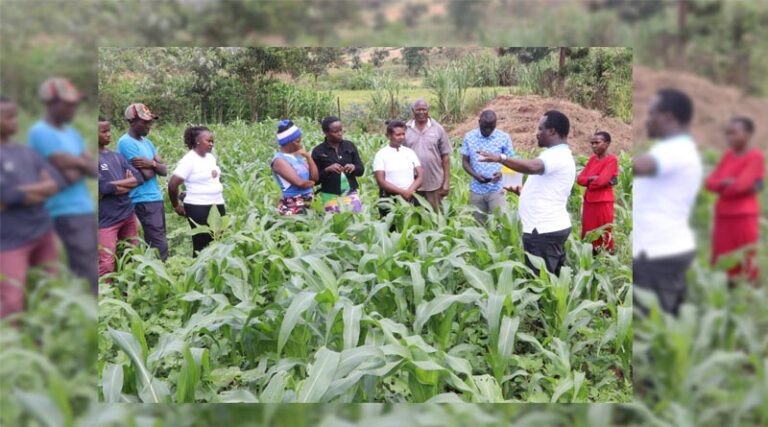
15 April 2026, Bungoma: The fields in Kabuchai sub-County flourish with maize, beans, vegetables and sweet potatoes. This can also be attributed to the farmer field schools (FFS) approach adopted by women and young farmers in this farming region.
Under the FAO–China South-South Cooperation (SSC) project on fall armyworm (FAW), this hands-on learning model is helping the farmers to sharpen their skills and knowledge, and to gain the confidence to adopt more sustainable farming practices.
A force behind healthy food production
For 23-year-old Veronica Nafula, the journey began on a field day that sparked her curiosity.
“Through the FFS, I have learned a lot about Good Agricultural Practices, cultural pest management methods, and the importance of organic farming for producing quality food,” she explains.
The training helped her confront challenges she had long struggled with, from insect pests to poor crop yields. Today, she embraces modern technologies with confidence, producing quality food, and generating income through value addition.
Just across another farm, 22-year-old Phoebe Wanjala shares a similar story of change. A mother of one, Phoebe joined the Kisiwa FFS to improve her maize farming skills. She now applies to the four principles of Integrated Pest and Pest Management (IPM) and has become an expert in controlling FAW. Before joining the FFS, she faced challenges such as poor land preparation, late planting and using uncertified seeds.
“With the knowledge I’ve gained, I know how to choose the best seed variety, prepare my land well and plant early. I now educate other farmers in my community to move from traditional farming methods to better, modern technologies,” she says.
Fearless warriors against pests and diseases
For farmers like Metrine Juma, a mother of six, the FFS has been a lifeline. Before joining, she was unaware of the importance of fertilizers or proper land preparation for her maize, vegetables, and soybeans. The practical skills she has learned from seed selection to pest control have improved her farm’s productivity.
“The FFS has made a big difference. It has helped me and even the wider community to recognize the mistakes we used to make in our farming practices and taught us how to do things better from crop management to pest control and proper seed selection,” Metrine reflects.
Even farmers with years of experience, like 49-year-old Eveline Nafula Simiyu, have benefited from various training in innovative farming technologies. Eveline joined the Namikelo FFS in 2021 seeking practical knowledge to fight poverty and support her children’s education. Today, she applies compost making, organic pesticides, and other improved agronomic practices to achieve higher yields.
Empowering future innovative farmers
The impact of the FFS extends to the youth as well. Sikuku Kennedy Wekesa, a young farmer from Sikata Village, was inspired to join farming after seeing the success of his parents, who had graduated from a nearby FFS.
“Since graduating, I have started applying the new techniques I learned, and I have seen an increase in food production,” he says. Through learning Good Agricultural Practices, Agro-Ecosystem Analysis (AESA), and value addition, Sikuku has transformed his family farm producing high quality food.
The FFS model does more than teach farming techniques; it empowers communities, builds confidence, and fosters resilience. Through hands-on learning, peer-to-peer exchange and practical demonstrations, women and youth are becoming agents of change in their communities.
Also Read: Corteva Names Luke Kissam as CEO of Future Crop Protection Company Ahead of Planned 2026 Separation
Global Agriculture is an independent international media platform covering agri-business, policy, technology, and sustainability. For editorial collaborations, thought leadership, and strategic communications, write to pr@global-agriculture.com