Airponix, Dyson Farming Test Fog-Grown System to Close UK’s Seed Potato Gap
04 November 2026, England, UK: UK agtech start-up Airponix and Dyson Farming Research have begun a two-year feasibility study to test whether England can grow its own supply of Generation Zero, or G0, seed potatoes, the disease-free first generation of planting stock from which all later seed and commercial potato crops are multiplied. The project is funded through Defra’s Farming Innovation Programme and delivered by Innovate UK, the government’s innovation agency.
England currently needs an estimated 3.5 million to 4 million G0 tubers a year, and growers typically have to multiply that initial stock three or four times in the field before it is ready for commercial planting as what the industry calls G3 or G4 seed. Airponix and Dyson Farming want to find out whether growing G0 stock domestically, in a controlled indoor environment, could be both cheaper and more reliable than current supply routes.
A fog-based growing method
Airponix’s system is a variation on aeroponics, a method of growing plants with their roots suspended in air rather than in soil, that the company says differs from conventional aeroponic setups. Its patented approach sprays an ultra-fine, nutrient-rich fog directly onto suspended roots inside an enclosed, sterile environment, which the company says lets plants take up water, nutrients and oxygen more efficiently than standard aeroponic misting or hydroponic systems that grow roots in nutrient solution. The trial uses natural light rather than artificial grow lights and a peat-free growing medium, avoiding the peat-based substrates that much of UK horticulture still relies on but which the industry is under pressure to phase out by 2030.
Machine vision cameras monitor root development, foliage growth, tuber formation and signs of plant stress around the clock, and growers can adjust the fog’s nutrient composition, delivery and surrounding environmental conditions for specific potato varieties and growth stages. Because the system allows continuous monitoring of individual plants, the companies say tubers can be harvested as they reach the required size rather than all at once, which is how field-grown seed potatoes are typically harvested.
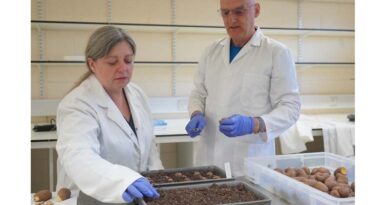
The current trial, housed in a Dyson Farming Research glasshouse, uses four Airponix growing units, known as A-frames, holding more than 6,000 plants. Airponix founder and chief executive Michael Ruggier has pointed to an existing commercial-scale reference for the technology: a 940 square meter facility operated by NADEC in Saudi Arabia that the company says produces about 1 million mini-tubers a year from 33,000 plants, using roughly 3 cubic meters of water a day, figures that come from the company rather than independent verification. Ruggier has said Airponix is targeting production costs under half those of existing seed potato propagation methods, and believes a facility covering a few thousand square meters could supply a meaningful share of England’s G0 demand.
Airponix and Dyson Farming were first introduced through Barclays Eagle Labs, a business incubator, in 2025, and reconnected later at the World Agri-Tech Innovation Summit in London before agreeing to the joint trial. Dyson Farming Research is providing glasshouse space, agronomy expertise, field trial capacity and connections to tissue-culture plant propagation suppliers, while Airponix supplies the growing technology itself.
From glasshouse trial to field testing
The project’s first phase, producing and assessing G0 tubers, is expected to deliver initial results during the 2026-27 growing season. Field trials that multiply that stock through subsequent generations are planned for 2027 and 2028, alongside ongoing work to establish a pathway for the resulting seed potatoes to receive official English seed certification. The study is due to conclude and publish its full findings in the spring of 2028. Researchers will also track G0 yield and quality per plant and per unit area, cost per mini-tuber, water and input efficiency, and how well the resulting plants perform once grown on in the field over successive generations.
If the trial succeeds, Airponix said it plans to pursue turnkey installations, technology licensing, joint ventures and build-own-operate partnerships to bring the system to commercial scale. Ruggier has also suggested the same fog-based growing approach could help speed up the breeding and release of new, more climate-resilient potato varieties, by shortening the time it takes to multiply small amounts of newly bred planting material into usable quantities of seed stock.
Also Read: India Says Finalized US Trade Deal Will Shield Its Farmers
Global Agriculture is an independent international media platform covering agri-business, policy, technology, and sustainability. For editorial collaborations, thought leadership, and strategic communications, write to pr@global-agriculture.com