18th GRIHA Summit, “Pathways for a Low-Carbon Future: Buildings to Infrastructure”
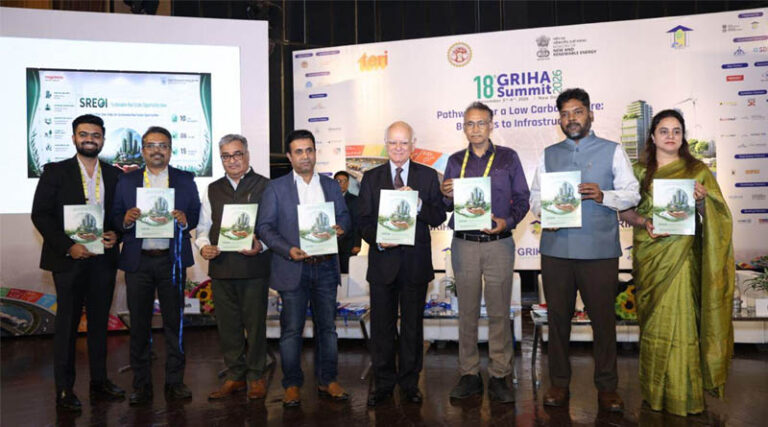
03 November 2026, New Delhi: GRIHA Council hosted the inaugural session of the 18th GRIHA Summit on 3 November 2026 in New Delhi, under the theme “Pathways for a Low-Carbon Future: Buildings to Infrastructure.” The inaugural ceremony was graced by esteemed dignitaries and sector leaders and was felicitated by Dr Vibha Dhawan, Director General, TERI and President, GRIHA Council and Mr Sanjay Seth, Vice President & CEO, GRIHA Council and Executive Director- Strategy & Partnerships, TERI.
Positioned as a pre-dialogue ahead of COP31, the Summit seeks to reflect on India’s evolving climate action priorities and consolidate perspectives that can inform the country’s contribution to the global climate agenda before nations come together to renew and strengthen their commitments. It serves as a platform for a diverse range of stakeholders to exchange knowledge, showcase emerging advancements and impactful community initiatives, identify critical gaps, and advance collective action towards a resilient, resource-efficient and low-carbon built environment.
During his opening address, Mr Sanjay Seth, Vice President & CEO, GRIHA Council and Executive Director – Strategy & Partnerships, TERI, emphasised, “Infrastructure is the foundation of a well-functioning, resilient society and central to India’s climate ambitions. As the country builds infrastructure at scale, the choices we make today will shape our carbon future for decades. The sustainability principles proven in buildings must now extend to the systems that connect and sustain them. This calls for a shift in perspective from individual buildings to integrated infrastructure, and from isolated improvements to systemic change, which is essential for reducing our carbon footprint and building a resilient and low-carbon future.”
Welcoming the gathering, Dr Vibha Dhawan, Director General, TERI and President, GRIHA Council stated, “Traditional building designs have long demonstrated how climate-responsive architecture can reduce operational costs through efficient strategies, minimising dependence on mechanical systems. Sustainability is not something that should be added as an afterthought. It must be integral to how we conceive, design, finance, build and operate our built environment, ensuring that every development decision contributes to a more sustainable future.”
Mr Sibi Chakravarthy M, Secretary, Public Works Department, Government of Madhya Pradesh and Managing Director, Madhya Pradesh Building Development Corporation (MPBDC), in his address shared, “If we cannot measure performance, we cannot establish whether our decisions are delivering the intended outcomes. GRIHA has evolved into a default rating framework for green buildings in the state of Madhya Pradesh, providing a recognised and comprehensive approach to assessing sustainability across buildings and land development. It is encouraging to see its role expanding towards a more integrated approach to sustainable infrastructure.”
In his Special Address, Mr. Sreedhar N, Senior Vice President & CEO – Asia Pacific and India, Saint-Gobain, shared “The cleanest and the least expensive unit of energy is the one a building never needs to consume. Transforming India’s built environment is a responsibility no organisation can fulfil alone. Our association with GRIHA reflects a shared commitment to bringing government, industry and academia together, accelerating the adoption of sustainable construction technologies and turning our collective ambition into action for a lighter, healthier and more resilient future.”
Sharing Special Remarks, Mr. Paul Procee, Operations Manager and Acting Country Director, The World Bank Group, noted “The challenge is no longer about understanding why green buildings matter; it is about creating the right policies, financing mechanisms and incentives that make sustainable construction an economically viable and preferred choice. JANGRIHA is an important initiative, particularly because it addresses the sustainability and resilience of self-built homes and small-scale buildings, an area that often remains outside the reach of conventional green building certifications. We look forward to engage with GRIHA Council, and work together in the small-scale housing sector.”
During the inaugural session, GRIHA Council launched three key publications – Madhya Pradesh PWD Training Report; The Sky Modelling Report; and Shashwat: Let Nature Be. In addition, GRIHA Council introduced AI-enabled tools to improve efficiency across its rating ecosystem.
The Inaugural Session also witnessed the signing of a Memorandum of Understanding (MoU) between ACETECH and GRIHA Council, marking another step towards strengthening collaborative action in the sustainable built environment.
The session concluded with the closing address by Ms. Shabnam Bassi, Deputy CEO & Secretary, GRIHA Council and Director, Sustainable Buildings, TERI.
Following the Inaugural Session, the Summit inaugurated “AAROHAN”, an exhibition featuring dynamic zones showcasing cutting-edge sustainable materials, technologies and innovations. Another key attraction was SPARSH 2.0, a life-size mock-up designed to offer a tangible experience of a low-carbon built environment. In parallel, the “Indian Streets Reimagined” Architectural Design Competition, organised in collaboration with the Council of Architecture (CoA), showcased shortlisted design entries exploring inclusive, climate-responsive and future-ready approaches to reimagining Indian streets.
Also Read: India Says Finalized US Trade Deal Will Shield Its Farmers
Global Agriculture is an independent international media platform covering agri-business, policy, technology, and sustainability. For editorial collaborations, thought leadership, and strategic communications, write to pr@global-agriculture.com