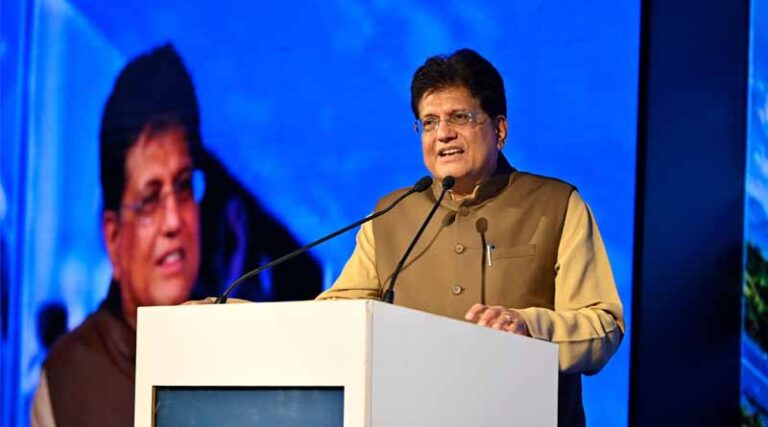
02 November 2026, New Delhi: India’s Commerce and Industry Minister Piyush Goyal said on October 29 that the country’s interim trade agreement with the United States, now in its final stages of negotiation, will fully protect the interests of Indian farmers. Speaking at the Fourth National Conference on India’s Industrial Transformation, organized by the Institute for Studies in Industrial Development and the India Development and Research Association, Goyal said Indians will “celebrate” once the full details of the pact are made public, and he rejected criticism from opposition groups that he said were politicizing the deal.
Separately, at the India-Netherlands Business Forum the same week, Goyal said most of the negotiations are complete and the agreement is now being fine-tuned before signing. No signing date has been announced.
Farm tariffs at the center of the deal
Under the agreement, India will eliminate or reduce tariffs on a range of American agricultural goods, including dried distillers’ grains with solubles, tree nuts and fruit. The move builds on a framework the two countries announced in February 2026, under which US tariffs on Indian goods fell to 18% from 50% as both sides worked to end roughly ten months of deadlock in bilateral trade talks.
Goyal said India has consistently prioritized its own domestic interests when negotiating free trade agreements, warning that what he called “imbalance agreements” would not serve the country well over time. He did not specify how the final agreement treats dairy products or genetically modified crops, two categories that have drawn the most scrutiny from Indian farm groups since the February framework was unveiled.
That scrutiny has not faded in the months since. The farmer network ASHA-Kisan Swaraj warned in a February 7 statement that removing tariffs on US farm goods could depress domestic prices, hurt farmers and horticulturists, and distort India’s feed and livestock markets by increasing import dependence. The group singled out dried distillers’ grains and red sorghum imports as a threat to Indian farmers who grow maize, jowar and soybean for fodder and animal feed, and it raised concerns that soybean oil and the same distillers’ grains could serve as a backdoor route for genetically modified material to enter India’s food and feed supply, since most US supplies of both commodities are derived from GM maize and soybean.
India’s Food Safety and Standards Authority requires non-GM certification for imports linked to 24 notified crops, including maize, soybean and wheat, under a 2020 order, a rule farm groups say the new tariff concessions could put under pressure. The network’s February statement also noted that soybean growers in Maharashtra, Telangana, Madhya Pradesh and Rajasthan are already in financial distress, adding urgency to its objections. Farmer organizations called for nationwide protests on February 12 in response to the framework, and opposition politicians have continued to press the government on the issue in the months since, even as formal negotiations moved toward their current, near-final stage.
Goyal’s comments this week represent the government’s most direct recent response to those concerns, framing the finalized deal as one that balances new market access for American exporters against protections for Indian growers, though the text of the agreement itself has not yet been released for public scrutiny.
Global Agriculture is an independent international media platform covering agri-business, policy, technology, and sustainability. For editorial collaborations, thought leadership, and strategic communications, write to pr@global-agriculture.com