Headline: California Moves to List Atrazine as Carcinogen Under Prop 65
02 November 2026, Sacramento, US: California’s Office of Environmental Health Hazard Assessment (OEHHA) has issued a notice of intent to list atrazine, one of the most widely used herbicides in American row-crop agriculture, as a chemical known to the state to cause cancer under Proposition 65. The notice is dated October 9, 2026, and opens a public comment period that closes November 9, 2026.
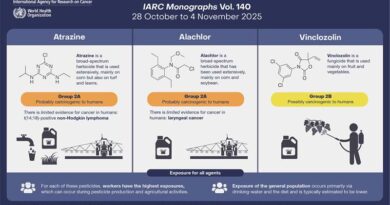
OEHHA is not conducting its own scientific risk review in this instance. The listing follows a procedural mechanism written into Proposition 65 that requires the agency to list any substance the International Agency for Research on Cancer (IARC) has already classified as a human or animal carcinogen, once that classification is confirmed. OEHHA’s notice points to IARC’s designation of atrazine as Group 2A, or probably carcinogenic to humans, a classification IARC issued in November 2025 based on limited evidence in humans, sufficient evidence in animal studies, and strong mechanistic evidence from laboratory research. The agency’s notice cites IARC’s compiled list of classified agents and a companion summary published in The Lancet Oncology describing the carcinogenicity findings for atrazine alongside two related agrochemicals, alachlor and vinclozolin.
Because the action is procedural, OEHHA has narrowed what it will consider during the comment window. It says it can only accept input on whether IARC sufficiently identified atrazine as a carcinogen, and cannot weigh arguments about the strength or quality of the underlying evidence IARC reviewed. Comments can be filed electronically through OEHHA’s website, by mail to the agency’s Sacramento office, or by hand delivery, addressed to agency contact Kiana Vaghefi. OEHHA has not published a timeline for when it expects to issue a final listing decision once the window closes.
What a Listing Would Change
A Proposition 65 listing would not revoke atrazine’s federal registration or restrict its use in the field directly. Instead, it would eventually trigger consumer and occupational warning obligations once the state sets a regulatory safe-harbor exposure level, a process that typically follows a final listing by a separate rulemaking. Manufacturers, distributors and commercial applicators operating in California would then need to assess whether warning labels or point-of-exposure notices apply to their products and work sites. Atrazine itself remains registered for sale and use nationally under the US Environmental Protection Agency’s Federal Insecticide, Fungicide and Rodenticide Act; the EPA and Health Canada have both stated they have not found a causal link between atrazine and cancer, putting the state and federal positions at odds for now.
The regulatory notice follows a fresh wave of litigation around the herbicide. On October 6, 2026, a California resident who says he mixed, loaded and applied atrazine products in Los Angeles County for roughly three decades filed suit against Syngenta AG and Syngenta Crop Protection LLC in the US District Court for the Central District of California, alleging the exposure caused him to develop non-Hodgkin lymphoma. The complaint brings claims of design defect, failure to warn, and negligence under California law, and alleges Syngenta could have reduced cancer risk through alternative formulations or packaging. Jeff Cecil, president of Syngenta’s North America Crop Protection business, called the lawsuit disappointing and said the company does not believe it is grounded in fact, adding that Syngenta remains committed to continued innovation in the category.
Atrazine has been banned in the European Union since 2004. In the United States, Syngenta previously agreed to a 105 million dollar settlement in 2012 with nearly 2,000 community water systems over atrazine contamination claims, a settlement that did not resolve personal injury claims. A US Supreme Court ruling in June 2026 that federal pesticide law preempts certain state failure-to-warn claims against glyphosate products has added uncertainty to how courts may treat similar claims involving atrazine going forward.
Also Read: New Case IH Puma 185 Tractor to Make Irish Debut at FTMTA 2026
Global Agriculture is an independent international media platform covering agri-business, policy, technology, and sustainability. For editorial collaborations, thought leadership, and strategic communications, write to pr@global-agriculture.com