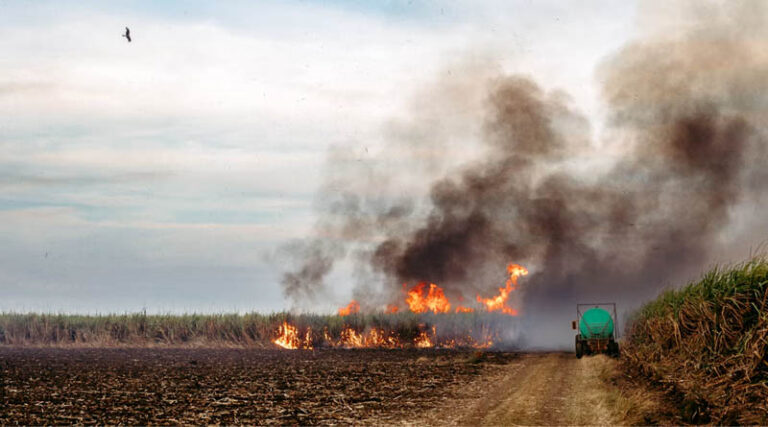
30 October 2026, Amritsar: Satellite monitoring shows Punjab recorded 574 stubble-burning incidents between September 15 and October 24 this year, a 2.3 percent rise over the 561 counted in the same window last year, even as government forecasters estimated that farm fires in neighbouring states contributed close to 11 percent of Delhi’s fine particulate pollution on October 26. The data, released October 25 and corroborated separately by official air quality forecasting figures the following day, has reignited a now-familiar seasonal dispute between Punjab’s ruling Aam Aadmi Party and the BJP-led Delhi government over who bears responsibility for the capital’s worsening air.
While this year’s count is higher than 2025, it remains far below the 1,678 fires recorded over the same period in 2024, a roughly 66 percent drop that officials on both sides have claimed credit for in the past. This year’s fires are heavily concentrated in just two border districts. Tarn Taran recorded 270 incidents and Amritsar 144, together accounting for more than 72 percent of the state’s total, with smaller numbers in Gurdaspur, Kapurthala and Jalandhar.
On the Delhi side, the capital’s air quality problem has multiple sources beyond farm fires. The Decision Support System for Air Quality Management, run by the Ministry of Earth Sciences, attributed 37 percent of Delhi’s PM2.5 load on October 26 to sources within the National Capital Region itself, with transport emissions responsible for roughly 21 percent, before stubble burning in Punjab, Haryana, Madhya Pradesh and Rajasthan. The timing is no coincidence: the spike in farm fires coincides with the paddy harvest, when farmers burn leftover crop residue to clear fields quickly ahead of the wheat sowing window, a practice successive governments have tried, with only partial success, to replace with machinery-based alternatives such as the Happy Seeder.
Enforcement rises alongside the political blame game
Enforcement has stepped up alongside the numbers. Rajesh Verma, chairperson of the Commission for Air Quality Management, personally led a review team to Amritsar and Tarn Taran, the two worst-affected districts. As of October 23, Punjab authorities had registered 91 police cases against farmers for burning residue, made adverse entries in land records in 182 cases, and issued warnings or show-cause notices to 305 nodal officers responsible for monitoring the practice at the village level.
The politics have been sharper than the enforcement. Punjab’s finance minister, Harpal Singh Cheema, said the state had supplied farmers with machinery worth more than 800 crore rupees and accused the BJP of trying to threaten and malign the farmers who, in his words, feed the nation. Delhi minister Manjinder Singh Sirsa fired back on social media, blaming what he called the AAP government’s incompetence rather than genuine helplessness. AAP’s state media coordinator, Baltej Pannu, countered that paddy harvesting had barely gathered momentum this year because of delayed rains, and claimed burning incidents had fallen by as much as 80 percent last year, a claim that is difficult to verify independently from the available data.
Underneath the political noise is a persistent structural problem: Punjab’s farmers operate on a tight calendar between harvesting paddy and sowing the next wheat crop, and despite years of subsidies for straw balers, happy seeders and other residue-management equipment, burning remains the cheapest and fastest option for many smallholders, particularly where custom hiring centres are oversubscribed or machinery is poorly maintained.
Global Agriculture is an independent international media platform covering agri-business, policy, technology, and sustainability. For editorial collaborations, thought leadership, and strategic communications, write to pr@global-agriculture.com