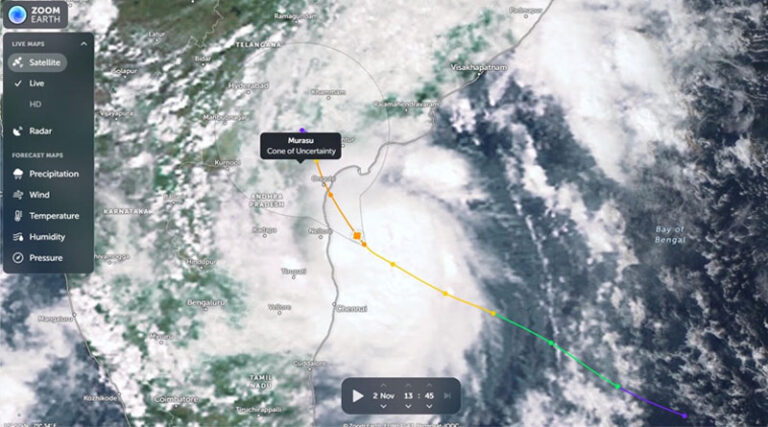
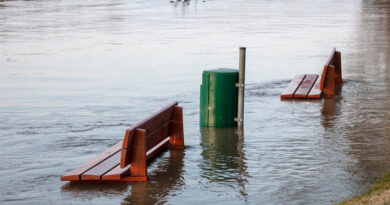
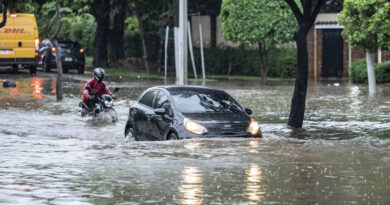
05 November 2026, Ongole, IN: Cyclone Murasu made landfall near Ongole in Prakasam district, Andhra Pradesh, at about 1 a.m. local time on Tuesday, the India Meteorological Department said, flooding low-lying farmland, uprooting trees and toppling electricity poles across the state’s coastal belt. It was the second cyclone to strike the region within a week, following Cyclone Arnab, which came ashore in Andhra Pradesh on October 28.
The storm brought extensive damage to Prakasam and Bapatla districts, where thousands of trees were felled, hundreds of power poles were damaged and fishing boats were wrecked, district officials said. Standing crops were hit as well, with several farmland areas left underwater as the storm moved through. Murasu also brought heavy rain to Tamil Nadu, Puducherry and Odisha, extending its reach across India’s southeastern coastline.
In neighboring Odisha’s Ganjam, Kandhamal and Gajapati districts, agriculture officials had already estimated crop damage of around 90,000 hectares from Cyclone Arnab, with paddy bearing the brunt of the losses, particularly in Ganjam. Weather forecasters warned of heavy to very heavy rainfall in southern Odisha, including Ganjam and Gajapati, as Murasu approached, raising fresh concern among farmers whose fields had not yet drained from the earlier storm. Ganjam district alone had about 2.16 lakh hectares under paddy cultivation this Kharif season, and had already reported crop losses on more than 3,402 hectares from separate flooding in late September, before Arnab and Murasu compounded the toll.
Farmers brace for a second blow
Sameer Kumar Pradhan, a farmer in Takarada village in Ganjam district’s Sheragada block, said standing paddy on about 10 acres of his land remained submerged in floodwater from Arnab that had yet to drain. He said a fresh spell of rain would rot the roots of paddy that was already in the milking stage. Shankar Kumar Pati, a farmer in Samantiapalli in the district’s Patrapur block, said a new round of rainfall under Murasu’s influence would destroy his entire paddy crop.
Manoranjan Roul, Odisha’s Chief District Agriculture Officer for Ganjam, said the administration had planned a survey to assess crop losses from Arnab once weather conditions cleared. Odisha Chief Minister Mohan Charan Majhi, after reviewing the flood situation, announced a relief package of 50 kilograms of rice and 2,500 rupees for every family affected by the rain and flooding in the state’s southern districts, along with compensation for crop and property losses tied to Cyclone Arnab. Small and marginal farmers who lost 33 percent or more of their crop will receive an input subsidy of 8,500 rupees per hectare in rain-fed and non-irrigated areas, and 17,000 rupees per hectare in areas with assured irrigation, the state government said. It also deployed 145 additional agriculture staff, including block agriculture officers and village agriculture workers, to help assess damage and manage the flooding.
In Andhra Pradesh, Prakhar Jain, managing director of the state’s Disaster Management Authority, said no deaths or injuries had been reported so far from Murasu. Authorities began evacuating residents from vulnerable coastal areas on Monday ahead of landfall, with plans to move about 30,000 people to safety across the state, Jain said. In Kothapatnam, a fishing village in Prakasam district, about 400 families were moved out before the storm hit, a local fisherman named Krishnamma said.
India’s Home Minister, Amit Shah, said on the social media platform X that he had spoken with Andhra Pradesh Chief Minister N Chandrababu Naidu about the situation and had assured him the central government would provide all kinds of assistance and support. Shah added that national and state disaster response teams were already on the ground in the affected districts.
Global Agriculture is an independent international media platform covering agri-business, policy, technology, and sustainability. For editorial collaborations, thought leadership, and strategic communications, write to pr@global-agriculture.com