From ONE Field To Many: How Farmer-led Learning Drives Agricultural Scaling
30 April 2026, Zimbabwe: Real agricultural transformation begins in a farmer’s field with a season that might not go quite as expected, a method that seems unfamiliar at first, and a decision to keep going. What began as a mother trial on one farmer’s land has grown into something much bigger, a practical example of how research, extension, farmer leadership, and institutional partnership can work together to move promising technologies beyond demonstration and into real adoption. It is also a reminder that lasting impact is not only about introducing a good idea, but about staying long enough for that idea to be understood, trusted, adapted, and taken forward by farmers themselves.
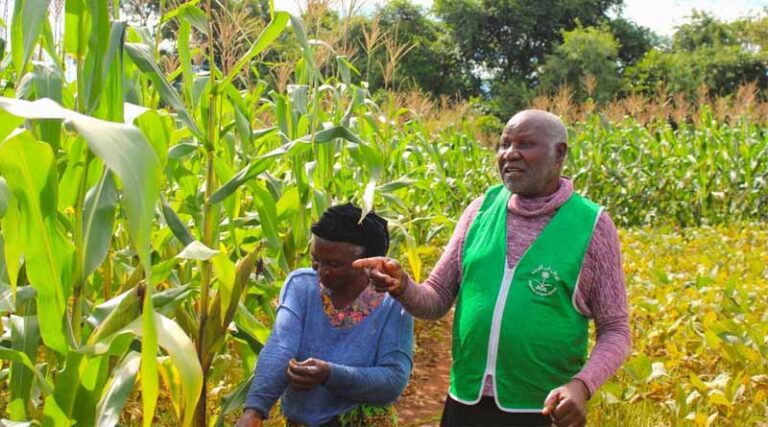
At the centre of this story is Mr Jackson Banda of Chinyanja camp, Chipata District, in Zambia’s Eastern Province. A retired teacher who has been farming for about 15 years, Mr Banda is not new to hard work or to the disappointments that can come with agriculture. Like many farmers, he has seen seasons become less predictable, with delayed rains, prolonged dry spells, and unreliable seed quality. He knows what it means to farm under uncertainty, or to shift from a traditional way of cropping to a system that first seems unfamiliar, even uncomfortable.
When he was selected to host a technology trial under SIFAZ in 2019, he started on a learning journey with six other farmers in his community. The first year was not easy as the system showed him to do things differently from the way he had always farmed. Instead of ploughing and keeping the land bare between crops, he was using soil disturbance, placed crops more deliberately, and start to diversify his maize crop with soybeans. At first, it was hard to understand, as new farming methods often are. Yet that difficult first
season turned out to be the beginning of something really new. Over time, what seemed hard became manageable, then meaningful, and finally convincing enough to share with others.
That evolution matters as it gets to the heart of how adoption really happens. Farmers do not adopt because a brochure says a technology works. They adopt because they have seen it in conditions like their own. They adopt because they can compare and ask questions. They adopt because someone they know has tested the risk before they do. This is the real value of the mother-and-baby trial model applied under the Sustainable Intensification of Smallholder Farming in Zambia (SIFAZ) project.
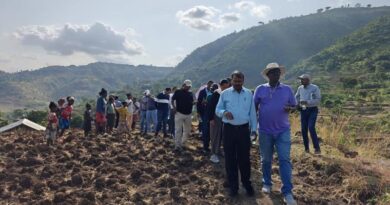
A mother trial moves beyond a demonstration plot, unfolding into a learning platform. In this case, the trial presents several treatments, from conventional maize-only systems to conservation agriculture, which incorporates legumes as intercrops or rotational crops, and from earlier practices such as traditional intercrops to newer strip-cropping arrangements introduced in recent years. Baby trials are subsets of this mother trial where farmers can test technologies on a very small scale in their own fields. It gives them something more useful than theory: a side-by-side comparison of options in a real farming environment. This matters in places where climate stress is no longer occasional but increasingly part of normal life. Farmers are taking bold steps to inquire into what holds up when rains delay, when dry spells stretch longer than expected, and when input costs rise faster than household incomes. Mr Banda’s field has helped answer those questions, season after season.
His own account of the experience is telling. “The trials changed my farming greatly. Before, I was doing many things on a very small scale. After seeing the value in the system, I have begun expanding it”, Mr Banda shares. What value has he seen? Better yields and more food, more crops from small plots, and better food security for the family. One of the most practical strengths of this system is diversification. In the SIFAZ trials, maize remains central, as it is the staple crop and a core part of Zambia’s farming systems. But the addition of soybean changes the equation, as it improves diversification, supports diets, offers a marketable crop, contributes to oil and feed value chains, and helps improve soil fertility through nitrogen fixation. When maize and soybean are brought together through intercropping, rotation, or strip cropping, the system becomes more resilient and more productive. As one simple field insight makes clear: two crops are better than one.
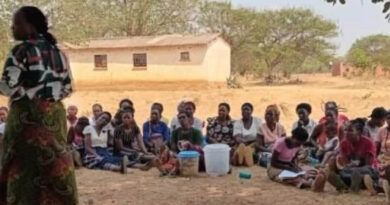
What is striking in Mr Banda’s case is not just that he learned the system, but that he became a lead farmer for others. He now supports 25 follower farmers in his network by visiting their fields, checking on their work, and advising them when they face difficulties. He is clear that this is not about presenting a perfect farm, but about sharing what has been learned. Development too often treats farmers only as beneficiaries when, in fact, many become translators, mentors, and local extension agents.
Scaling is built on local proof. In this community, that proof has spread outward from the mother trial into baby trials and then into adopter fields. The progression is important. Farmers first observe and compare. Then some try selected practices on smaller plots. Then a smaller number take the further step of investing their own resources and expanding on their fields. That is where adoption becomes transformational, moving from interest to ownership. That is exactly what we see in the case of one of Mr Banda’s follower farmers, Muntundu Zulu. Her story is the natural next chapter in this context. She represents what every strong agricultural research and development programme hopes to see: an adopter who does not simply copy a plot but scales a system because they have seen enough value to commit their own resources. Last year, she cultivated 1.5 hectares using the four-row strip cropping system, which comprised four rows of maize alternated with four rows of soybean. From those fields, she harvested 4 tons of maize and 1.5 tons of soybean per hectare. This year, she expanded her field further and invested fertilizer and seed to keep adopting the learned technologies under riplines in a Conservation Agriculture (CA) system.
There is an even larger lesson here. The move from Mr Banda’s six-year role as a mother trial implementer to Ms Zulu’s scaling as an adopter is not accidental. It shows how influence works when a system is designed to move knowledge outward. The mother trial creates evidence. The lead farmer creates trust. The baby trials create experimentation. The adopter field creates proof of scale. Together, they form a pathway that is both practical and replicable. And yet none of this happens through farmer effort alone.
That is where the partnership behind SIFAZ deserves recognition. Too often, “partnership” is treated as a familiar development word that sounds good in reports but feels vague in practice. In SIFAZ, each actor brings a distinct role, and the impact depends on those roles fitting together well. CIMMYT contributes the research backbone. The mother trial system itself reflects years of agronomic work around sustainable intensification, conservation agriculture, diversification, and adaptive research. These trials compare farming systems, intercropping, rotation and strip-cropping, while testing fertilizer efficiency and other pressing field questions to guide farmer decisions and national policy through practical, purpose-driven research beyond publication.
ZARI deepens the science through on-station research, offering the controlled conditions needed to understand what is happening in the soil, the plants, and the wider adaptation processes shaped by climate change. This complements on-farm research, where farmers test ideas under real-world conditions, with all the labour, risk, and resource constraints they face. Bridging these two spaces are government extension officers, who translate research into practical advice, respond to what farmers are seeing, and help spread learning beyond individual plots. FAO then helps move promising technologies beyond research sites by addressing barriers that often slow adoption, from seed availability and varietal choices to multiplication systems, agro-dealer networks, and policy support. Overarching all this, the Ministry of Agriculture provides the policy and delivery framework, ensuring these efforts contribute directly to Zambia’s national goals for productivity, resilience, and climate-smart agriculture.
Seen together, this is what a productive collaboration among partners really looks like. Research does not operate in isolation. Extension is evidence -based. Promotion follows successful examples from research camps. Scaling does not happen without farmer trust. Policy does not remain abstract. Each piece supports the others. The value of funding models like SIFAZ is not only in the technologies being tested. It is in the architecture of learning that brings change. Six years is enough time for a farmer like Mr Banda to move from uncertainty to confidence. It is enough time for followers to emerge and observe multiple seasons, including difficult ones and for adoption to begin showing up in farmer-managed fields. In agricultural development, patience is not a luxury; it is part of what makes the work credible.
There is also something deeply important in the household dimension of this story. Mr Banda’s wife, Joyce Banda, speaks with pride about working alongside her husband. Even when he is away, she knows what needs to be done to keep the trials performing well. That detail should not be forgotten. The success of farming systems often rests not on a single named farmer, but on household knowledge and shared labour. When knowledge settles into a household rather than with a single individual, the chances of continuity become much stronger. And continuity is the real test.
Asked what would happen if SIFAZ ended today, Mr Banda’s answer was simple and powerful. “I will not stop. I will continue and offer advice to the farmers who have already made choices about which options suit them best.”
This is not a story about a project that visited a community and left behind a few demonstration plots. It is a story about how a carefully designed process can create local leadership, farmer confidence, institutional alignment, and early scaling. It is a story about how climate-smart and conservation-oriented farming systems become persuasive when they are tested under real stress, translated into local practice, and carried forward by farmers who believe in them enough to invest their own resources. That is how real change spreads. From one field to another. From one farmer to many. And from one good investment to a stronger system that can stand on its own.
Also Read: Biotalys Reports Full-Year 2025 Financial Results and Business Highlights
Global Agriculture is an independent international media platform covering agri-business, policy, technology, and sustainability. For editorial collaborations, thought leadership, and strategic communications, write to pr@global-agriculture.com