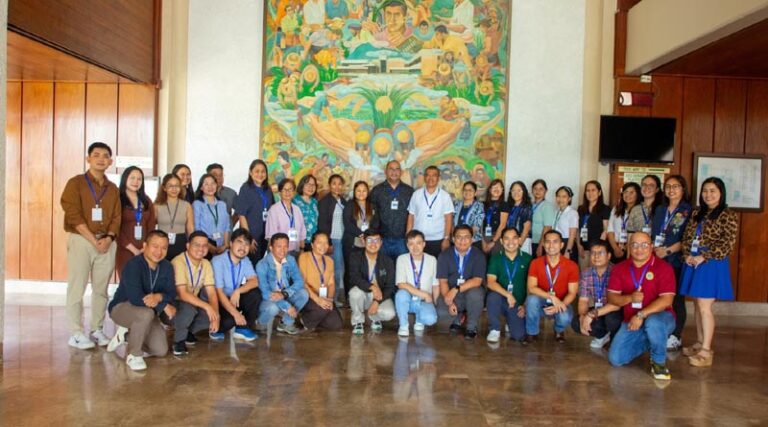
IRRI, DA Partners Launch SuRE Project To Help Climate-vulnerable Rice-based Farming Communities Build Resilience And Improve Livelihoods
31 July 2026, Philippines: The International Rice Research Institute (IRRI), in partnership with the Department of Agriculture National Rice Program, Bureau of Agricultural Research (DA-BAR), Climate Resilient Agriculture Office (DA-CRAO), Agricultural Training Institute (DA-ATI), and the DA Regional Field Offices of Central Luzon, Bicol, and Western Visayas, has launched the Sustainable Rice Ecosystems (SuRE) Project.
This three-year initiative, implemented in collaboration with representatives from local government units in targeted project sites, aims to co-create and scale climate-smart solutions for rice-based farming communities most vulnerable to the impacts of climate change in the Philippines.
The project will work with rice-based farming communities in Tarlac, Iloilo, and Camarines Sur during its first year, helping farmers address persistent challenges brought about by droughts, floods, typhoons, saltwater intrusion, and other climate-related risks. Through close collaboration with farmers and local institutions, SuRE will develop and validate site-specific climate-smart packages of technologies that improve farm productivity, strengthen resilience, and create new livelihood opportunities.
Over its three-year implementation period, SuRE aims to increase the adoption of climate-smart technologies, strengthen the adaptive capacity of farmers and local institutions, diversify livelihood opportunities, and improve productivity in vulnerable rice-based systems. The project targets a 20% increase in rice yields and at least 30% increase in smallholder incomes through more resilient and sustainable farming systems.
The initiative builds on the Department of Agriculture’s Adaptation and Mitigation Initiative in Agriculture (AMIA) program, which has established hundreds of climate-resilient agriculture learning sites across the country. While AMIA villages have made significant progress in climate adaptation, many communities continue to face barriers in sustaining gains and expanding successful practices. SuRE seeks to bridge this gap by strengthening local capacities, validating technologies under real farm conditions, and creating pathways for scaling successful innovations beyond pilot sites.
A key feature of the project is the development of climate-smart packages of technologies (POTs) tailored to specific local conditions. These packages may include stress-tolerant rice varieties, improved crop and water management practices, diversified farming systems, community-based seed systems, climate information services, and risk-management mechanisms such as crop insurance. Rather than promoting one-size-fits-all solutions, SuRE will work with farmers to identify combinations of technologies that best match local climate risks, resources, and livelihood needs.
The project will also introduce village-level climate risk mapping using IRRI’s Climate-Smart Mapping and Adaptation Planning (CS-MAP) approach, integrated with a social equity lens to ensure that women, youth, tenant farmers, and other vulnerable groups have a voice in adaptation planning. This process will help communities identify priority risks, assess adaptive capacity, and co-design interventions that are both technically effective and socially inclusive.
“The SuRE project is about partnership. No single institution can build climate resilience on its own. Farmers need not only technologies, but also access to climate information, irrigation services, quality seeds, extension support, financing, crop insurance, and enabling local policies. These services are provided by different institutions, each with an important role to play. Our challenge is to work together so that these services complement one another and reach farming communities in a coordinated and practical way,” said Dr. Junel Soriano, IRRI Deputy Director General – Philippines Representative.
Beyond technology development, SuRE will support farmer groups through training, leadership development, entrepreneurship programs, and the establishment of community-based seed systems to ensure continued access to climate-resilient rice varieties. The project will also generate policy recommendations and scaling roadmaps to help local governments and national agencies institutionalize successful approaches.
The project is funded by the DA National Rice Program through the DA-Bureau of Agricultural Research.
Also Read: Bayer Launches New Insecticide Trance for Cotton in India
Global Agriculture is an independent international media platform covering agri-business, policy, technology, and sustainability. For editorial collaborations, thought leadership, and strategic communications, write to pr@global-agriculture.com