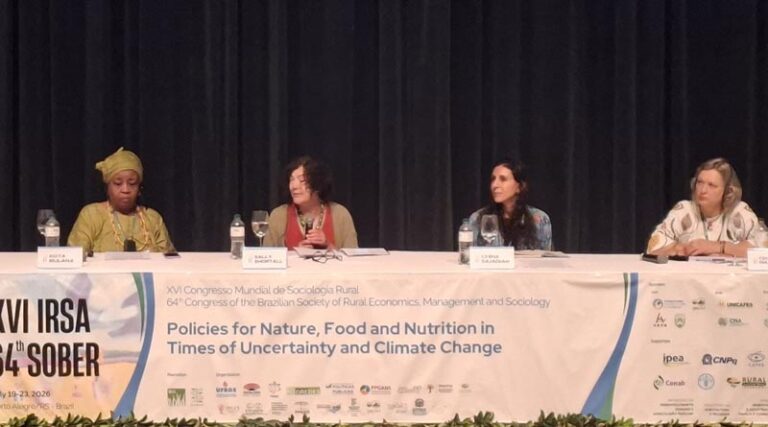
31 July 2026, Brazil: FiBL researchers attended the World Congress of Rural Sociology in Porto Alegre, where social scientists discussed agroecology, food systems, and the political role of science in addressing climate, inequality, and agribusiness challenges. The insights from this creative gathering will also stimulate the ongoing development of policy tools and advice in the GALILEO project, of which FiBL is a partner.
1500 social scientists met in Porto Alegre, Brazil, from 19 to 24 July to discuss policies for agriculture, nature, food and nutrition in times of uncertainty and climate change. FiBL was present at this important gathering with three researchers and contributions, helping to find answers to the various challenges posed by pollution, health, hunger, climate change, increasing inequalities, and other socioeconomic problems. Major solutions are expected from rural sociology, which is well organised worldwide (except in Africa) through the International Rural Sociology Association IRSA.
From the perspective of the Department of International Cooperation at FiBL, the South-South relations between Brazil, Africa and China were very interesting, as they have very different conditions but all favour more agroecology as a strategy to mutually support family farms. Tensions with highly subsidised agribusiness are also part of the ongoing research. Agribusiness is still the most promoted model of production by the governments in the Western and Southern world, except China.
Science must better support politics
An important statement that congress participants made during the many discussions was that researchers have a particular responsibility in these difficult times, which is also characterised by relatively poor political leadership and multiple crises beyond the sector. In Brazil, the “Movimento dos Trabalhadores Rurais Sem Terra” (MST) has been a very interesting and impressive civil society initiative since the 1980s, and it has already provided land to 400,000 families. But millions of landless rural families are still waiting for a solution. The congress participants visited one of their farms and processing units, COPERAV, which is the biggest organic rice producer in Latin America.
Related to the topic of science and policy, FiBL is involved in a European Union-funded project promoting agroforestry over four countries in Africa (GALILEO). FiBL’s main role in this ambitious project is to provide policy guidance at country and African Union level through new tools and advice. This congress provided insights and stimulation to foster farmer-policy relations and make best use of politics as a key driver and decisive force to address structural problems in the fields of technology, finance, the economy, the environment, and society. What else than science should inform politicians on evidence-based facts?
Global Agriculture is an independent international media platform covering agri-business, policy, technology, and sustainability. For editorial collaborations, thought leadership, and strategic communications, write to pr@global-agriculture.com