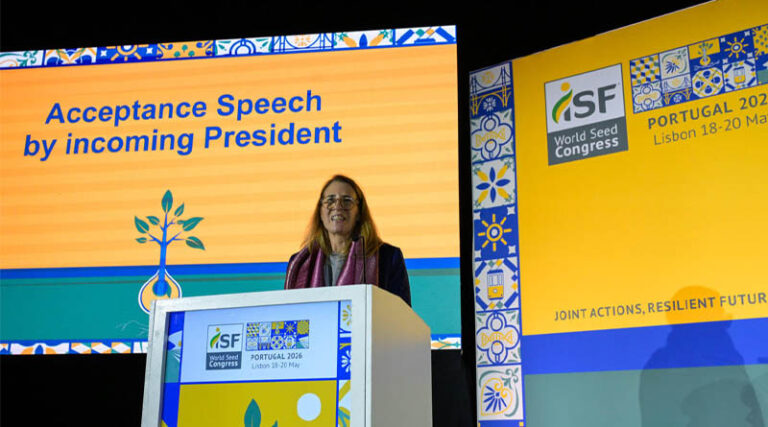
21 May 2026, Lisbon: The International Seed Federation concluded the World Seed Congress 2026 in Lisbon, Portugal, marking a historic moment for the global seed industry with the election of Lorena Basso as the first woman President in the federation’s 102-year history.
Organized under the theme “Joint Actions, Resilient Futures,” the Congress brought together more than 1,800 delegates and guests from 78 countries, representing over 900 companies and organizations across the seed value chain. The event served as a key platform for discussions on seed trade, plant breeding innovation, climate resilience, food security, and the future of global agriculture.
According to Michael Keller, the Congress demonstrated the sector’s commitment to collaboration despite increasing geopolitical tensions, climate-related disruptions, and challenges facing global agri-food systems. He emphasized that ISF members, representing nearly 96 percent of global seed trade, remain focused on ensuring farmers worldwide continue to have access to quality seeds that support food and nutrition security and resilient farming systems.
A major highlight of the Congress was the election of Lorena Basso, President of Argentina-based Basso Semillas, as ISF President. With more than two decades of experience in the seed industry and active participation in ISF’s strategic initiatives, Basso described her appointment as an important moment not only personally, but also for women across the seed sector and for Latin America.
Basso acknowledged the contributions of women working throughout the seed industry, including those involved in research, laboratories, associations, companies, and leadership positions. She also welcomed the election of Ellen Sparryas Vice-President, noting that the simultaneous appointment of two women to top leadership roles reflects the evolving landscape of the global seed sector.
Speaking about the industry’s broader mission, Basso stated that seeds play a central role in supporting farmers, strengthening food systems, advancing innovation, improving climate resilience, and safeguarding future generations.
During the Congress, ISF also launched a new voluntary guidance framework titled “A Practical Guide for Seed Production: Navigating Social Rights and Ethical Practices in the Seed Sector.” The document is intended to support seed companies, growers, suppliers, and associations in strengthening responsible labour practices and ethical standards throughout the seed value chain.
Discussions throughout the three-day event focused heavily on the importance of open, science-based, and predictable seed trade systems. Representatives from organizations including the World Trade Organization, the World Bank, and the International Plant Protection Convention highlighted the growing need for resilient and inclusive seed systems capable of supporting global agriculture under changing climatic conditions.
The Congress also addressed regulatory frameworks for plant breeding innovation, particularly the role of new genomic techniques and the importance of science-based policies that allow innovation to reach farmers efficiently. In addition, experts emphasized the critical role of plant genetic resources in breeding climate-resilient crops and called for increased investment in gene banks and stronger public-private partnerships to conserve and utilize genetic diversity.
Hosted in cooperation with the Portuguese Seed Association ANSEME, the Congress reinforced Portugal’s growing importance as a hub for discussions on agricultural innovation, climate adaptation, and global collaboration within the seed industry.
Global Agriculture is an independent international media platform covering agri-business, policy, technology, and sustainability. For editorial collaborations, thought leadership, and strategic communications, write