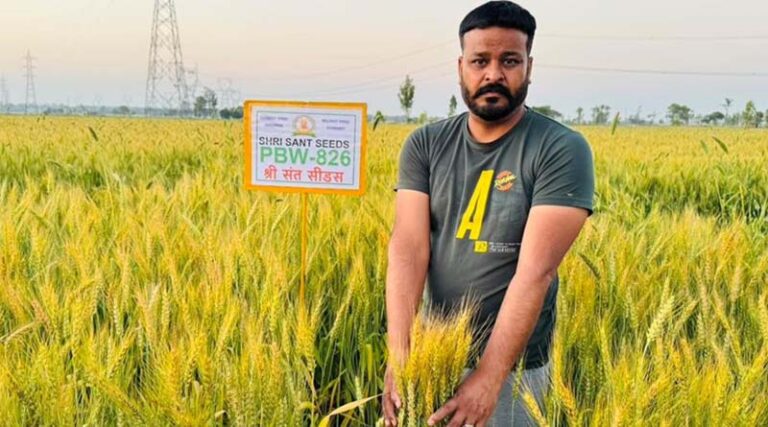
The New Breakthrough High-Zinc Wheat Transforming Nutrition in India
21 May 2026, New Delhi: High-zinc wheat varieties have spread widely across the Northwestern Plain Zone of India, emerging as mega-varieties that now cover nearly 70% of the area and improve the dietary quality of more than 90 million consumers every day.
These varieties are adopted by farmers because of their high yield, heat-tolerance, and disease resistance. Not only do farmers consume high zinc wheat flour from their own production, but zinc wheat now comprises a high percentage of total wheat supply in the market. Wheat flours from several varieties are typically blended when sold in the market. The extra zinc is invisible and added to diets at no extra cost to consumers and the final products (chapatis and rotis) taste similar to that of normal wheat.
Background
For generations, wheat has been at the heart of daily life across northern India. Every morning begins with fresh chapatis rolled from wheat flour, and every evening the same grain fills the plates of farming families returning from the fields. Wheat has long provided food security to stave off hunger. Wheat already provides significant amounts of selected minerals and vitamins (including iron and zinc) but millions of rural households cannot afford to buy sufficient non-staple foods that would provide an adequate nutritious diet.
Across South Asia, micronutrient deficiencies, particularly zinc deficiency, weaken immunity, impair child growth and development, and increase vulnerability to diseases continues to affect millions of people. Women and young children are among the most affected. Yet these deficiencies often remain invisible until their long-term consequences become severe.
To address this challenge, HarvestPlus initiated the biofortified crop development alliance across CGIAR centers. Building on these collaborative efforts, scientists and breeders from CIMMYT, and Indian national agricultural research partners spent years developing a new generation of biofortified wheat varieties capable of delivering better nutrition through everyday diets. One of the most promising outcomes of this effort is Ninga — a new high-zinc wheat variety designed to combine superior nutrition with strong field performance for Indian farmers.
Unlike conventional wheat, Ninga family of elite sister lines have broad adaptation, disease resistance and climate resilience and bred to naturally contain significantly higher levels of zinc (30% over checks) while maintaining the qualities farmers value most: high grain yield, disease resistance, climate resilience, and excellent grain quality. Because wheat is consumed daily by millions of families, researchers recognized it as one of the most effective pathways for delivering improved nutrition to vulnerable populations.
How it was developed:
Ninga is derived from three distinct parents (Neloki//Sokoll/Excalibur) and including one of the parental lines Neloki includes the India’s mega-variety PBW343 and second parent ‘Sokoll’ derived from synthetic hexaploid wheat with good level of stress tolerance and the third parent ‘Excalibur’ is an Australian variety with high tillering and high Zn uptake efficiency. These three parental combos brought the breakthrough Ninga wheat family.
The development of Ninga represents over a decade of scientific innovation and international collaboration. Researchers identified naturally high-zinc traits in ancient wheat, landraces, and wild relatives, then carefully transferred those traits into modern, high-yielding wheat lines. Through hundreds of breeding crosses each year, scientists combined enhanced zinc levels with strong agronomic performance, disease resistance, stress tolerance, and farmer-preferred quality traits.
Field performance:
Ninga demonstrated strong agronomic performance, competitive yields, resilience against disease and heat stress and increased grain Zn (+8ppm). Like other breakthrough biofortified wheat varieties released in India, it was developed using advanced breeding approaches that increased grain zinc concentrations by 20–40% compared to conventional wheat varieties (25 ppm), without compromising productivity.
Reaching Scale
The sister lines of the Ninga family released respectively from 2021 to 2024 in India as DBW 327, PBW 826, HD 3386 and DBW386 from 2021 to 2024, have become a mega variety family in Northwestern India during Rabi (winter) season 2025-2026, covering 7-8 million hectares in Punjab, Haryana and Western Uttar Pradesh.
A major factor behind the rapid expansion of these high-zinc wheat varieties was the coordinated effort of the Indian Institute of Wheat and Barley Research (IIBWR), Punjab Agricultural University (PAU), public seed agencies, and local seed networks to accelerate seed multiplication and farmer outreach. Because wheat is a self-pollinated crop requiring large quantities of seed for sowing, varietal replacement is often slow. However, the rapid multiplication and dissemination of sister lines such as DBW 327, PBW 826, HD 3386, and DBW 386 demonstrated an exceptional example of accelerated seed delivery in wheat through public private seed production model implemented by IIWBR. Early-stage breeder and foundation seed multiplication and decentralized seed production enabled these varieties to move quickly from research stations into farmers’ fields across Punjab, Haryana, and Western Uttar Pradesh.
Small and medium-scale seed producers also played a critical role in driving varietal turnover at the village level. Their involvement created new rural seed business opportunities, improved local access to quality seed, and generated additional income for farming communities. This decentralized seed system helped farmers adopt newer, climate-resilient and zinc-enriched wheat varieties much faster than traditional replacement cycles, illustrating how strong public research partnerships combined with local entrepreneurship can transform seed delivery even in self-pollinated staple crops like wheat.
For farming families, the benefits extended far beyond the harvest
The remarkable success of high-zinc wheat demonstrated enormous potential. Biofortified varieties such as Ninga are rapidly expanding because farmers value not only the improved nutritional profile, but also the high yield, lodging resistance, disease resistance, and excellent chapati-making quality.
India accelerated the release and dissemination of biofortified wheat varieties. Between 2018 and 2025 alone, 28 high-zinc wheat varieties were released for diverse wheat-growing zones across the country. Ninga is part of this growing movement to bring nutrition directly from research fields into farmers’ fields and ultimately onto household plates. Today, biofortified wheat varieties occupy nearly half of India’s wheat-growing area and reach millions of consumers annually.
Scientific evidence has confirmed the health benefits of biofortified crops, including zinc-enriched wheat. For example, a nutrition efficacy trial conducted in India found that children and their mothers consuming high-zinc wheat (as compared with control child-mother pairs who consumed non-biofortified wheat) experienced fewer days of sickness, e.g. pneumonia, fever, vomiting.
The Government of India has mandated that 10 percent of Frontline Demonstrations (FLDs) include biofortified varieties to showcase their potential to farmers. The government has also encouraged scientists to shift their focus from food security to nutrition security by prioritizing research and development in biofortified crops.
Today, farmers growing Ninga are not only harvesting grain — they are helping fight hidden hunger in their communities. The variety represents a new vision for agriculture: producing crops that nourish people more effectively while maintaining strong productivity and resilience under increasingly challenging climates.
For India, Ninga is more than a wheat variety. It is proof that agricultural innovation can improve both livelihoods and nutrition at the same time. As climate pressures intensify and nutrition insecurity continues to challenge vulnerable communities, Ninga demonstrates that even a small increase in zinc inside a grain of wheat can create a profound impact on the health and future of millions of families across India.
Also Read: Insecticides (India) Limited Launches New Paddy Insecticide ‘Granuvia’
Global Agriculture is an independent international media platform covering agri-business, policy, technology, and sustainability. For editorial collaborations, thought leadership, and strategic communications, write to pr@global-agriculture.com