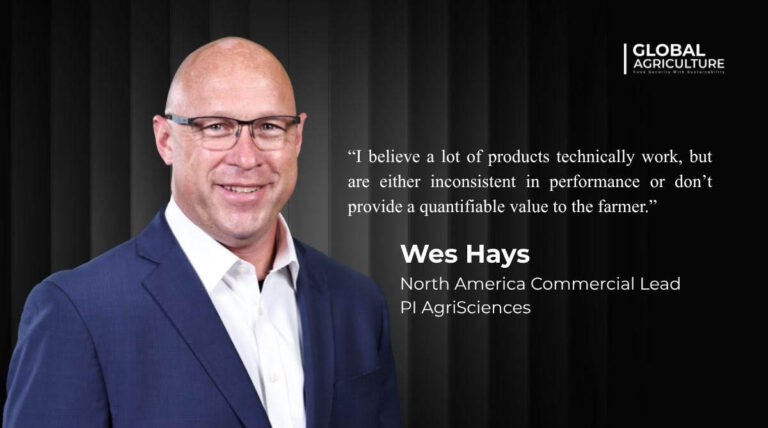
Performance Matters More Than Promises in Biologicals Markets, Says Wes Hays, North America Commercial Lead at PI AgriSciences
20 May 2026, Raleigh: As the agricultural biologicals sector continues to expand globally, companies are increasingly facing a critical question: what truly separates products that achieve commercial scale from those that fail to move beyond early traction? In this interview, Wes Hays shares his perspective on the realities of scaling biostimulants and biological products in today’s market. From grower trust and channel alignment to the importance of consistent field performance and strategic positioning, Hays explains why delivering measurable value to farmers remains central to long-term success.
This interview is part of the Global Agriculture interview series for the 8th US Biostimulants Summit, taking place on August 5–6, 2026, in Raleigh, North Carolina, USA, featuring conversations with keynote speakers and industry experts. Global Agriculture is the official Media Partner for the event.
Q. A lot of products prove they “work” —why do so few actually make it into consistent commercial programs?
Q. From a commercial standpoint, what’s harder today: securing distribution, or securing real access to acres?
I don’t know that these are mutually exclusive. Securing distribution is the fastest way to securing access to acres. Access alone isn’t enough. Many folks believe that if you just convince a distributor or retail HQ to bring on your product that you’ll instantly have sales. Selling your product into distribution is great and how most companies get paid, but having an organization supporting your product, generating demand and actually selling it to farmers is the key. You can have sell-in without sell-out, but that’s a short game. The point is to get a consistent cycle of sell-in and sell-out, and a healthy level of inventory at retail/distribution.
Q. Where do you see the biggest bottleneck in scaling —channel alignment, grower trust, or internal execution?
Specifically, with biological products, the bottleneck I’ve seen is grower trust. There are so many products that have been brought to market with big promises, yet fail to consistently deliver. The lack of consistent value over time has eroded farmers’ trust in the category.
Q. Are partnerships and co-development becoming essential to scale —or are they just a workaround for weak go-to-market models?
Partnerships and co-development can be very useful, especially if the product concept needs help. However, I don’t believe they are essential. If not structured well or if the deal isn’t with the right partner, they can actually be detrimental to scale.
Q. If you had to call it early, what signals tell you a product will scale —versus stall after initial traction?
The biggest signal is product performance, and validation of the product concept. That product performance should be seen with a critical eye. Putting the time and effort into testing and understanding your product’s performance and positioning is critical to success. Many times, companies will chase every opportunity and spread themselves thin. They’ll do a little testing everywhere in every crop just to say they have data. In reality, if you want to scale you need to prove, with statistical significance, that your product works and provides value. Even if that means you only do so in one or two crops. Sometimes you may even need to prove where your product doesn’t work to home in and get traction.
As the biologicals industry matures, Hays believes companies that prioritize consistency, grower confidence, and disciplined commercialization strategies will be better positioned for long-term growth in increasingly competitive markets.
Also Read: Insecticides (India) Limited Launches New Paddy Insecticide ‘Granuvia’
Global Agriculture is an independent international media platform covering agri-business, policy, technology, and sustainability. For editorial collaborations, thought leadership, and strategic communications, write