Guest Author: Pratap Singh Birthal and Devesh Roy, IFPRI South Asia
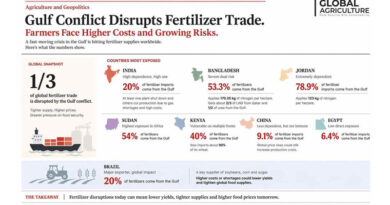
20 May 2026, New Delhi: If the war between the United States, Israel, and Iran were to last longer, it can trigger a global food crisis by disrupting the fertilizer–energy–food security nexus. The tensions around the Strait of Hormuz have increased uncertainty in maritime trade flows, disrupting the movement of crude oil, liquefied natural gas (LNG), and fertilizers where Gulf countries are most important suppliers of these commodities. A cumulation of these effects poses a significant risk to agricultural systems and food security.
To put things into perspective, crude oil and LNG prices have increased by 50% since the beginning of the conflict at the end of February. Rising prices of natural gas directly raised the cost of production of fertilizers, mainly nitrogenous. Prices of urea and DAP increased by about 20% and 10% respectively. Further, rising crude oil prices result in higher costs for diesel used for irrigation and farm mechanization. Also, uncertainty in fertilizer shipments risks delaying nutrient application during critical crop growth stages, potentially affecting crop yields. India is significantly dependent on fertilizer imports, with 17% of its 20 million tons of nitrogen (N), 55% of its 3.4 million tons of phosphorus (P), and nearly all of its 1.4 million tons of potassium (K) being sourced from abroad.
The implications of conflict in the Middle East may thus be predicated on heavy reliance on imported LNG, crude oil, and fertilizers. India imports approximately 25 million tons of LNG annually—half of its needs where 60% of LNG imports originating from Gulf, Qatar, UAE and Oman. Fertilizer manufacturing moreover accounts for 30% of natural gas in India. India’s dependence on crude oil imports is starker up to 85% share with over 40% supply originating from Gulf. Agriculture does not use crude oil in raw form, using diesel, a refined product, for powering irrigation pumps and farm machinery. Agriculture accounts for 13% diesel consumption, equivalent to around 5% of total crude-oil-based fuel use. 41% of India’s imports of N, 35% of P, and 20% of K originate from the Gulf region highlighting disruptions in supply chain potentially resulting in decreased crop production and reduced farm income.
Pathways for Reducing Import Dependence in conflict ridden world
Reforms in the fertilizer distribution system: India’s existing fertilizer distribution system is linked to farmers’ identities through an Aadhaar-enabled point-of-sale (PoS) network under DBT regime. This system has ostensibly improved transparency and ensured that subsidized fertilizers reach the intended farmers notwithstanding the problem of nutrient imbalance that has been decoupled from crop- and soil-specific recommendations with nitrogenous fertilizer most overused because of heavy subsidies.
The soil Health Card Scheme in India was launched in 2015 to provide farmers with information on the status of key soil nutrients and crop-specific fertilizer recommendations. So far, over 230 million Soil Health Cards have been issued. Linking Aadhaar-authenticated fertilizer distribution under the DBT–PoS system with SHC-based nutrient prescriptions in principle can help correct nutrient imbalances. Evidence from experimental pilots does suggest that following soil- and crop-specific recommendations can reduce nitrogen use by 10–15% and phosphorus use by 5–8%, while increasing potash application by 10–20% without compromising crop yields.
Now comes the precarious time of war. Strange as it may seem, but this might be the time to go back to basics i.e. dung, not to replace but to complement given India’s dung endowments by unlocking the potential of dung-based bioenergy: India has a bovine population of over 300 million, producing roughly 1,270 million tons of wet dung annually. About 35% of dung is used as a household cooking fuel and the remaining is used as manure, largely without scientific processing. Processing of entire volume of dung into biogas or bio-CNG can produce 48 billion cubic metres of biogas or 22 million tons of bio-CNG, equivalent to nearly India’s current LNG imports. The co-product of this process is slurry, containing 4.1 million tons of nitrogen, 1.8 million tons of phosphorus, and 3.8 million tons of potash. This can significantly reduce the dependence on imported fertilizers.
Promoting crop diversification: The urgency of shifting crop production towards pulses, oilseeds, and coarse grains has been long discussed but the current as these crops typically requires fewer chemical fertilizers than cereal-dominated systems. Notably, pulses and oilseeds, such as soybeans and groundnuts, can biologically fix atmospheric nitrogen, thereby decreasing reliance on external nitrogen fertilizers. In history, cause of wars has been classified into immediate and long-term factors. The response to war may also be classified into short and long term where crop choices would lie in the latter.
Improving fertilizer-use efficiency through research: Fertilizer-use efficiency in Indian agriculture remains low, at 30–50% for N, 15-20% for P, and 50-60% for K. Enhancing this efficiency is crucial to decrease fertilizer consumption and reduce dependency on imports. Important strategies include advocating for slow-release nitrogen fertilizers, such as neem-coated urea, expanding the use of bio-fertilizers and nano-fertilizers, encouraging integrated nutrient management, and advancing precision nutrient-application techniques, such as site-specific nutrient management.
Agricultural research has considerable potential to improve fertilizer-use efficiency by developing crop varieties with enhanced nutrient efficiency, optimizing root architecture for improved access to soil nutrients, and promoting biological nitrogen fixation in non-leguminous crops.
Turning Vulnerability into Opportunity
Overall, practices such as soil-test-based precision nutrient application, compost and bio-slurry application, crop diversification with pulses and oilseeds, integrated nutrient management, and conservation agriculture, can significantly enhance soil fertility and reduce fertilizer consumption. They do so by improving soil organic carbon, nutrient cycling, water retention, and microbial activity—key ecosystem services provided by healthy soils. These benefits extend beyond individual farms to society. Hence, farmers can be compensated through mechanisms such as payments for ecosystem services and performance-linked fertilizer subsidy reforms that reward balanced nutrient application. Ironically war offers us the opportunity to fix things in agriculture, opportunities for which would not be likely in normal times.
Global Agriculture is an independent international media platform covering agri-business, policy, technology, and sustainability. For editorial collaborations, thought leadership, and strategic communications, write