15 April 2026, London: The conflict in the Gulf region is rapidly emerging as a major risk for global agriculture, with fertilizer supply disruptions now adding pressure to already fragile food systems. While energy markets often dominate attention during geopolitical crises, the effect on fertilizer trade may prove just as significant for farmers, governments, and consumers in 2026.
According to the UN Trade and Development (UNCTAD), the collapse in Gulf exports of oil, gas, and fertilizers is already creating shortages and higher costs in countries that depend on the region for essential agricultural inputs. At the same time, nations economically linked to Gulf markets through food exports or labour flows are facing secondary economic stress.
One-Third of Global Fertilizer Trade Under Pressure
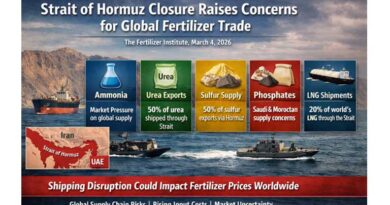
The Gulf States are major suppliers of nitrogen and phosphate fertilizers to South Asia, East Asia, and Africa. With roughly one-third of global fertilizer trade disrupted, import-dependent countries are being forced to seek alternative suppliers, often at higher prices and with longer shipping routes. That combination of scarcity and rising costs could influence planting decisions and crop productivity in the months ahead.
Fertilizer remains one of the most critical inputs in modern farming. Any delay in availability or sharp price rise can reduce application rates, lower yields, and ultimately raise food prices.
South Asia is identified as one of the most exposed regions. India and China each rely on the Gulf for an estimated 20 percent of their fertilizer imports. Pakistan faces an additional energy challenge, sourcing virtually all of its LNG from Qatar and the United Arab Emirates, which increases vulnerability across both industrial and agricultural sectors.
For India, concerns are already visible. The Indian media have reported at least one domestic fertilizer plant shutting down and others cutting production because of gas shortages and expensive inputs. That has raised alarms ahead of the summer planting season, when timely fertilizer availability is crucial.
The report highlights that exposure is not only about import dependence, but also about how heavily countries rely on fertilizer use to sustain yields. Nations that combine high Gulf dependency with intensive nitrogen application face the greatest danger.
Bangladesh is presented as one of the clearest examples. It sources 53.3 percent of its fertilizers from the Gulf and applies 170.35 kilograms of nitrogen per hectare. In addition, the country normally receives around two-thirds of its LNG from Qatar and about half of its imported urea from the Gulf region. Any prolonged disruption could sharply increase production costs and threaten food security.
Jordan also stands out with 78.9 percent dependence on Gulf fertilizer imports and nitrogen application of 123 kilograms per hectare. India and Thailand are also identified in the high-risk zone, each applying more than 120 kilograms of nitrogen per hectare while maintaining significant reliance on Gulf supplies of around 35 percent.
Africa Faces Shortages and Food Security Pressure
Many African countries are also highly exposed because they depend heavily on imported fertilizer, much of it sourced from the Middle East. Sudan is identified as the most exposed country in the dataset, importing 54 percent of its fertilizers from Gulf sources.
In East Africa, countries including Tanzania, Somalia, Kenya, and Mozambique obtain a large share of fertilizer from Gulf exporters and now face acute shortages. Kenya is singled out as especially vulnerable because it normally imports around 40 percent of its fertilizer from the Gulf while also depending on imports for 90 percent of its wheat needs. That combination raises the risk of deeper food insecurity if disruptions continue.
Across sub-Saharan Africa, where many smallholder farmers already use minimal fertilizer, any price rise could reduce usage further and depress already low yields. Governments may also face budget pressure if they attempt to expand subsidy programmes to protect farmers.
China and Egypt Less Exposed to Supply Cuts, Not to Price Surges
Some major agricultural producers appear less exposed to direct Gulf supply losses. Egypt sources only 6.4 percent of its fertilizer imports from the Gulf, while China’s share is 9.1 percent. However, both countries could still face higher costs if global fertilizer prices continue rising.
Even countries with diversified supply chains cannot fully avoid inflation in global input markets when such a large share of trade is disrupted.
Brazil’s Global Impact Could Extend Beyond Its Borders
Brazil is another key case because of its importance to world food markets. The country sources around one-fifth of its fertilizers from the Gulf, making it vulnerable to logistical bottlenecks and supply shocks. At the same time, Brazil uses enormous volumes of nitrogen fertilizer, meaning global price increases could sharply raise production costs even for supplies sourced elsewhere.
That matters globally because Brazil is a leading exporter of soybeans, corn, and sugar. If farmers reduce fertilizer use due to cost or scarcity, lower yields could tighten global supplies and add to food inflation.
West Africa’s Cash Crops Also at Risk
UN Trade and Development (UNCTAD) also warns that major agricultural economies in West Africa, including Ghana, Nigeria, and Côte d’Ivoire, could be affected through higher costs and possible fertilizer shortages. For Ghana and Côte d’Ivoire, this includes risks to cocoa production, a major export crop and income source.
A 2026 Test for Agricultural Resilience
The fertilizer disruption linked to the Gulf conflict highlights how deeply agriculture depends on stable trade flows for essential inputs. Countries with high import dependence and intensive fertilizer use are facing the sharpest immediate risks, while poorer farming systems may suffer the greatest social consequences.
If shortages persist or prices remain elevated, the result could be lower harvests, higher food prices, and increased pressure on governments to intervene. In 2026, fertilizer availability may become one of the most important variables shaping global crop production and food security.
Global Agriculture is an independent international media platform covering agri-business, policy, technology, and sustainability. For editorial collaborations, thought leadership, and strategic communications, write to pr@global-agriculture.com