Strait of Hormuz Closure Raises Concerns for Global Fertilizer Trade, Says The Fertilizer Institute
11 March 2026, Arlington: The The Fertilizer Institute (TFI), the U.S. industry association representing fertilizer producers, wholesalers, and retailers, is closely monitoring developments following reports of the closure of the Strait of Hormuz, one of the world’s most critical maritime routes for energy and fertilizer shipments. The situation is already creating uncertainty in global fertilizer markets, with cargo insurance cancellations forcing several vessel operators to halt shipments and limiting the availability of ships to transport fertilizer products through the region.
According to TFI, the fertilizer market is highly globalized and interconnected, meaning that supply disruptions in one region can quickly ripple across international trade routes. Such disruptions often affect fertilizer availability and pricing in multiple regions, including countries that may not directly import products from the affected area.
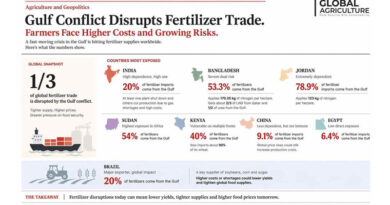
Several major fertilizer-producing countries rely on the Strait of Hormuz to ship products to global markets. Any prolonged disruption to this shipping corridor could therefore have significant implications for the supply of key fertilizer nutrients and raw materials.
One of the most closely watched products is ammonia, a fundamental input for nitrogen fertilizers. Although the United States typically does not import ammonia directly from countries located west of the Strait, the removal of supplies from the global market could tighten overall availability and push international prices higher.
The impact may be more pronounced in the urea market, where nearly half of global exports originate from countries west of the Strait of Hormuz and pass through this strategic maritime route. Any shipping disruption could therefore constrain global trade flows and affect fertilizer markets in multiple regions.
The supply of sulphur is another concern. Sulphur is both an important plant nutrient and a critical raw material used in the production of phosphate fertilizers. Approximately 50 percent of global sulphur exports originate from countries west of the Strait and typically transit through the waterway.
In the phosphate market, Saudi Arabia is among the world’s top four exporters and remains a leading supplier of phosphate imports to the United States. With Chinese phosphate exports currently restricted until August, the global market is already relying more heavily on alternative suppliers such as Russia and Morocco.
Energy markets could also face pressure. Around 20 percent of global liquefied natural gas (LNG) shipments pass through the Strait of Hormuz, and natural gas is a key feedstock in the production of nitrogen fertilizers. Any disruption in LNG shipments could therefore influence fertilizer production costs worldwide.
TFI emphasized that fertilizer markets are deeply interconnected, meaning disruptions in one part of the world can quickly affect global supply chains. Even countries that produce a significant portion of their own fertilizer, such as the United States, remain influenced by international supply and demand dynamics that ultimately shape input costs for farmers.
At this stage, the full extent of the impact on fertilizer markets remains uncertain. TFI said the overall consequences will largely depend on how long the disruption lasts and how global supply chains respond.
The institute added that it remains in close communication with member companies, policymakers, and stakeholders across the agricultural sector as the situation evolves.
Also Read: From Rust Threat to Wheat Expansion in Ethiopia
Global Agriculture is an independent international media platform covering agri-business, policy, technology, and sustainability. For editorial collaborations, thought leadership, and strategic communications, write to pr@global-agriculture.com