25 July 2026, Vietnam: When the Fertilize Right (FerRight) project began working with rice farmers in Can Tho’s Thanh An, Thanh Phu, Thoi Xuan, and Trung Hung communes, mechanized direct seeded rice (mDSR) was practiced by fewer than 1 in 100 of them. Two years later, the project’s midline farmer survey found that 18% of farmers in these communes had adopted the technology — up from a 2023 baseline of just 0.7%. Fertilizer deep placement, a complementary practice often paired with mDSR, has also taken hold, now reaching 0.5% of farmers and growing. Together, the numbers are one of the clearest signals yet that the project, funded by the United States Department of Agriculture (USDA) and implemented by the International Rice Research Institute (IRRI), is changing how farmers cultivate their rice.
A technology farmers can measure for themselves
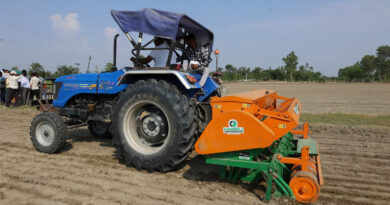
Unlike traditional broadcast seeding, mDSR, paired with fertilizer deep placement, uses dynamic, air-assisted row seeders to place seed precisely 1 to 2 mm into the soil and deliver nutrients directly to the root zone. Multi-season field trials with the Cuu Long Rice Research Institute (CLRRI), spanning four crops from 2024 to 2026, show why the technology is catching on: seed rates fall by at least 50%, nitrogen fertilizer use drops by at least 20%, and the carbon footprint per kilogram of rice produced falls by at least 10%, alongside more uniform stands and greater resilience to pests, disease, and lodging.
Those gains show up in farmers’ fields, too. Comparing mDSR adopters with farmers who still broadcast-seed, the project’s farm-level adoption study found mDSR fields yielded 6.81 tons per hectare against 6.67 tons for broadcast seeding — a 2.1% advantage — with nitrogen-use efficiency up 1.4% and net income up 2.7% per hectare.
Turning demonstrations into farmer confidence
This adoption did not happen by chance. From October to December 2025, IRRI and Can Tho’s Sub-Department of Plant Production and Protection scaled up training on the project’s digital tools, such as the Rice Crop Manager (RCM) app, the Lúa Việt e-extension platform, and EasyFarm, reaching nearly 3,000 farmers, dealers, and extension workers across the city.
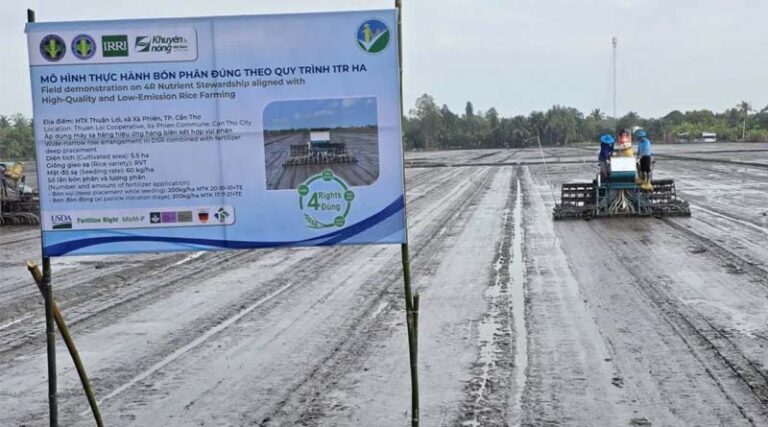
On 19 December, IRRI and the Can Tho Department of Agriculture and Environment brought the technology to the field at Thuan Loi Agricultural Cooperative, where a 5.5-hectare demonstration applied the “4R” principle — right source, right rate, right time, and right place — using mDSR with fertilizer deep placement at a seed rate of just 60 kg/ha, cutting fertilizer applications to two per crop. The event drew 122 participants, from local officials to farmers and enterprises.
“The program goes beyond merely delivering knowledge; it aims to help farmers ‘see with their own eyes and do it with their own hands,’ thereby building confidence in adoption,” said Ms. Nguyen Thi Giang, Deputy Director of Can Tho’s Department of Agriculture and Environment, at the event. “This is the key to ensuring that scientific and technological advances are disseminated and scaled up in a sustainable manner.”
Built on partnership, aligned with a national goal
None of this happened in isolation. FerRight’s work to validate and scale mDSR draws on a network of partners: CLRRI for on-farm trials, Can Tho’s Sub-Department of Plant Production and Protection and Department of Agriculture and Environment for farmer outreach, and the National Agricultural Extension Center for digital extension strategy. In October, that same network trained 253 farmers and officers across Dong Thap, Can Tho, and An Giang on the 4Rs, RCM, and Lúa Việt — many of them already enrolled in Vietnam’s One Million Hectares of High-Quality, Low-Emission Rice program.
“Digital extension has an important role in the transformation of Vietnam’s agriculture toward green and sustainable growth,” said Dr. Huynh Kim Dinh, Deputy Director of the National Agricultural Extension Center, presenting the government’s capacity-building strategy for farmers in the One Million Hectares program at the same training series.
That alignment is deliberate: mDSR speaks directly to the program’s twin goals of higher-quality, lower-emission rice, giving Can Tho’s experience a natural path to inform scaling across the Mekong and Red River Deltas. FerRight is already carrying that momentum forward, with mDSR demonstrations planned for Hung Yen, Ninh Binh, and Hai Phong provinces in early 2026.
Global Agriculture is an independent international media platform covering agri-business, policy, technology, and sustainability. For editorial collaborations, thought leadership, and strategic communications, write to pr@global-agriculture.com