27 October 2026, Ethiopia: With Africa importing about 18 million tons of rice a year and global supplies tightening ahead of a strong El Niño, African and Asian leaders have called for a decisive move from rice strategies to their implementation through increasing financing and investment across the whole value chains, maintaining predictable trade, and building regional rice reserve mechanisms and early-warning systems.
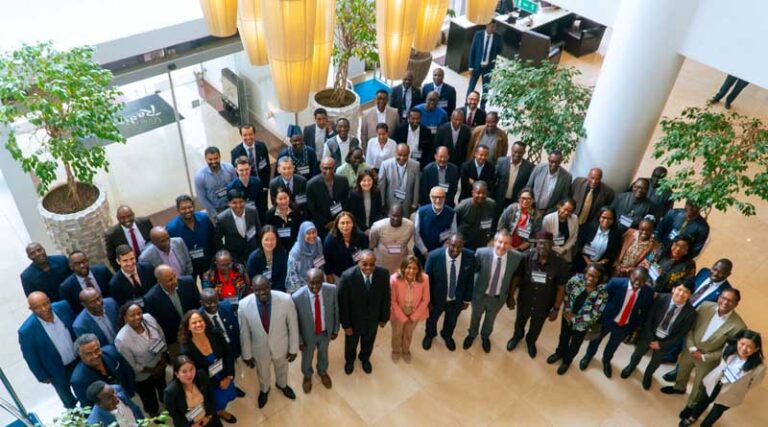
The call came at the close of the Global Rice Policy Dialogue 2026: Building Resilient Rice Markets, held on 15–16 October and co-hosted by the African Union Commission’s Department of Agriculture, Rural Development, Blue Economy and Sustainable Environment (ARBE) and the International Rice Research Institute (IRRI), in partnership with AfricaRice and the CGIAR Policy Innovations Science Program, and co-organized with the Ethiopian Institute of Agricultural Research (EIAR). More than 80 policymakers, researchers, financiers, and private sector leaders from 25 African and Asian countries agreed that no country can secure its rice supply through self-sufficiency or trade alone.
While 32 African countries already have national rice development strategies, participants agreed that the missing piece is implementation at scale, which depends on sustained financing, coordination across ministries, political buy-in, and dependable regional markets.
Rice is a US$362 billion-a-year crop. Yet only about 11 percent of global output is traded, and five exporters — India, Thailand, Vietnam, Pakistan and Cambodia — supply almost 80 percent of it.
Africa is especially exposed. Sub-Saharan Africa now buys about a third of all internationally traded rice, and the continent spends US$6–9 billion a year on rice imports. Production is rising by about four percent a year, with consumption rising by about six percent.
In his keynote, H.E. Hailemariam Desalegn Boshe, Board Chair of AGRA and CGIAR and former Prime Minister of Ethiopia, urged leaders to focus on implementation of the Kampala CAADP Declaration targets.
“Africa does not lack plans, and it does not lack potential. What we need is the discipline to deliver, and the generosity to learn from one another.”
He called for investment across the whole value chains — seed, irrigation, mechanization, milling, storage, logistics and finance. He pointed to Tanzania, which raised its irrigation budget for rice areas almost nine-fold in three years and now produces more rice than it consumes, and to the new US$500 million West Africa Rice Investment Facility, with a first US$100 million from the ECOWAS Bank for Investment and Development (EBID), as examples of why rice serves as a good investment case for the continent.
H.E. Moses Vilakati, African Union Commissioner for Agriculture, Rural Development, Blue Economy and Sustainable Environment (ARBE), said Africa’s agrifood systems face interlinked pressures from climate variability, market uncertainty, price volatility, and trade disruptions. He noted that rice has become an essential staple for many African households and a growing economic opportunity for farmers, processors, traders, and entrepreneurs — yet West Africa alone spends an estimated US$5 billion a year on rice imports.
“We are here to draw lessons from Africa and beyond, including from Asia’s long experience in rice sector development, and to adapt those lessons to our own contexts, our institutions, and our aspirations.”
He called for rice sectors that are productive, competitive, resilient, and inclusive, with yields that match those of leading producers. He singled out affordable inputs, mechanization and finance for farmers and young people, and climate-resilient varieties able to withstand the coming El Niño. He also urged participants to leave with concrete action plans and said the African Union Commission would build the Dialogue’s outcomes into its own programs to support Member States in strengthening their national rice strategies.
Mr. Abera Lemma Alemu, Advisor to the State Minister for Agricultural Inputs and Investment Sector, spoke on behalf of H.E. Desalegn Teshale, Ethiopia’s State Minister for Agriculture and Horticulture Sector Development. He noted rice as one of ten priority commodities in Ethiopia’s 10-year agricultural development plan and has been elevated to a national flagship program.
“Our ambition is not simply to produce more rice. It is to build a sector that can supply markets reliably, create value for farmers and businesses, and compete on quality, productivity, and cost.”
He set out Ethiopia’s priorities — stronger irrigation and water management, seed systems that link research, multiplication and extension to farmers, and better milling quality, post-harvest handling, storage, and transport. He called for a balanced approach in which domestic production and predictable trade reinforce each other, since decisions on exports, imports and public stocks in one country affect prices and food security elsewhere.
For the Dialogue co-host, IRRI, Director General Dr. Yvonne Pinto pointed to participating governments that have already shown what deliberate policy can achieve. Tanzania multiplied production more than five-fold and tripled its irrigated area. Ethiopia, which more than doubled national output in a decade through research, and farmer seed cooperatives and extension on the Fogera plain, among many other successful country examples.
“Each country paired a clear national strategy with sustained public investment. And each made room for science and for the private sector to do their part. No country here has all the answers, but every country here has learned something from their experience that we can learn from”.
Dr. Fekadu Gurumu, Director of the Crop Research Directorate, who spoke on behalf of Prof. Nigussie Dechasa, Director General of the EIAR, called for evidence that captures differences in irrigation access, seed availability, labor costs, farm size, finance and market proximity, alongside production costs and economic returns. He urged that solutions be tested with farmers during implementation, and that low adoption be read not as rejection but as a signal of gaps in services, unsuitable practices, or weak incentives. Implementation, he said, must be treated as a learning process.
Partners including CARD, ASARECA, Akademiya2063, SRI-2030 and Apolitical highlighted seed policy harmonization, intra-African rice trade under the AfCFTA, better trade data, and skills for public officials.
“Good policy depends not only on the quality of the evidence, but also on how well that evidence reflects the conditions in which farmers and value chain actors operate.”
Dr. Baboucarr Manneh, Director General of AfricaRice, noted that more than 80 percent of Africa’s rice is rainfed. He urged African countries to scale climate-smart varieties, alternate wetting and drying, and solar-powered irrigation. Meanwhile, Dr. Clemens Breisinger, Director of the CGIAR Policy Innovations Science Program, stressed that much of the value and many of the jobs in rice lie beyond the farm, in milling, parboiling, packaging, and trade.
IRRI Senior Scientist Dr. Alisher Mirzabaev warned that global production is projected to fall below consumption this season for the first time in three years. Global stocks look comfortable at 36 percent of annual use, but India and China hold 82 percent of them; for the rest of the world the ratio is only 13 percent. A strong El Niño, oil prices about 75 percent higher than in January, and high domestic fertilizer prices put the March–April 2027 planting season at particular risk.
Amidst this scenario, participants ranked climate shocks and water scarcity as the top risk to rice markets, followed by low productivity and competitiveness, and fertilizer and energy costs. Irrigation and water management meanwhile topped the investment priorities, followed by seed systems, research and extension, and milling, storage and quality.
Four working groups set out pathways forward:
Sustainable supply under climate and input shocks: resilient and short-duration varieties, climate-smart practices, early warning and timely crop management advice, better targeted subsidies, crop insurance and shared climate-risk data.
Responding to price and input shocks: smarter fertilizer subsidies, investment in irrigation, post-harvest infrastructure and roads, and a sequenced national reform pathway tracked through a proposed RICE indicator (resilience, industrialization, competitiveness and inclusion).
Trade shocks, reserves and regional cooperation: putting food access first in a shortfall, diversifying suppliers, clear triggers for stock releases, and a shared early-warning format with regular pre- and post-season reviews.
Mobilizing finance: farm mechanization, water management and the training for next generation of rice farmers ranked as the most underfunded areas, with credit guarantees, equipment leasing, climate insurance, contract farming and cooperative guarantee funds proposed to share risk.
Participants agreed to turn South–South exchange into sustained partnerships, moving beyond one-off meetings to joint research, continued learning and support for specific national and regional bottlenecks. Over the next 12 months, they called for quick wins with clear timelines in irrigation, seed and extension systems, value-chain upgrading, credible market data, and coordination between ministries, researchers, businesses and development partners.
Global Agriculture is an independent international media platform covering agri-business, policy, technology, and sustainability. For editorial collaborations, thought leadership, and strategic communications, write to pr@global-agriculture.com