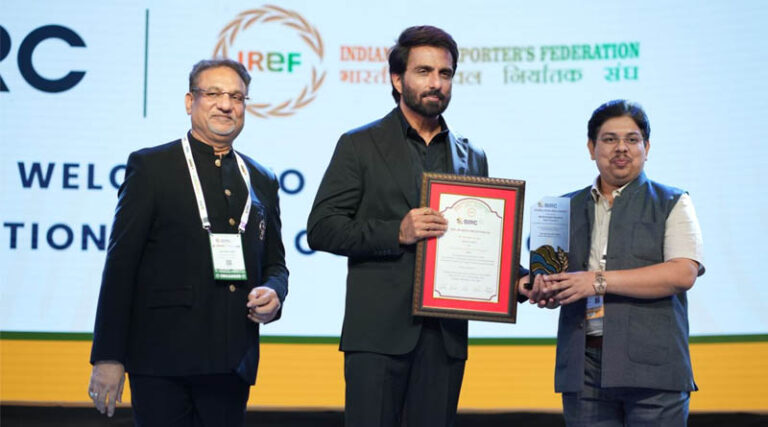
28 October 2026, New Delhi: The International Rice Research Institute (IRRI) received the Global Leadership in Rice Research, Innovation and Food Security award at the Bharat International Rice Conference (BIRC) 2026, recognizing its contributions to sustainable rice production, nutrition, climate resilience and farmer profitability.
Organized by the Indian Rice Exporters Federation (IREF), in collaboration with the Agricultural and Processed Food Products Export Development Authority (APEDA) and India’s Ministry of Commerce and Industry, BIRC brings together stakeholders from across the global rice sector to discuss research, innovation, sustainability and market development.
As a knowledge partner of the event, IRRI contributed its global expertise in rice research, market intelligence, and business strategy to discussions shaping India’s and the global rice industry, while showcasing specialty rice innovations, including iron- and zinc-biofortified rice, high-protein rice, and low- and ultra-low-glycemic index (GI) rice.
The Indian Rice Exporters Federation (IREF) proudly recognized IRRI for its outstanding global leadership in advancing rice research, innovation, food security, and sustainable agricultural development. IRRI’s contributions to nutrition-focused rice innovations, climate resilience, and farmer prosperity continue to create a lasting impact across India and the world.
In a technical session, Dr. Swati Nayak, IRRI scientist and India Interim Country Manager, highlighted the importance of sustainable water management, water-responsive technologies, and aligned incentive systems in transforming rice production. She stressed that proven technologies must be continually improved, tailored to local needs, and scaled, with supportive policies and incentives to make adoption viable for farmers.
“Diversification must not come at the cost of disinvestment in rice research and development. Rice-based R&D remains central to sustainability, policy reform, food security, and India’s agricultural economy. The priority must be to make rice systems more productive, resource-efficient, climate-resilient, and environmentally sustainable, in line with the national goal of more crops per drop,” Nayak said.
She added that technologies alone cannot deliver widespread impact. They must be appropriately targeted and scaled, with institutional support and incentives that enable farmers to adopt them.
Linking rice nutrition with market opportunities
In a special IRRI session on “Top Performer Rice Varieties of India,” IRRI scientist Dr. Priyabrata Roy highlighted how nutrition-focused rice, including low-GI and zinc-enriched varieties developed by IRRI, can create new market opportunities alongside India’s traditional and GI-tagged rice varieties, such as Kala Namak, Kalajeera, Joha, Gobindobhog, and Navara. He emphasized the role of value addition, traceability, branding, natural production practices, and supportive policies in connecting nutritional benefits with market demand.
“The next rice revolution will be driven by nutrition, value addition, and market differentiation. When science-led healthier rice meets India’s heritage rice treasures, farmers gain higher incomes, consumers gain better health, and the country gains a billion-dollar market opportunity,” he said.
IRRI scientist Dr. Saurabh Badoni highlighted the need to develop climate-resilient rice varieties that combine productivity and sustainable production with good grain quality and nutritional value. He also emphasized translating research into market opportunities for premium, locally adapted heirloom varieties that can thrive under low-input conditions and help farmers earn higher returns.
“While sustainability is critical under a rapidly changing climate, good grain quality and nutrition are equally important to maintaining rice as a premium commodity in domestic and international markets and helping farmers earn higher returns. High temperatures and drought can compromise grain quality in rice varieties, making it essential to advance grain quality and nutrition alongside productivity and sustainability,” he said.
Meanwhile, at the conference exhibition, IRRI showcased high-protein, low GI, biofortified, and other specialty rice varieties. IRRI scientist Dr. Sk Mosharaf Hossain highlighted the potential of iron- and zinc-biofortified rice to help address micronutrient deficiencies, alongside the nutritional value of indigenous rice varieties.
“Rice is a staple food consumed by millions of people. Improving its nutritional value through higher levels of iron and zinc, more protein or a lower glycemic index can offer consumers more nutritious choices. At the same time, specialty rice can create opportunities for farmers to access higher-value markets and earn better returns,” Hossain said.
BIRC serves as a platform for policymakers, researchers, exporters, importers, and other stakeholders to strengthen collaboration across the rice sector and explore new trade opportunities. For IRRI and its partners, the challenge is to ensure that advances in rice research translate into practical benefits for farmers and consumers, from more sustainable production and better market opportunities to improved nutrition and food security.
Global Agriculture is an independent international media platform covering agri-business, policy, technology, and sustainability. For editorial collaborations, thought leadership, and strategic communications, write to pr@global-agriculture.com