28 October 2026, Daegu, South Korea: Rice farmers can roughly halve methane from their paddies by letting fields dry out periodically, and can push the cuts further by pairing that water discipline with deeper urea placement, balanced fertilization and lower-emitting varieties, according to a review led by researchers at Kyungpook National University in South Korea.
The paper, published in Rice Science, the journal of the China National Rice Research Institute, brings together decades of field and laboratory work on why flooded rice fields release so much methane and which fixes hold up in practice. The corresponding author is Prof. Kyung-Min Kim of Kyungpook’s Coastal Agriculture Research Institute and Department of Applied Biosciences, working with colleagues from the University of Nizwa in Oman, the Yancheng Institute of Technology in China and the National Institute of Crop Science under South Korea’s Rural Development Administration. It is a review rather than a new field trial. The manuscript was accepted in November 2025 and appears in the journal’s 2026 volume, and its figures come from the studies it analyses.
The stakes are large. Rice paddies release an estimated 30 to 50 million tonnes of methane a year, about 8% to 12% of all human-caused methane, the authors note, citing the Intergovernmental Panel on Climate Change. Kilo for kilo, methane traps about 27 times more heat than carbon dioxide over a century.
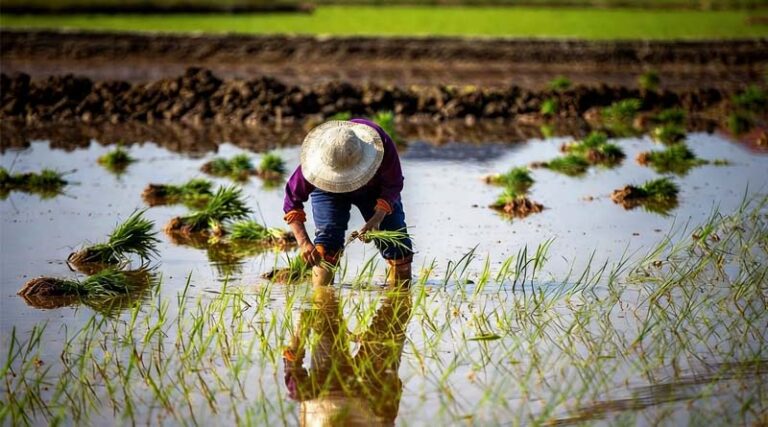
The problem starts with standing water. A flooded paddy, typically holding 5 to 10 cm of water, starves the soil of oxygen. Once other compounds such as nitrate, iron and sulfate are used up, microbes called methanogens (single-celled archaea that live without oxygen) take over the breakdown of crop residues, manure and the sugars that rice roots leak into the soil, releasing methane as a by-product. A rival group, methanotrophs, consumes methane, but these bacteria need oxygen and struggle in waterlogged soil. The rice plant then works like a chimney. Air channels in its roots and stems, known as aerenchyma, carry an estimated 80% to 90% of field emissions into the air, mostly through tiny pores in the lower leaf sheaths. Heat adds to the problem, with methane production rising 2.5 to 3.5 times for every 10°C increase between 15°C and 30°C, a warning sign for rice belts that are getting warmer.
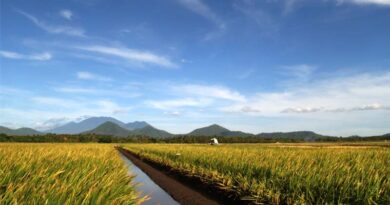
Water management delivers the biggest and most consistent gains. Under alternate wetting and drying (AWD), the water level is allowed to drop as low as 15 cm below the soil surface before the field is flooded again, except for a week either side of flowering. Studies covered by the review found methane cuts of 60% to 87% in California with stable or higher yields, and a 51.6% cut in another trial. A meta-analysis found AWD lowered the combined warming effect of methane and nitrous oxide by 46.9% compared with continuous flooding. Draining fields in the fallow season between crops cut annual emissions by 48% to 68%.
The authors are candid about trade-offs. In one Italian trial, AWD cut water use by 70% and methane by 97%, but yields fell by a third and nitrous oxide, a far more potent gas per kilo, rose fivefold. Nitrous oxide usually remains a small share of total emissions, they argue, but yield risk at farm level has to be managed.
Fertilizer choices offer a second lever. Urea deep placement (UDP), where urea is buried 7 to 10 cm below the surface instead of being broadcast, improves nitrogen use efficiency, and a recent global estimate put its methane reduction at 24.6%. Sulfate-based nitrogen also helps. Ammonium sulfate cut emissions by 23% to 36% across studies, and ammonium thiosulphate by 38% to 60% depending on dose. Balanced nitrogen, phosphorus and potassium lowered emissions by 48% compared with nitrogen alone, with potassium helping keep the root zone oxidized.
Evidence on biochar (charcoal made from crop waste) is promising but mixed. An analysis of 45 studies found that high biochar with moderate nitrogen cut methane by 82%, while low doses of both raised it, and at least one study recorded higher emissions after biochar was added. Variety choice is cheaper. High-yielding cultivars tend to emit less because more carbon goes into grain rather than roots, and one study found every 10% gain in rice biomass cut methane by 10.3%. Among Korean varieties, seasonal emissions ranged from 36.9 g per square metre for Dasanbyeo to 76 g for Mangeumbyeo, a twofold gap. Early-maturing types and japonica rice generally emit less than late-maturing and indica rice.
Stacking fixes, and the gaps that remain
The review’s central conclusion is that no single practice is enough. Combining AWD with UDP or biochar delivers deeper cuts than any one measure while sustaining or even improving yields. The authors call for smart irrigation (real-time soil moisture sensors, remote sensing and automated water control) alongside precision nutrient management, plus breeding work on root architecture and aerenchyma. They also flag clear limits. Most studies are tied to one region or method, the interplay between water, nutrients and variety is poorly understood, and AWD, UDP and biochar all need long-term, site-specific validation. Scaling these practices is hardest in resource-poor regions, where much of the world’s smallholder rice is grown.
Global Agriculture is an independent international media platform covering agri-business, policy, technology, and sustainability. For editorial collaborations, thought leadership, and strategic communications, write to pr@global-agriculture.com