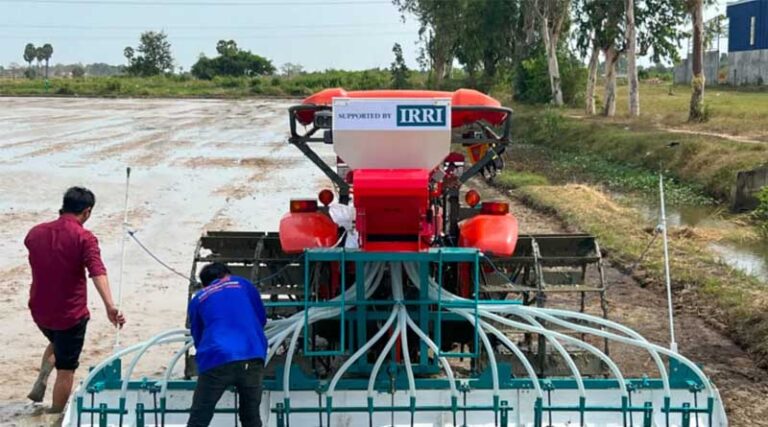
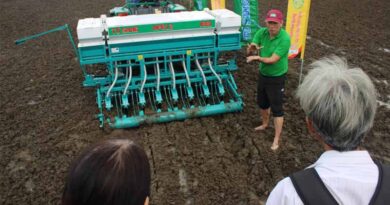
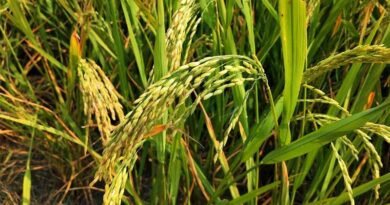
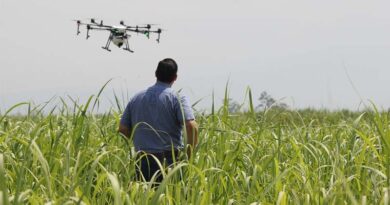
17 September 2026, Cambodia: Rice production in Cambodia faces serious challenges due to acute machinery shortages, high equipment import costs, and limited service providers. Traditional manual broadcast seeding exacerbates these issues through high labor demands and input inefficiencies. To address these barriers, the International Rice Research Institute (IRRI)—through the CGIAR Initiative on Excellence in Agronomy and, eventually, the Sustainable Farming program—deployed a multi-pronged scaling strategy to transform labor-intensive broadcasting into a climate-smart, precision-seeded system using mechanized direct seeded rice.
Scaling up mechanized seeding required overcoming major supply, service, and behavioral constraints. Imported machinery remains expensive, local prototypes are still in development, and very few service providers operate across entire provinces. Consequently, service providers struggled to meet narrow optimal planting windows. Furthermore, farmers were accustomed to familiar broadcast methods or felt pressure from commercial row-seeding campaigns. To build an enabling environment, structured multi-level stakeholder consultations brought together regional agricultural departments, cooperatives, and equipment manufacturers. Diagnostic baseline surveys across four key provinces established baseline performance tracking, while scaling strategies utilized public-private partnerships to make equipment accessible.
The intervention operated across capacity building, business development, and policy advocacy. Comprehensive training programs, including Training of Trainers workshops, Farmer Field Schools, and practical field demonstrations, built technical skills among local officers and lead farmers. To improve machinery access, one-stop service centers and custom-hiring business models were established through Modern Agricultural Cooperatives and development partnerships, supported by financial planning and maintenance linkages with equipment manufacturers. Simultaneously, strategic policy advocacy secured the formal inclusion of mDSR in Cambodia’s Nationally Determined Contributions 3.0 under the Paris Agreement, targeting 100,000 hectares by 2035. This alignment facilitated integration into large-scale initiatives, including the USD 240 million Climate Adaptive Irrigation and Sustainable Agriculture for Resilience project.
Evaluations among 200 participating pilot farmers demonstrated average yield increases of 0.9 tons per hectare and over USD 200 per hectare in additional profit. The precise placement of seeds reduced seed rates by 50%, optimized nitrogen use, lower labor costs by up to 40%, and decreased methane emissions. Commercial activity expanded as local service providers demonstrated viable custom-hire operations, and climate funds supported machinery purchases in the target provinces. Importantly, network observations revealed that male farmers previously dominated machinery access during tight planting windows. Adjusting service protocols to prioritize female farmers enabled women producers in Takeo Province to achieve 17% higher yields. By pairing technical innovation with inclusive business models and national policy alignment, the initiative established a sustainable foundation for resource-efficient rice production across region.
Global Agriculture is an independent international media platform covering agri-business, policy, technology, and sustainability. For editorial collaborations, thought leadership, and strategic communications, write to pr@global-agriculture.com