20 May 2026, London: The world’s food systems are under pressure from all sides in 2026. Geopolitical shocks, climate extremes, and a rapid technology revolution are hitting farmers simultaneously. Here is what is actually happening — and what it means on the ground.
1. The Fertilizer Crisis Nobody Saw Coming
The single biggest disruption to global agriculture in 2026 did not come from weather or disease — it came from a shipping lane.
Since the Strait of Hormuz closed to nearly all shipping traffic on 28 February 2026, fertilizer prices have more than doubled, driven by the strait’s role in handling roughly half of global fertilizer feedstock exports on a normal day. Urea prices rose more than 28% within just three weeks of the closure, reflecting the heavy concentration of urea and ammonia production in the Persian Gulf. By April, urea prices had climbed above $850 per metric ton — up 80% since February and the highest level since 2022.
With farmers across the northern hemisphere in the midst of the spring planting season, this disruption has the potential to significantly affect crop input costs, yields, and eventually food prices in markets worldwide. Import-dependent and already fragile food systems — including parts of East Africa and South Asia — appear most exposed, though the price shock is being felt across every major farming region.
The World Bank fertilizer price index rose more than 12% in Q1 2026, reaching its highest level since October 2022. Risks remain tilted upward if elevated energy prices persist and shipping disruptions continue beyond Q3 2026.
According to the FAO’s assessment of the conflict’s agrifood implications, the Gulf region’s central role in fertilizer production means any instability there can quickly ripple through to farmers, crop production, and food prices across the world. The key policy takeaway is blunt: a maritime disruption in an energy corridor can quickly become an agricultural supply shock, then a food security problem.
FOR YOUR FARM OR AGRIBUSINESS
Whether you operate in Brazil, Kenya, Ukraine, or Southeast Asia — if you have not locked in fertilizer contracts for the second half of 2026, act now. Organic and biological alternatives are no longer just sustainable choices; in this market, they are cost-competitive ones.
2. AI Moves From Hype to Hard Results
For years, “AI in agriculture” was a promise. In 2026, it is becoming a business reality with measurable returns.
Global AI in agriculture has reached $3.37 billion in 2026 — up from $2.71 billion in 2025, representing a 24.5% compound annual growth rate — with market projections pointing to $8.23 billion by 2030. The consensus across the industry is that the defining trends of 2026 are driven by two urgent necessities: standardisation, meaning making data work, and survivability, meaning helping crops withstand extreme climate.
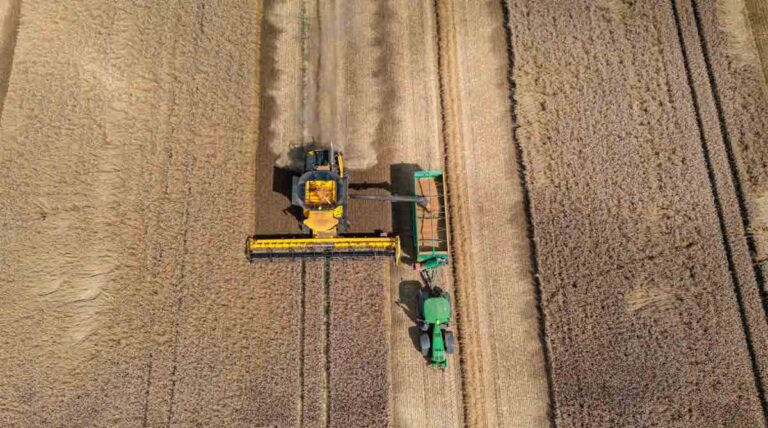
The applications are practical and immediate. Autonomous equipment such as driverless tractors, robotic harvesters, and AI-powered sprayers are now addressing labour shortages, reducing input costs, and improving precision in field operations — automating tasks like weeding, planting, and harvesting using GPS, sensors, and AI controls that can be operated remotely via smartphones or tablets. The global autonomous farm equipment market is projected to reach $55.3 billion by 2032.
For smallholder farmers in developing countries, satellite-based tools are beginning to close the gap. Satellite imagery and IoT sensors are now within reach for both smallholders and large enterprises, with AI-powered disease detection and precision farming platforms enabling targeted use of fertilizers, pesticides, and water. AI-powered monitoring tools can increase crop yield by up to 35%, setting new standards for efficient farming.
3. Climate Resilience Is Now a Survival Skill
Climate change has moved from a long-term concern to an immediate operational challenge for farmers on every continent.
Unpredictable weather patterns — including prolonged droughts, intense heat waves, devastating floods, and the proliferation of novel pests and diseases — are increasingly disrupting traditional farming practices and reducing crop yields. Rising global temperatures are already leading to heat stress in many crops, disrupting vital physiological processes such as photosynthesis and pollination, and ultimately reducing yields.
At the World Agri-Tech Innovation Summit 2026 in San Francisco, field-level data tied to carbon credits, regenerative agriculture verification, and carbon intensity scoring was a major focus. Sustainability programmes are shifting from reporting to active monetisation, with new financial incentives, rebates, and compliance frameworks pushing producers, grain handlers, exporters, and processors to adopt digital recordkeeping and traceability systems that can prove environmental outcomes.
4. Deglobalisation Is Redrawing Trade Routes
The old model of global agricultural trade — cheap inputs flowing freely across borders — is under structural stress.
The shift from globalisation to deglobalisation is impacting export-driven commodity businesses, with the use of tariffs and sanctions carrying long-term negative implications in an increasingly competitive global environment. The Hormuz crisis is only the most visible example of a broader pattern: supply chains that were optimised for efficiency are proving brittle in the face of geopolitical disruption.
Supply shortages of fertilizers, price rises of energy including gas and oil, and disrupted shipping lanes are impacting farmers and agricultural systems deeply across the world. Countries and farming communities that built supply chain resilience — local seed banks, domestic fertilizer alternatives, diversified crop portfolios — are proving far more stable than those dependent on a single global supply line.
5. Data Is the New Soil
Perhaps the most underappreciated shift in global agriculture is the rise of farm data as a strategic asset.
Real-time, high-quality data is quickly becoming a critical economic asset in agriculture — with digital recordkeeping and traceability systems that can prove environmental outcomes now being driven by new financial incentives, rebates, and compliance frameworks. Agriculture remains deeply fragmented, and many outside observers still underestimate the industry’s complexity, but the data layer is fast becoming the connective tissue that makes the whole system work.
The farmers and agribusinesses that navigate 2026 successfully will be those who treated geopolitical risk, climate adaptation, and digital tools not as separate conversations — but as one integrated strategy. Keeping records, tracking yields by variety, and documenting input use are no longer just good practice — they are the entry ticket to credit, premium markets, and resilience against the next shock, whatever it turns out to be. For crop input companies specifically, regulatory compliance software can help streamline everything from EPA registrations to state licensing under one digital roof.
The Bottom Line for 2026
Challenge
Short-term action
Long-term strategy
Fertilizer prices up 80%+
Shift to organic/bio alternatives
Build compost infrastructure now
Erratic climate
Grow 2–3 varieties per crop
Invest in soil water retention
Labour shortages
Explore drone-based spraying
Cooperative equipment sharing
Trade disruption
Source inputs locally where possible
Diversify suppliers
Data gap
Start recording yield by field
Join digital farm platforms
Sources: World Bank, FAO, University of Illinois (farmdoc daily), ICL Group, World Agri-Tech Innovation Summit 2026
Global Agriculture is an independent international media platform covering agri-business, policy, technology, and sustainability. For editorial collaborations, thought leadership, and strategic communications, write