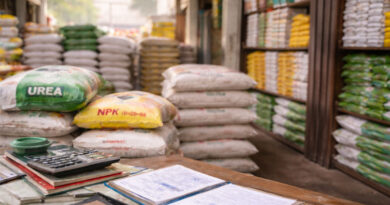
21 May 2026, Beijing: According to the latest data released by General Administration of Customs of China, China’s fertilizer trade during April and the January–April 2026 period reflected a dual trend of rising exports and continued dependence on imports, particularly for potash fertilizers. Export volumes and values increased simultaneously, while fertilizer imports continued to be driven largely by strong domestic demand for muriate of potash (MOP).
Fertilizer Exports Rise Sharply
In April 2026 alone, China exported 3.24 million tonnes of various fertilizers. Ammonium sulphate dominated exports at 1.79 million tonnes, while urea exports stood at 15,000 tonnes. Exports of diammonium phosphate (DAP) remained absent during the month, while monoammonium phosphate (MAP) exports were limited to 50,000 tonnes.
During the January–April 2026 period, China’s cumulative fertilizer exports reached 11.39 million tonnes, registering a year-on-year increase of 17.5%. Export value climbed even faster to USD 2.578 billion, up 29.1% compared to the same period last year, indicating stronger international prices alongside higher shipment volumes.
Urea exports reached 490,000 tonnes, recording an extraordinary year-on-year rise of 5,661.1%, largely attributed to a low base in the previous year and the gradual release of export quotas.
Ammonium sulphate remained the largest export product with shipments of 6.38 million tonnes, up 19.3% year-on-year. The product accounted for more than 55% of China’s total fertilizer exports during the period.
DAP exports dropped sharply to only 20,000 tonnes, down 76.3% year-on-year, reflecting the continued impact of phosphate fertilizer export restrictions.
MAP exports increased to 110,000 tonnes, registering growth of 48.1% over the previous year.
Based on nutrient calculations, China’s total fertilizer exports during the first four months of 2026 amounted to approximately 1.644 million tonnes of pure nitrogen, phosphorus and potassium nutrients.
Potash Continues to Dominate Fertilizer Imports
China’s fertilizer imports continued to be led by potash products. In April 2026, total fertilizer imports stood at 1.39 million tonnes, of which muriate of potash accounted for 1.23 million tonnes. Imports of NPK compound fertilizers reached 90,000 tonnes.
For the January–April period, China imported 5.81 million tonnes of muriate of potash, reflecting a year-on-year increase of 24.7%. Imports of NPK compound fertilizers rose to 390,000 tonnes, up 20.8% year-on-year.
The data highlights China’s continued dependence on overseas potash supplies, as domestic potash resources remain limited. Industry estimates indicate that China relies on imports for more than 70% of its potash requirements.
When converted into pure nutrient terms, total fertilizer imports during January–April 2026 reached 3.673 million tonnes, substantially exceeding the nutrient volume exported during the same period.
Grain and Oil Imports Add to Fertilizer Demand
China’s imports of major grain and oilseed agricultural commodities—including cereals, soybeans and vegetable oils—also contributed indirectly to fertilizer demand.
During January–April 2026, these agricultural imports represented an implicit import of approximately 2.172 million tonnes of pure fertilizer nutrients, marking a year-on-year increase of 17.1%. The trend suggests that rising agricultural commodity imports are further widening the country’s fertilizer demand gap.
Key Market Trends Behind the Trade Pattern
Industry analysts attribute the evolving fertilizer trade structure to several key factors.
First, ammonium sulphate has emerged as the primary export driver due to the absence of major export restrictions, while phosphate fertilizer exports continue to be constrained by policy controls. Urea exports, meanwhile, benefited from quota relaxations and improved international demand.
Second, China’s heavy reliance on imported potash continues to support strong import volumes. Limited domestic reserves and sustained agricultural demand have kept muriate of potash imports elevated.
Third, rising international energy prices have pushed fertilizer prices higher globally. Combined with improving overseas demand, this has resulted in export value growth outpacing export volume growth during the first four months of 2026.
Global Agriculture is an independent international media platform covering agri-business, policy, technology, and sustainability. For editorial collaborations, thought leadership, and strategic communications, write