Building Confidence In A Low-emissions Future For Australian Grain
31 March 2026, AU: As market demand for low-carbon commodities increases, GRDC’s LEIFS initiative will ensure that growers have the knowledge and confidence to understand their GHG account, benchmark their performance, and make informed emissions decisions that generate value for their business.
Australian grain growers are operating in a marketplace where buyers, investors and supply chains are placing greater emphasis on how greenhouse gas (GHG) emissions are measured and reported. Along with partners, GRDC is investing in new research to ensure growers have clear pathways to remain globally competitive as market expectations change.
The Low Emissions Intensity Farming Systems (LEIFS) initiative is a 5-year (2025–30), $39 million partnership between GRDC, NSW Department of Primary Industries and Regional development (DPIRD), WA DPIRD, South Australian Research and Development Institute, and CSIRO.
The LEIFS initiative will deliver science-backed, practical knowledge to help growers understand the relationship between on-farm management practices and emissions, while continuing to meet productivity and profit goals.
Initiative lead Dr Lynne Macdonald, Principal Research Scientist at CSIRO, says LEIFS will build regionally relevant evidence to support growers in making confident emissions decisions, compare their performance to regional benchmarks, and meet shifting market demands.
What LEIFS will do
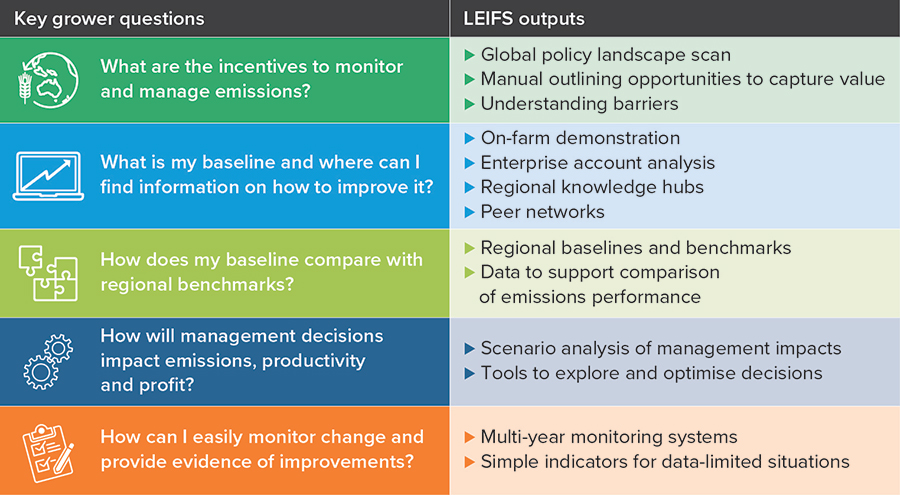
By engaging with growers, service providers and researchers, the initiative will answer key questions to assist growers in understanding and managing their emissions profile (Figure 1).
The research will deliver:
- improved understanding of opportunities to manage GHG emissions and how to generate value or access low-emissions market opportunities
- data to support emissions performance benchmarking against regional climate and management norms
- evidence of management impacts on emissions intensity alongside economic and agronomic performance
- simple indicators and scenario tools to track progress over time and support better decisions
- regional knowledge hubs and peer networks to demonstrate opportunities and overcome challenges in monitoring, managing and reporting on-farm emissions.
1. Demonstrating on-farm value – Action Research Networks
Central to the LEIFS initiative are state-led Action Research Networks (ARNs), organised around Regional Knowledge Hubs (see Table 1).
Regional Knowledge Hubs will work with growers and advisers to build peer-to-peer learning and trusted information resources. State ARNs are ready to get the first demonstration sites into the ground in 2026.
Nick Paltridge from the Department of Primary Industries and Regions South Australia (PIRSA) says: “We know things like precision agriculture, sustainable rotations and the use of enhanced efficiency fertilisers should all improve emissions intensity – but we don’t know by how much, or what the business case is.
Our demonstration sites will help put numbers on what emissions efficiencies are possible, and what impacts on profit.
LEIFS ARNs build on existing programs that support advisers and farmers in monitoring and managing emissions. For example, the Carbon Farming Outreach Program (CFOP), funded by Department of Agriculture, Fisheries and Forestry, provides a national knowledge hub to understand opportunities and to guide emissions reduction actions.
Carbon accounting calculators play an important role in managing and reporting emissions. These calculators help growers understand where emissions are coming from, compare emissions totals and intensities over time, and test how management changes might affect emissions.
To improve consistency across carbon tools, standards and guidelines will be introduced by the Australian Government in 2026.
Engaging with growers and advisers, the LEIFS ARNs will demonstrate the impact of management decisions on enterprise accounts and crop emissions intensity. Targeted demonstrations will examine how agronomic strategies and innovations such as enhanced efficiency fertilisers could improve GHG emissions intensity.
Table 1: Location of Regional Knowledge Hubs with demonstrations led by state Action Research Networks
| State | Western Australia | South Australia | New South Wales |
|---|---|---|---|
| Lead contact – organisation | Kate McCormack – WA DPIRD | Nick Paltridge – PIRSA | Aaron Simmons – NSW DPIRD |
| Location of regional knowledge hubs | Katanning | Eyre Peninsula | Wagga Wagga |
| Esperance | Northern and Yorke | Yanco | |
| Geraldton | Mallee | Cowra | |
| Merredin | South East and Kangaroo Island | Trangie | |
| Tamworth | |||
| Narrabri |
Regional Knowledge Hubs will build peer-to-peer learning and trusted information resources to support growers to monitor and manage greenhouse gas accounts.
Source: CSIRO
2. Improving regional baselines and benchmarks
The ‘Australian Grains GHG account 2020’ shows that, on average, Australian grain has low emissions intensity compared with other global producers. However, emissions intensity estimates vary with season, between regions and with management.
As reporting expectations increase, understanding how season and on-farm management decisions influence grain emissions intensity will become more important.
“LEIFS research will improve the accuracy of regional baselines and benchmarks, so that growers, advisers and industry can compare emissions consistently and fairly – relative to local norms and seasonal variations,” says Dr Macdonald
The research will use accounting methods (such as carbon calculators) and research modelling (such as the Agricultural Production Systems sIMulator, known as APSIM) to better understand emissions estimates. Emissions intensity from grain crops will be assessed alongside soil, climate and management drivers, and the interactions with soil carbon and nitrogen cycling.
Dr Lindsay Bell, Senior Principal Research Scientist with CSIRO, says previous analysis has shown that estimations of GHG emissions vary due to regional characteristics and farming system attributes, and there are regional differences in how management choices (such as fertilisers, rotations) can influence these.
“We aim to provide capacity for producers and their advisers to explore their current status compared to others in their region or district.”
Surrogate approaches aim to assist growers and advisers to compare options in situations where detailed data or modelling are not available. If validated, these will help growers to make decisions confidently without relying solely on enterprise accounting tools.
3. Understanding benefits and trade-offs – supporting emissions-informed decisions
Improving knowledge on how management decisions affect agronomic, economic and emissions intensity is important. This understanding is needed to ensure emissions mitigation opportunities align with broader enterprise goals and what value can be gained.
LEIFS activities will rapidly generate insights on the interactions between different aspects of performance. Collaborating with broader field-based research activities, LEIFS will overlay emissions estimates into existing long-term research.
Building regional evidence of the benefits and trade-offs associated with management choices will help support informed decision-making.
Supporting a globally competitive industry
LEIFS will help growers by producing a range of practical, accessible resources to ensure Australian grains production remains competitive under changing market demands. Early work under the LEIFS initiative has conducted a scan of the global policy landscape.
CSIRO’s Maartje Sevenster says it shows that major global trends in bioenergy and mandatory emissions reporting for large corporations will soon generate data demands that are not adequately met. LEIFS research can help inform appropriate GHG estimation guidance and reporting scales.
LEIFS on-farm demonstrations of low-emissions intensity farming and regional benchmarking evidence will strengthen Australia’s competitive position by showcasing the sustainability performance of Australian grain production systems.
Also Read: ADAMA’s Makhteshim Plant in Israel Affected Amid Ongoing War
Global Agriculture is an independent international media platform covering agri-business, policy, technology, and sustainability. For editorial collaborations, thought leadership, and strategic communications, write to pr@global-agriculture.com