ICRISAT Identifies Sorghum and Pearl Millet Varieties for Saudi Arabia
Research conducted with FAO and Saudi Arabia’s agriculture ministry identifies five crop candidates with potential to improve domestic grain and livestock feed production in water-scarce regions.
30 October 2026, Jazan: The International Crops Research Institute for the Semi-Arid Tropics (ICRISAT), in partnership with the Food and Agriculture Organization of the United Nations (FAO) and Saudi Arabia’s Ministry of Environment, Water and Agriculture (MEWA), has identified five promising sorghum and pearl millet candidates for strengthening the country’s food and livestock feed production.
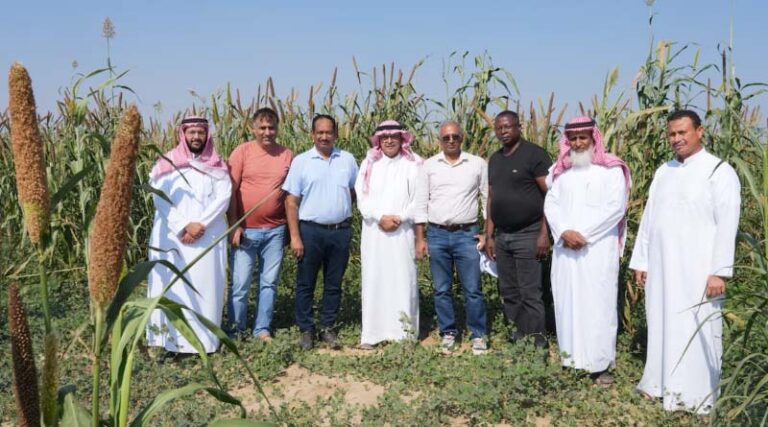
The research evaluated 27 sorghum and 15 pearl millet entries across lowland and highland environments in Jazan and Abha. The objective was to identify crop varieties capable of producing both grain and fresh biomass under Saudi Arabia’s dryland farming conditions.
The findings, published in Frontiers in Plant Science, are part of a collaborative initiative involving ICRISAT, FAO and the Sustainable Agricultural Rural Development Programme (Saudi REEF).
The research identified three sorghum and two pearl millet candidates with favourable combinations of grain yield and fresh biomass production.
Dr Himanshu Pathak, Director General of ICRISAT, said the partnership aims to strengthen domestic food and livestock feed security while supporting agricultural resilience in water-scarce environments.
He highlighted the role of scientific collaboration in developing crop options suited to local farming conditions and creating economic opportunities for farmers across Saudi Arabia.
Dr Kakoli Ghosh, Chief Technical Adviser, Sustainable Rural Agricultural Development Programme, FAO Saudi Arabia, said sorghum and pearl millet offer the advantage of producing both food grain and livestock feed.
She noted that identifying cultivars adapted to local conditions is an important step towards strengthening domestic production and supporting farmers.
Sorghum and Pearl Millet Show Yield Potential
Among the three selected sorghum candidates, the best-performing entry recorded 9.3% higher grain yield and 41.3% higher fresh biomass production compared with the best-performing check variety.
Two pearl millet candidates also demonstrated favourable grain and biomass performance. The best-performing entry recorded 33.9% higher grain yield than the best check. However, its fresh biomass yield was 37.1% lower than the check variety.
According to Dr Ephrem Habyarimana, Principal Investigator and Principal Scientist, Sorghum Breeding at ICRISAT, and Dr SK Gupta, Principal Scientist, Pearl Millet Breeding at ICRISAT, the selected materials provide a basis for further evaluation of dual-purpose crops suited to Saudi Arabia’s agricultural conditions.
Dr Raman Babu, Global Research Program Director – Accelerated Crop Improvement at ICRISAT, said selecting crops based on multiple traits can help identify varieties that balance grain production with biomass requirements for livestock feed.
He added that this approach is relevant to farming systems facing constraints such as water scarcity and climate variability.
Further Trials Planned Before Wider Adoption
The research was conducted across four site-season environments at the Jazan Agricultural Research Center and the Seed Multiplication Station in Abha. It provides field-based evidence to guide further crop improvement and evaluation in Saudi Arabia.
The next phase will involve farmer-managed trials, assessments of fodder quality and water productivity, seed multiplication and national registration. These steps will help determine the suitability of the selected candidates for wider cultivation.
Farmers and livestock keepers will also participate in evaluating crop performance, feeding value and practical suitability under local farming conditions.
Successful validation could expand the crop options available to farmers in Jazan, the Asir highlands and other comparable dryland regions. The dual-purpose varieties could also contribute to domestic grain and fodder supplies and support the resilience of crop-livestock farming systems.
Also Read: India Tops $4.39 Billion Emerging-Market AgTech Funding
Global Agriculture is an independent international media platform covering agri-business, policy, technology, and sustainability. For editorial collaborations, thought leadership, and strategic communications, write to pr@global-agriculture.com