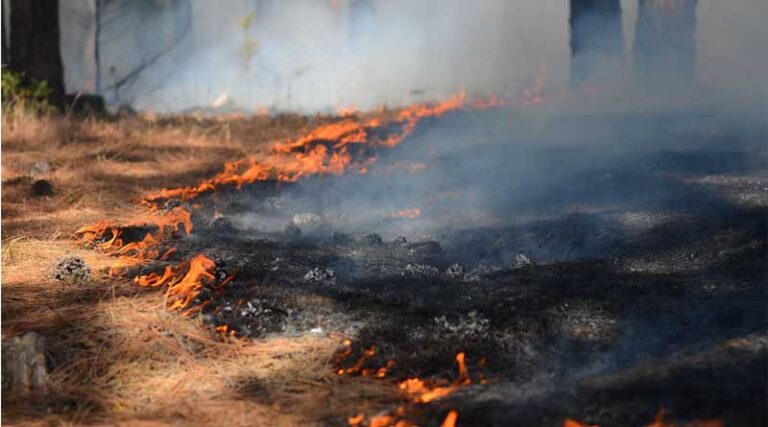
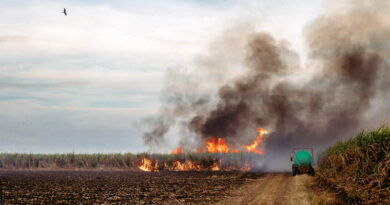
12 November 2026, New Delhi, IN: Stubble burning incidents in Punjab climbed sharply around this year’s Diwali holiday, pushing the state’s cumulative tally since mid-September past 4,400 cases, even as enforcement data show thousands of inspections and fines have done little to slow the pace of fires during the critical harvest window.
According to a Monitoring and Enforcement Actions Report compiled jointly by the Punjab Pollution Control Board and the Commission for Air Quality Management (CAQM), the state recorded 1,152 fresh stubble burning incidents on November 8, Diwali day this year, a 34.8 percent jump over the previous day’s count. That single-day spike pushed the cumulative total since September 15 to 4,459, up from 3,307 two days earlier and 3,144 the day before that. Tarn Taran district recorded the highest cumulative count at 654 incidents, followed by Ferozepur at 592, Sangrur at 488, and Bathinda at 406. Paddy harvesting across the state’s 32.87 lakh hectares was 91.4 percent complete by November 8, according to the same board.
Enforcement has produced large numbers on paper but few consequences so far. The report shows 2,998 farms were inspected statewide, with burning confirmed at 1,310 locations and burn marks found at another 122 sites outside designated active fire zones. Authorities imposed environmental compensation in 1,228 cases totaling nearly 62.55 lakh rupees, of which only about 32.60 lakh rupees had been recovered. Police registered 884 FIRs and made red entries against 1,017 farmers in land revenue records. The CAQM also issued 1,103 show-cause notices to nodal and supervisory officers and initiated prosecution against 18 supervisory officers under Section 14 of the CAQM Act, though as of the report, no charge sheets or suspension orders had actually been issued.
Delhi’s air swings between very poor and poor
Delhi’s own air quality has fluctuated sharply through the same stretch. The city’s average Air Quality Index eased to 299, in the “poor” category, on November 10, down from 344, “very poor,” the day before, according to Press Trust of India reporting that cited the Air Quality Early Warning System for Delhi. Of the capital’s 58 monitoring stations, 28 registered “very poor” readings and 28 registered “poor,” with none in the “severe” band that day. Readings at Delhi Cantonment and Sri Aurobindo Marg, at 135 and 155 respectively, were among the lowest recorded in the city.
The Decision Support System for Delhi, which models pollution source contributions, attributed only about 2 percent of the city’s pollution load on November 10 to stubble burning, with transport responsible for roughly 18 percent and particulate matter the predominant pollutant. The system projected stubble burning’s contribution would rise to nearly 7.9 percent the following day. Mahesh Palawat, vice president at the private weather forecaster Skymet, attributed the recent improvement in Delhi’s air quality to a shift in wind patterns, telling PTI that northwesterly winds had begun affecting the region and aiding pollutant dispersal.
Separate satellite-based monitoring from the CREAMS Laboratory at the Indian Agricultural Research Institute recorded 559 residue-burning incidents across six northern states on November 9 alone, including 198 in Punjab, 239 in Madhya Pradesh, 50 in Rajasthan, 47 in Uttar Pradesh, 17 in Haryana, and 8 in Uttarakhand. The same satellite-based count put the cumulative total across those six states at 8,665 incidents since September 15, a figure measured independently of, and not directly comparable to, the ground-level enforcement tallies kept by Punjab’s pollution board.
Global Agriculture is an independent international media platform covering agri-business, policy, technology, and sustainability. For editorial collaborations, thought leadership, and strategic communications, write to pr@global-agriculture.com