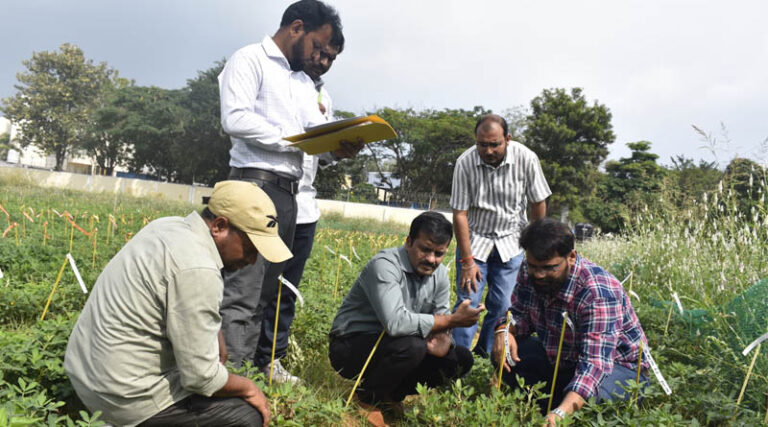
11 November 2026, Patancheru: Researchers from the International Crops Research Institute for the Semi-Arid Tropics (ICRISAT), in collaboration with leading agricultural research institutions in China and Australia, have completed a comprehensive genomic investigation of cultivated peanut, uncovering previously unexplored genetic diversity that could accelerate global groundnut breeding programmes.
Published in Nature Genetics, the study analysed 2,320 peanut accessions collected from 87 countries, providing an extensive genomic resource to support the development of high-yielding, climate-resilient and nutritionally improved groundnut varieties.
Titled “Pan-genome-based resequencing of 2,320 accessions reveals structural variations and accelerates breeding advances in cultivated peanut,” the research was co-led by Dr Manish K. Pandey, Principal Scientist – Genebank and Trait Discovery at ICRISAT’s Centre for Pre-breeding Research (CPBR). The collaboration included the Institute of Crop Germplasm Resources, Shandong Academy of Agricultural Sciences (SAAS), China; the State Agricultural Biotechnology Centre (SABC), Murdoch University, Australia; and the Henan Academy of Agricultural Sciences, China.
The research builds on the genetic resources conserved in ICRISAT’s Genebank. The accessions analysed represent 88.03% of ICRISAT’s core collection and 59.21% of the United States Department of Agriculture (USDA) peanut collection, making the study a significant contribution to global groundnut research and breeding.
Commenting on the findings, Dr Himanshu Pathak, Director General, ICRISAT, said that pan-genome research is becoming increasingly important for advancing agricultural science. He highlighted ICRISAT’s contributions to genomic studies in major pulses, including chickpea and pigeonpea, describing the latest publication as another milestone in efforts to deliver improved crops for smallholder farmers in dryland regions.
Dr Stanford Blade, Deputy Director General – Research and Innovation, ICRISAT, emphasised the importance of international scientific collaboration in developing pan-genome assemblies. He noted that partnerships between ICRISAT, Chinese research institutions and Murdoch University are essential to translating genomic discoveries into practical crop improvement outcomes.
A major outcome of the research is the identification of previously undetected structural variations (SVs) and homoeologous exchanges across the peanut genome. These findings provide new insights into the crop’s genetic architecture and offer researchers additional tools for identifying genes associated with important agronomic characteristics.
Among the identified genes are AhTFL1, associated with flowering-time regulation, and Ah12g032500, identified as a dwarfing gene in cultivated peanut. Both represent potential targets for future groundnut improvement programmes.
The identification of dwarfing-related genes could have practical implications for groundnut production. Compact plant architecture may facilitate mechanised harvesting and support higher planting densities, potentially improving production efficiency. The genomic resource could also help researchers identify favourable genetic variants associated with important traits such as seed size and pod number.
Dr Raman Babu, Global Research Program Director – Accelerated Crop Improvement, ICRISAT, said the institute’s Genebank played a central role in enabling the discovery. He highlighted that identifying genes associated with flowering time and plant architecture provides valuable resources for breeding groundnut varieties with improved resilience to climate-related challenges.
Dr Manish K. Pandey noted that groundnut breeding has historically faced limitations arising from a relatively narrow genetic base. According to him, the graph-based pan-genome captures important structural variations and provides a publicly accessible resource that can support the development of high-yielding, nutritionally superior and climate-resilient groundnut varieties worldwide.
The findings underline the importance of conserving crop genetic resources and using advanced genomic technologies to unlock their potential. By combining extensive germplasm collections with international research collaboration, the study establishes a foundation for more targeted groundnut breeding, with potential benefits for farmers and agricultural production systems across different regions.
Global Agriculture is an independent international media platform covering agri-business, policy, technology, and sustainability. For editorial collaborations, thought leadership, and strategic communications, write to pr@global-agriculture.com