03 October 2026, Fumesua, Ghana: Researchers in Ghana have genetically fingerprinted 81 okra varieties from ten countries and matched that DNA data against two years of field performance, producing a public breeding resource that identifies specific plant lines best suited as parents for new, higher-yielding okra varieties, according to a study published in the journal Discover Agriculture in June 2026.
The work was led by Jacinta Adoma Opoku of the West Africa Centre for Crop Improvement (WACCI) at the University of Ghana, working with scientists from Ghana’s CSIR-Crops Research Institute, the Cocoa Research Institute of Ghana, and Uganda’s National Crops Resources Research Institute. Okra is a staple vegetable across West Africa, South Asia and parts of the Americas, grown mainly by smallholders, but it has received far less investment in modern breeding tools than major grain and oilseed crops, leaving breeders with limited genetic information to guide crosses.
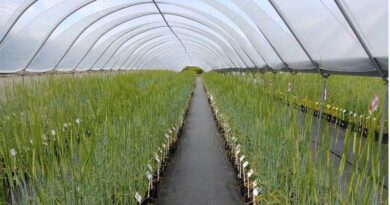
The team assembled 81 okra accessions, a term for distinct seed samples or varieties held in a germplasm collection, sourced from Ghana, Nigeria, Uganda, Senegal, India, Bangladesh, the Philippines, Thailand, the United States and Vietnam. Each accession was grown in a field trial at the CSIR-Crops Research Institute’s station in Fumesua, near Kumasi, using a statistical field layout called a 9×9 alpha lattice design with three repeated plots per accession, a method that helps separate genuine genetic differences from random variation in soil or growing conditions across the field. Researchers measured 16 quantitative traits, such as fruit yield, plant height, stem girth and days to flowering, and 10 additional qualitative traits like stem and pod colour.
In parallel, the team genotyped the same 81 accessions using a technique called DArTseq, a DNA-sequencing method that scans the genome for small variations known as single nucleotide polymorphisms, or SNPs, which act as genetic markers that can distinguish one variety from another and be linked statistically to useful traits. After filtering, the analysis yielded 19,951 high-quality SNP markers, a large enough set to build a detailed genetic map of how closely related the different okra accessions are to one another.
The combined dataset produced two separate groupings of the 81 accessions, one based on their physical traits in the field and one based purely on their DNA, and the two groupings largely agreed, both resolving the collection into four major genetic clusters. That agreement matters because it means breeders can use the cheaper, faster DNA test to predict how a variety will perform or which varieties are genetically distinct enough to cross, rather than relying solely on multi-season field trials. Fruit yield across the accessions ranged widely, from about 504 kilograms per hectare up to 3,139 kilograms per hectare, and flowering time ranged from 37 to 82 days, showing substantial untapped variation for breeders to work with. For traits including plant height, individual fruit weight, stem girth and hundred-seed weight, the study found high heritability, meaning those traits are strongly controlled by genetics rather than environment, paired with high genetic advance, meaning selection for those traits should produce meaningful gains in just a few breeding generations.
From gene bank to breeding program
Based on the combined phenotypic and genetic analysis, the researchers named several specific accessions, including lines labelled JKOH540, Asontem 2, Asontem 4, JA2133 and CRI-OFK, as strong candidate parents for new breeding programs because they combine earlier flowering with higher yield potential. The authors describe the dataset as a foundation other breeders can draw on directly for parental selection and for developing improved okra varieties aimed at both higher yield and traits that matter to consumers and traders, sometimes called market-preferred attributes, such as pod shape, colour and size.
This is conventional marker-assisted breeding rather than gene editing or genetic modification: no genes are inserted or deleted, and the SNP markers are used only to guide which existing natural varieties should be crossed with each other, a method that faces none of the regulatory hurdles associated with genetically modified crops in most markets, including India, where okra, known locally as bhindi, is grown on several million hectares and is a significant vegetable export crop.
Global Agriculture is an independent international media platform covering agri-business, policy, technology, and sustainability. For editorial collaborations, thought leadership, and strategic communications, write to pr@global-agriculture.com