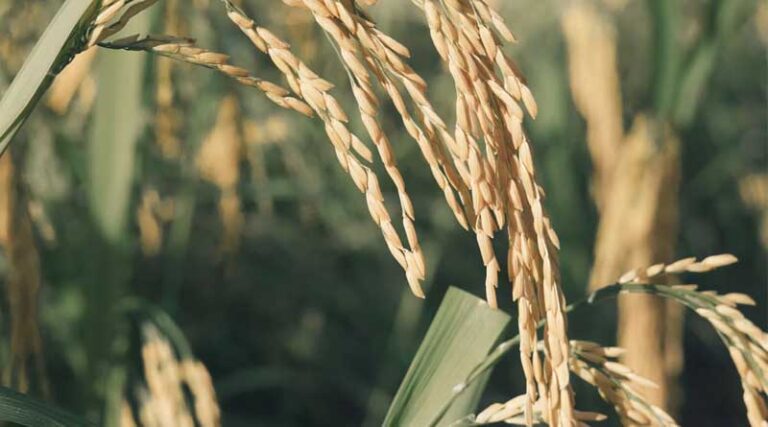
12 November 2026, Columbia, US: Researchers at the University of Missouri announced on November 2 that they had used an artificial intelligence-designed gene-editing tool to create rice plants with resistance to bacterial blight, one of the most damaging diseases affecting the crop worldwide.
The work was led by Bing Yang, Curators’ Distinguished Professor of Plant Science and Technology at the university’s Bond Life Sciences Center and a principal investigator at the Donald Danforth Plant Science Center in St. Louis. Yang’s team adapted a tool called OpenCRISPR-1 for use in rice, applying a gene-editing platform that had been designed using artificial intelligence by the California-based company Profluent and previously demonstrated only in animal cells. The Missouri team’s work represents one of the tool’s first documented applications in a food crop.
Bacterial blight is a bacterial disease that infects rice through natural openings and wounds in the plant’s leaves, and it ranks among the most destructive diseases threatening the crop, capable of causing severe yield losses in affected fields. The disease is especially damaging in parts of Asia and Africa, where rice is a dietary staple and smallholder farmers often lack access to resistant seed varieties or chemical controls.
Adapting an AI-built tool for a food crop
The findings were published in the journal aBIOTECH, with Ajay Gupta, Rabia Ahuja, and Bo Liu among the listed authors alongside Yang. The paper describes how OpenCRISPR-1 enabled targeted mutagenesis and prime editing in rice, giving the team a new way to introduce precise genetic changes aimed at disease resistance without relying on the Cas9-based CRISPR systems that have dominated plant gene-editing research in recent years.
Yang’s broader research program has long used bacterial blight as a model disease for studying how rice plants interact with pathogenic microbes, and his lab has previously worked with CRISPR and TALEN-based gene-editing tools to study and engineer resistance traits in rice. The adaptation of OpenCRISPR-1, a newer and AI-designed tool, extends that line of research into a system the team suggests could eventually be applied more broadly.
Years before reaching farmers’ fields
Researchers cautioned that the engineered resistance trait remains in a laboratory line and has not yet been bred into rice varieties grown commercially. Moving from the lab to commercial seed will require additional testing, regulatory review in the markets where the rice would be grown, and partnerships with seed or agricultural biotechnology companies, a process the team said is likely to take several years before farmers could plant the resulting varieties.
Yang said farmers in parts of Asia and Africa, where bacterial blight causes some of the heaviest crop losses, stand to benefit most once the technology reaches commercial varieties. The research team also said the same AI-designed editing approach could potentially be extended to other major staple crops, including corn and soybeans, as a way to introduce disease resistance traits more efficiently than previous gene-editing methods allowed.
Global Agriculture is an independent international media platform covering agri-business, policy, technology, and sustainability. For editorial collaborations, thought leadership, and strategic communications, write to pr@global-agriculture.com