Sri Lanka’s Organic Farming Experiment: How a Nationwide Fertilizer Ban Triggered an Agricultural and Economic Crisis
04 March 2026, Sri Lanka: In April 2021, Sri Lanka launched one of the most ambitious agricultural policy experiments in modern history. The government abruptly banned the import of chemical fertilizers and pesticides, declaring its intention to make the island nation the world’s first country to practice 100 percent organic farming. What followed was a rapid decline in crop yields, farmer protests, food shortages, and a deepening economic crisis that reshaped the country’s political leadership and agricultural policy.
The episode remains one of the most widely cited examples of how abrupt agricultural transitions can affect food security, trade, and national stability. The policy decision, driven by political leadership and economic pressure, quickly moved from a sustainability experiment to a national agricultural crisis.
Sri Lanka’s Agriculture Before the Fertilizer Ban
Before the policy shift, Sri Lanka had a diversified agricultural economy built around rice cultivation and export-oriented plantation crops such as tea, rubber and coconut. Agriculture played a major role in employment and food security, with more than two million farmers involved in the sector, according to reporting by Time magazine.
Sri Lanka has roughly 2.8–2.9 million hectares of agricultural land, according to World Bank estimates cited in agricultural policy studies. The country’s total land area is approximately 6.55 million hectares, meaning agriculture occupies a large share of the national landscape. World Bank datasets indicate that around 30,000 square kilometers (about 3.0 million hectares) are classified as agricultural land.
Within this area, arable land accounts for about 1.37 million hectares, while cropland extends to roughly 2.3 million hectares, according to World Bank and FAO datasets. The agricultural landscape is dominated by both food crops and plantation crops.
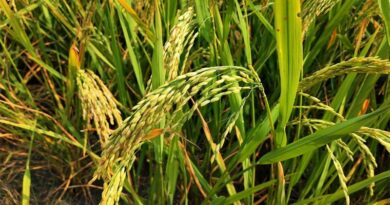
Rice is the country’s staple food crop and occupies a large share of cultivated land. According to Sri Lanka’s Department of Agriculture, rice cultivation covers more than 1.3 million hectares annually across the Maha and Yala cultivation seasons and supports the livelihoods of more than two million farming families. Paddy fields themselves cover about 780,000 hectares, according to biodiversity and land-use reports from Sri Lanka.
Plantation crops represent another major part of the agricultural system. Tea, rubber and coconut together occupy approximately 772,000 hectares, according to Sri Lanka’s national biodiversity and land-use assessments.
Sri Lanka’s agricultural calendar is divided into two main cultivation seasons. The Maha season, which runs from September to March, is the primary cropping period, while the Yala season, from May to August, accounts for the secondary production cycle. These seasons determine rice output as well as production of other field crops.
For decades, Sri Lanka’s agricultural productivity relied heavily on subsidized chemical fertilizers supplied by the government. Farmers received these inputs at controlled prices to maintain national food production levels. Until 2021, the country imported most of its chemical fertilizers, which were distributed through government support programs.
The Decision to Go Organic
The decision to ban chemical fertilizers was made under President Gotabaya Rajapaksa, who came to power in 2019. During his presidential campaign, Rajapaksa pledged to move Sri Lanka toward organic agriculture, originally proposing a transition over a ten-year period.
However, the timeline changed dramatically in 2021.
On April 27, 2021, the Sri Lankan government announced a nationwide ban on the import of chemical fertilizers, pesticides and herbicides. The policy came into effect on May 6, 2021, effectively forcing the entire agricultural sector to shift to organic inputs almost overnight.
Government officials presented the policy as a combination of environmental, health and economic reforms. The administration argued that reducing chemical fertilizer use would improve soil health and protect farmers from potential health risks. Officials also cited concerns about chronic kidney disease among farmers, although scientific studies and assessments by the World Health Organization did not establish a direct link between fertilizer use and the disease.
Another major factor was the country’s worsening foreign exchange crisis. Sri Lanka was struggling with declining reserves and rising import costs, and fertilizer imports required significant foreign currency spending. By eliminating fertilizer imports, the government hoped to reduce pressure on its financial reserves.
To implement the policy, the government created task forces and administrative mechanisms aimed at promoting organic agriculture and distributing organic inputs. However, agricultural scientists, economists and farmer organizations warned that a rapid nationwide transition without preparation could disrupt food production.
Farmers Without Fertilizer
The consequences of the fertilizer ban became visible within months of its implementation.
Sri Lanka lacked sufficient capacity to produce organic fertilizers at a scale large enough to replace synthetic fertilizers. According to agricultural research analyses, the country did not have adequate biomass resources such as plant residues or animal waste to supply nutrients required by national crop production.
Farmers across the country reported severe shortages of nutrients needed for crop growth. Many had little experience with organic farming practices and lacked training in soil fertility management without chemical inputs.
Agricultural experts warned that replacing chemical fertilizers with organic alternatives would significantly reduce crop productivity. According to an assessment by the United States Department of Agriculture cited in policy analyses, rice yields could decline by about 33 percent and tea yields by around 35 percent if synthetic fertilizers were removed without adequate alternatives.
The predictions quickly began to materialize.
According to data cited by the United Nations Food and Agriculture Organization, Sri Lanka’s food production declined by 40–50 percent within a single growing season following the fertilizer ban. Rice production fell sharply during the 2021–2022 harvest season. Several analyses reported that rice output dropped by nearly 40 percent, forcing the country to import rice for the first time in years.
The decline in tea production created another economic challenge. Tea is Sri Lanka’s largest agricultural export and a major source of foreign exchange. Reduced yields in tea plantations resulted in significant export losses.
Farmers across Sri Lanka began protesting the fertilizer ban as harvest losses increased and input shortages continued. Agricultural organizations warned that the policy was putting both farmer livelihoods and national food security at risk.
From Agricultural Shock to Economic Collapse
The agricultural crisis soon became intertwined with Sri Lanka’s broader economic collapse.
Reduced crop yields meant that Sri Lanka had to import more food at a time when the country was already facing severe foreign exchange shortages. At the same time, falling tea production reduced export earnings, further weakening the country’s financial position.
Food prices began rising sharply, and shortages of essential commodities became increasingly common. The fertilizer policy became one of several factors contributing to a nationwide economic crisis that included shortages of fuel, medicine and basic goods.
Public frustration grew rapidly. Farmers, trade unions, students and civil society groups organized protests across the country demanding government accountability.
The political consequences were dramatic. In July 2022, amid massive nationwide protests and worsening economic conditions, President Gotabaya Rajapaksa fled the country and later resigned from office. The resignation marked one of the most significant political upheavals in Sri Lanka’s modern history.
Policy Reversal and the Path to Recovery
As agricultural losses mounted, the Sri Lankan government began reversing its policy.
In November 2021, just six months after the fertilizer ban was introduced, the government lifted restrictions on fertilizer imports for key crops. Chemical fertilizers were gradually reintroduced, particularly for rice and plantation crops.
The government also began importing large quantities of urea and other fertilizers to support farmers and stabilize crop production.
However, recovery in agricultural production did not occur immediately. Farmers had already experienced major harvest losses, and fertilizer prices had increased significantly due to global market conditions.
Several reports indicated that farmers continued to struggle with debt and reduced productivity even years after the policy reversal. According to a Reuters report published in 2025, many rice farmers were still trying to rebuild production levels and recover financially from the failed policy experiment.
While rice production began improving gradually after fertilizers returned to the market, output levels took several years to stabilize.
Lessons from the Sri Lankan Experiment
Sri Lanka’s attempt to convert its entire agricultural sector to organic farming within a short period remains one of the most widely discussed agricultural policy failures of the past decade.
Many agricultural economists argue that the crisis did not occur because organic farming is inherently unworkable, but because the transition was implemented abruptly without adequate preparation, research or farmer training.
The experience highlighted the risks of rapid policy changes in food systems that depend on stable agricultural inputs. It also demonstrated the close relationship between agriculture, economic stability and political governance.
Today, Sri Lanka continues to rebuild its agricultural system while maintaining discussions about sustainability and reduced chemical use. The country’s experience is frequently cited in global agricultural policy debates as a reminder that transitions in farming systems require careful planning, scientific support and gradual implementation.
Also Read: Atish Chandra Assumes Charge as Secretary, Department of Agriculture & Farmers Welfare
Global Agriculture is an independent international media platform covering agri-business, policy, technology, and sustainability. For editorial collaborations, thought leadership, and strategic communications, write to pr@global-agriculture.com