Early farmer impressions from the Water & Soil Accelerator Program in Central Malawi
19 July 2026, Malawi: For many smallholder farmers in Central Malawi, the challenge is no longer only about producing more but about producing under increasingly difficult conditions. From unpredictable rainy seasons, declining soil fertility, rising input costs, and dry spells that can reduce crop performance even when farmers have done everything right. In this context, the Water & Soil Accelerator (WASA) Program is offering a glimpse into why soil and water management must be treated as a core part of climate resilience.
Implemented by the International Water Management Institute (IWMI) in partnership with CIMMYT, and other partners, WASA aims to accelerate the adoption of climate-smart soil and water management practices among smallholder farmers in Zambia and Malawi. In Central Malawi, the program’s mega demonstrations are testing and showcasing practical options for Conservation Agriculture (CA), focusing on minimum soil disturbance, crop residue retention, crop diversification, and maize varietal assessment.
The work builds on CIMMYT’s more than two decades of research and promotion of CA across Southern Africa. Over the years, CIMMYT and partners have generated evidence that practices such as reduced tillage, residue retention, crop rotations, intercropping, and improved varieties can contribute to better soil structure, increased water infiltration, reduced erosion, and more stable yields under variable rainfall. This experience provides an important scientific foundation for WASA as it enters a new phase of implementation, adaptation, and farmer learning.
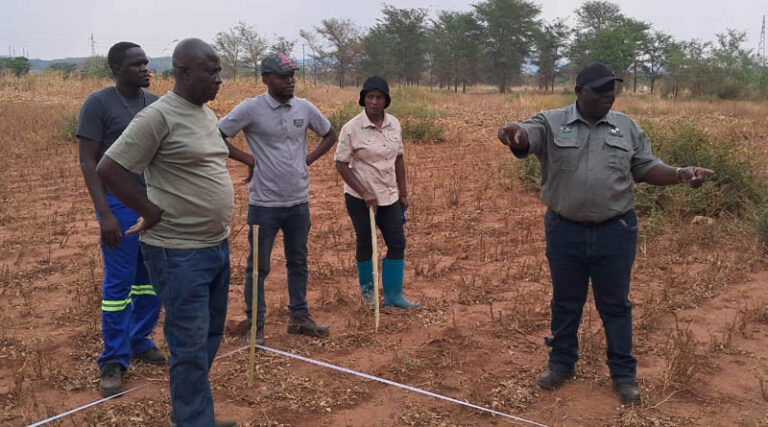
CIMMYT’s role in the consortium includes developing field implementation protocols, coordinating agronomic research, strengthening partner capacity, and supporting the generation of field-based evidence. In the first year, this has been particularly important as the credibility of the demonstrations depends on the quality of site selection, plot demarcation, trial layout, crop management, and data collection.
The Training of Trainers adopted a participatory co-learning approach, combining technical sessions, field demonstrations, and hands-on practice. Field teams worked through nine treatment configurations, including maize varietal comparisons, maize–groundnut and maize–cowpea intercrops, maize–legume rotations, and double- and four-row strip cropping systems. For many participants, strip cropping was a new concept, requiring careful discussion on spatial arrangement, fertilizer placement, crop interactions, and the type of data to be collected, including yield, biomass, residue cover, and labour use.
“For these technologies to be useful beyond the demonstration plot, the people implementing them must understand the science and the field reality,” said Dr Blessing Mhlanga, CIMMYT Cropping Systems Agronomist (Associate Scientist). “The co-learning approach allows researchers, field staff, and farmers to engage practically with the treatments, ask questions, and build confidence in practices that can be adapted to local conditions.”
Early observations from Central Malawi show encouraging levels of farmer interest and acceptance, while also revealing the practical issues that will shape scaling. In Chipeni, located in Dowa district, farmer Loveness Mwale’s site showed strong establishment across all plots, with visible varietal differences. Farmers were able to compare crop performance under the same conditions, and two farmers selected rotations and two-row strip cropping as options they were interested in taking forward. This suggests that farmers are not simply receiving information, but they are assessing options and making choices based on what they experience.
At Loice Maliwa’s site, the trial was well laid out, with good weed management, strong crop establishment, and consistent spacing. Farmers demonstrated an understanding of the concepts being tested, showing that the training approach is helping translate research protocols into practical field management.
In Chinguluwe, where a cooperative of 51 farmers is participating, the demonstrations have created an important space for collective learning. Although signs of dry spell stress were visible in maize, the overall crop stand was good, and cowpea had many pods. Farmers also raised important market considerations. While cowpea performed well in the field, many preferred groundnuts because they fetch higher prices and have more reliable markets. This feedback is critical because adoption depends not only on agronomic performance, but also on income potential, labour demand, market access, and farmer familiarity.
For Christian Thierfelder, CIMMYT principal cropping systems agronomist, WASA reflects the kind of integrated science and partnership needed to respond to climate pressure in smallholder farming systems. “This program connects long-term CA research with practical implementation at scale,” he said. “It brings together science, innovation, and partnerships in a way that supports CIMMYT’s broader strategy of building more productive, inclusive, and resilient agrifood systems.”
In its first year, WASA is already showing value as a research and learning platform. The mega demonstrations are helping farmers assess drought-tolerant varieties, rotations, intercropping, strip cropping, and soil and water management practices under real field conditions. The results are promising, but the program is also generating something equally important: farmer feedback that can guide iterative refinement and scaling. As implementation continues, WASA’s strength lies in combining scientific evidence with farmer decision-making. For smallholder farmers in Central Malawi, this means having access to tested options that can improve water use, rebuild soil health, and support more stable production in a changing climate.
Also Read: Crystal Crop Protection Launches Six New Products for Kharif 2026
Global Agriculture is an independent international media platform covering agri-business, policy, technology, and sustainability. For editorial collaborations, thought leadership, and strategic communications, write to pr@global-agriculture.com