26 October 2026, Trinidad: Nutrien, one of the world’s largest fertilizer producers, confirmed on October 5 that it will indefinitely shut down its Trinidad Nitrogen operations at the Point Lisas facility, closing the door on a plant that had already been idled for a year, at the same time that US retail fertilizer prices extended a months-long climb driven by Middle East shipping disruption, Chinese export curbs and a global sulphur shortage.
Nutrien said the decision followed a review of strategic alternatives and discussions with stakeholders, and that ongoing natural gas supply constraints made the shutdown “the best option” for improving free cash flow and return on invested capital. The Point Lisas plant had been under a controlled shutdown since October 23, 2025, after port access restrictions and an unreliable, uneconomical natural gas supply had already eroded its contribution to earnings. Dean Perkins, Nutrien’s senior vice president for upstream, nitrogen and proprietary product operations, said the company appreciated the Trinidad team’s contributions and would manage the transition “responsibly and safely.” Nutrien said its 2026 nitrogen sales guidance is unaffected because the company had already assumed zero production from Trinidad, and that it plans to grow nitrogen volumes instead through reliability improvements and low-cost expansion projects at its North American plants.
Hormuz Tensions and Export Curbs Keep a Floor Under Prices
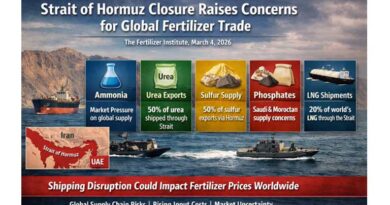
The Trinidad closure lands against a backdrop of broadly rising fertilizer costs. According to DTN’s retail fertilizer survey for the second week of October, average US prices stood at $674 a tonne for urea, up 13% from a year earlier; $987 a tonne for anhydrous ammonia, up 18%; $937 a tonne for DAP, up 2%; $981 a tonne for MAP, up 5%; and $503 a tonne for potash, up 3%, with UAN32 and UAN28 both higher on the month as well. S&P Global Ratings said the disruption to fertilizer supply chains “is evident as the Strait of Hormuz conflict continues,” a reference to the shipping and freight risk affecting Middle East-origin nitrogen and phosphate cargoes, a corridor that normally carries a large share of global fertilizer trade. DTN also cited China’s continuing export restrictions on fertilizer and a worldwide shortage of sulphur, a key input for phosphate fertilizer production, as additional pressure points. Market forecasters cited in the same report expect prices to stay elevated through the rest of 2026, with only gradual relief expected into 2027 if shipping risk eases and gas-linked urea costs soften.
Taken together, the two developments point in the same direction: global nitrogen and phosphate supply has less spare capacity to absorb shocks than it did a few years ago, whether from a single plant closure in the Caribbean or a geopolitical flashpoint thousands of kilometres away, and the cost of that tightness is landing on farmers through higher input bills just as many growers are finalising spending for the next cropping cycle.
Global Agriculture is an independent international media platform covering agri-business, policy, technology, and sustainability. For editorial collaborations, thought leadership, and strategic communications, write to pr@global-agriculture.com