India Urgently Needs a National Land Use Policy
Guest Author: Pravesh Sharma, Chairman, Steering Committee, National Association for Farmer Producer Organisations (NAFPO). He is Former MD, SFAC & Ex-Agriculture Secretary, Madhya Pradesh.
12 August 2026, New Delhi: One of the more significant policy announcements to come out in the public domain this year originated not from a finance ministry or a central bank, but from China’s agricultural planners. Beijing recently released its 15th Five-Year Plan for Agricultural and Rural Modernisation (2026–2030), which sets out an integrated roadmap for strengthening the country’s food security over the coming decades. Among its headline objectives are raising national grain production capacity to around 725 million tonnes annually by 2030, ensuring that over 98 per cent of agricultural products meet food safety standards, expanding high-standard farmland, improving irrigation, accelerating agricultural mechanisation, strengthening seed technology and deploying digital agriculture at scale.

What distinguishes the plan, however, is not merely the ambition of its targets but the coherence with which they are embedded within China’s larger development strategy. Agriculture is planned alongside urbanisation, industrial development, water management, environmental conservation and technological innovation. Food security is treated not as the responsibility of the agriculture ministry alone, but as a national strategic objective requiring coordinated action across government.
The contrast with India is difficult to ignore. India has no comparable long-term vision for the use of its most fundamental natural resource—land. We have policies for housing, industry, highways, renewable energy, urban development and agriculture. Yet there is no overarching framework that asks perhaps the most basic planning question of all: how should India’s finite land resources be allocated over the next twenty-five to fifty years?
Live Newsroom
This omission is becoming increasingly consequential. India is entering a period in which competing demands for land will intensify at an unprecedented pace. The country will require millions of new urban homes, industrial corridors, logistics parks, airports, renewable energy projects, highways, data centres and public infrastructure. Simultaneously, agriculture must continue to feed a population that will approach 1.7 billion before stabilising, while also responding to changing dietary patterns, rising demand for fruits, vegetables, livestock products and the uncertainties introduced by climate change.
The uncomfortable reality is that land cannot be expanded. Every hectare converted to one use is permanently unavailable for another. Yet our development processes continue to treat land conversion largely as a series of isolated administrative decisions rather than as components of a long-term national strategy.
The absence of such a strategy raises a series of questions that India has never systematically attempted to answer. How much agricultural land will the country actually require in 2050 or 2060 or 2075 to remain food secure? Can future productivity gains compensate for reductions in cultivated area? Which agricultural regions possess such exceptional productive potential that they should be treated as strategic national assets? How much land should realistically be reserved for future urban expansion, manufacturing, renewable energy or ecological restoration? Without answering these questions, every land acquisition decision becomes reactive rather than strategic.
Ironically, India has demonstrated precisely the opposite, and impressive, capability in several other sectors. We prepare twenty-year projections for electricity demand before constructing power plants. Transport infrastructure is increasingly guided by long-term logistics planning. Water resources are assessed basin by basin. Demographic projections routinely shape investments in education and health. Yet when it comes to land—the physical foundation upon which all these sectors ultimately depend—we continue to plan one project at a time.
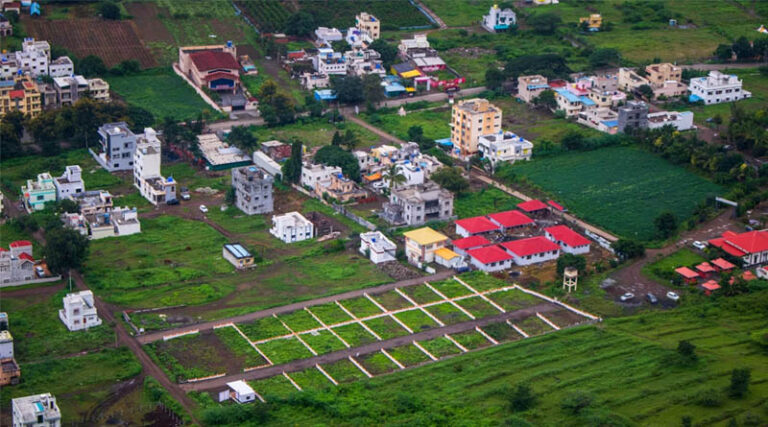
The consequences are visible across the country. Urban expansion almost invariably occurs over flat, well-connected and highly productive agricultural land. The rapid growth of Noida and Greater Noida has consumed large tracts of some of the richest and most fertile alluvial plains of the Yamuna basin. The proposed development of Amaravati in Andhra Pradesh similarly involved the conversion of some of the Krishna delta’s most productive irrigated farmland. Comparable patterns are evident around Bengaluru, Hyderabad, Pune, Ahmedabad, Lucknow, Indore and numerous other expanding cities.
None of these projects can be dismissed as unnecessary. Cities must grow. Industries require land. Infrastructure cannot be built in the air. The real question is whether India possesses a transparent national framework for deciding which agricultural lands should be developed, which should remain protected and what trade-offs society is consciously willing to accept. At present, such decisions are largely driven by local political dynamics, administrative convenience and immediate economic opportunity rather than by an assessment of long-term national priorities.
The implicit assumption often appears to be that agriculture can simply relocate elsewhere. This ignores an elementary reality. Agricultural land quality and its productive potential are not homogeneous. The deep alluvial soils of the Indo-Gangetic plains, the black soils of central India and the irrigated deltas of peninsular rivers represent natural assets that have evolved over millennia, supported by farm level infrastructure, irrigation systems, logistics, market linkages etc. Most importantly, the accumulated farming knowledge of rural communities which live in these regions represents an invaluable, and irreplaceable form of intellectual capital. Extinguishing a hectare of highly productive irrigated land may require several hectares elsewhere to produce equivalent output. Once urbanised, these landscapes are effectively lost to agriculture forever.
This is precisely why India requires a National Land Use Policy—not as another regulatory instrument, but as a long-term framework for balancing competing developmental objectives. Such a policy should begin by estimating the country’s future land requirements across agriculture, housing, industry, infrastructure, renewable energy, forests and ecological conservation over the next quarter century. Only after establishing these national requirements can rational decisions be made regarding future land allocation.
Equally important is the identification of Strategic Agricultural Production Zones comprising the country’s most productive and food-secure landscapes. These regions should enjoy a level of protection comparable to that accorded to forests, wildlife habitats or environmentally sensitive areas. Development would not become impossible, but conversion would require a far higher threshold of justification. China has already moved in this direction by identifying minimum cultivated land that must be preserved irrespective of development pressures.
Planning must also become spatially intelligent. Advances in satellite imagery, geographic information systems and digital land records now make it entirely feasible to prepare national land suitability maps identifying the most appropriate locations for agriculture, industry, urbanisation, renewable energy and ecological conservation. Major public investments should be evaluated against such maps before decisions on land acquisition are taken rather than afterwards.
Finally, India needs an institutional mechanism capable of integrating decisions that are currently dispersed across multiple ministries. Agriculture, housing, industry, environment, transport and water resources continue to operate largely within their respective silos, even though they compete for the same finite land resource. A permanent National Land Use Commission could provide precisely the strategic coordination that is presently missing.
The Green Revolution demonstrated what India can achieve when food security becomes a national mission backed by science, policy and institutional coordination. The challenge before us today is different but no less important. It is no longer sufficient to increase agricultural productivity. We must also ensure that the physical resource upon which future productivity depends is not gradually eroded through thousands of uncoordinated land-use decisions.
China’s latest agricultural strategy offers an important reminder that food security begins long before seeds are sown. It begins with deliberate choices about land. India has every reason to pursue its own development pathway, but it cannot afford to postpone this conversation indefinitely. Once fertile agricultural land is replaced by concrete, the decision is effectively irreversible. The longer we wait to develop a coherent national land use policy, the fewer choices future generations will inherit.
About NAFPO
NAFPO is a non-profit, multi-stakeholder national platform dedicated to building resilient Farmer Producer Organisations for farmer prosperity. NAFPO strengthens the FPO ecosystem through digital tools, capacity building, policy engagement, and market linkages. NAFPO envisions strong farmer-led institutions that enable smallholder Farmers to access finance, technology, markets, and governance systems—driving inclusive and sustainable agricultural transformation. Read about NAFPO at www.nafpo.in.
Also Read: Novonesis To Acquire Remaining Share Of Microbiogen To Strengthen Yeast Capabilities
Global Agriculture is an independent international media platform covering agri-business, policy, technology, and sustainability. For editorial collaborations, thought leadership, and strategic communications, write to pr@global-agriculture.com