21 November 2026, New Delhi: India’s seed exports increased by around 30% to ₹3,023 crore in 2025-26, up from ₹2,323 crore in the previous financial year, according to the Ministry of Agriculture and Farmers Welfare. With exports exceeding imports of ₹1,756 crore, the seed industry is seeking policy reforms, faster regulatory approvals and a unified export framework to expand India’s presence in global seed markets.
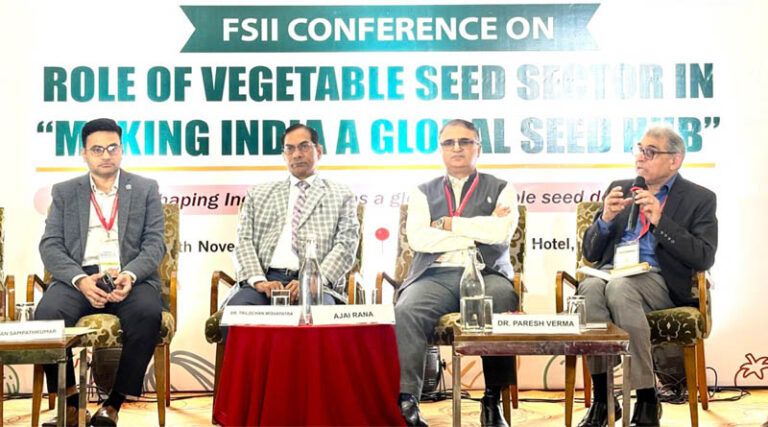
The Federation of Seed Industry of India (FSII) raised these issues at the second edition of its conference on the “Role of Vegetable Seed Sector in Making India a Global Seed Hub”, held in New Delhi on November 20, 2026. The conference brought together policymakers, industry representatives, exporters and researchers to discuss India’s potential in vegetable seed research, production, processing and exports.
The industry welcomed the government’s proposed single-window system for seed exports, stating that faster clearances and approvals would be necessary to increase export volumes. Representatives also welcomed the abolition of the EXIM Committee, integration of the SATHI platform with Directorate General of Foreign Trade (DGFT) processes, and the continued issuance of electronic phytosanitary certificates.
Ajeet Kumar Sahu, Joint Secretary (Seeds), Ministry of Agriculture and Farmers Welfare, invited industry stakeholders to submit inputs for a Seed Export Promotion Policy based on a cluster approach.
Ajai Rana, Chairman, FSII and MD & CEO, Savannah Seeds, said the conference reflected a shared commitment to positioning India as a global seed hub. He highlighted the government’s focus on global practices and standards and said the five Centres of Excellence announced, including those focused on seed treatment and seed health, would support the development of export capabilities.
India currently accounts for less than 2% of global seed trade, while the industry’s target is to increase this share to 10%. Industry representatives said achieving this target would require coordinated action across ministries and regulatory bodies.
Seed exports are governed by multiple regulatory frameworks covering seed legislation, biodiversity, intellectual property, plant variety protection and international trade. Industry representatives called for a unified approach through a dedicated task force or export mission supported by inter-ministerial coordination.
They also highlighted the need for technology-driven approvals, noting that seeds are living organisms and delays in regulatory clearances can affect seed quality and export readiness.
Dr Trilochan Mohapatra, Chairperson, Protection of Plant Varieties and Farmers’ Rights Authority, called on the industry to increase investment in indigenous research and breeding capabilities. Referring to India’s pharmaceutical sector, he said the seed industry should move beyond importing parental lines and exporting multiplied seeds.
He emphasised the need to strengthen domestic breeding through molecular breeding and genomic selection, while developing varieties with improved nutritional characteristics and taste to establish distinct Indian seed brands. He also called for stakeholders to move from discussions to concrete action towards achieving the export growth target.
Dr Paresh Verma, Director General, FSII, said the discussions reflected a shared commitment among stakeholders to strengthen India’s seed export ecosystem. He noted that the government had been receptive to industry concerns and said FSII would submit actionable recommendations, including proposals for a dedicated Seed Export Promotion Policy.
Global Agriculture is an independent international media platform covering agri-business, policy, technology, and sustainability. For editorial collaborations, thought leadership, and strategic communications, write to pr@global-agriculture.com