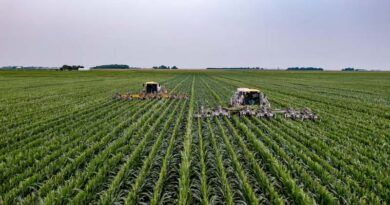
21 November 2026, Guelph, CA: A research team at the University of Guelph in Ontario is field-testing an autonomous robot called AgriScout, designed to drive through farm fields on its own, photograph crops as it goes, and use artificial intelligence to flag early signs of disease, pests and crop stress before they spread.
The project, detailed in a University of Guelph release published November 9, is led by computer science master’s student Jacob Serafin, who began working on agricultural robotics after taking a course taught by University of Guelph researcher Gurjit Randhawa during his undergraduate studies. Conversations about Randhawa’s research pulled Serafin toward agricultural problems, and the collaboration grew into AgriScout, now backed by Canada’s Natural Sciences and Engineering Research Council (NSERC) and the Ontario Ministry of Agriculture, Food and Agribusiness, though the university did not disclose specific funding amounts.
AgriScout combines mechanical components, cameras and sensors, computing hardware and custom electronics on a single mobile platform built to withstand field conditions rather than a controlled lab setting. As the robot moves through a field, its cameras capture images of the crop canopy, and onboard artificial intelligence models, trained to recognize visual patterns associated with disease, pest damage and plant stress, analyze those images in place of a human scout walking the rows. The university’s release names disease detection as the project’s main focus area, with pest and stress detection described as related capabilities under development. It does not specify which crop or crops the team has tested the robot on, nor does it name the camera hardware or the specific AI model architecture used.
From Lab Demo to Working in Mud and Rain
Serafin has been candid about the gap between a working prototype and a machine that survives real farm conditions. “Before I thought the AI model was everything, but it’s actually not,” he said. “It’s everything else that goes around it.” That “everything else” includes cameras that keep working as light conditions change through the day, enough battery power to finish a field, and mechanical parts tough enough for uneven, rutted ground, since fields rarely offer the flat, predictable surfaces of a university lab or hallway.
Those lessons came from repeated failures in testing. The team has dealt with robot legs breaking on rough terrain and batteries dying mid-field after dark, problems that pushed Serafin to learn welding and to scour hardware stores for parts that were never designed for agricultural robotics. One fix became something of a running joke on the team: a cutting board taken from a kitchen now sits inside AgriScout, repurposed for its material properties rather than bought as a specialized robotics component. Dust, rain, wind and sun exposure round out the list of everyday field stresses the robot has had to be hardened against, on top of the usual challenge of maintaining a wireless data connection in areas with limited connectivity.
Serafin frames farmer adoption, not raw model accuracy, as the real test for the project going forward. He has said a scouting system will not get used if it is too expensive, too difficult to operate, unreliable, or simply does not provide enough useful information to change how a grower manages a field. The underlying case for a system like AgriScout is that catching disease hot spots early allows a farmer to treat only the affected patches of a field rather than spraying the entire area, which Serafin argues reduces both crop loss and the amount of crop protection product applied overall. The University of Guelph release does not describe a commercialization timeline, a planned farmer pilot program, or how AgriScout’s detection accuracy has performed when benchmarked against manual field scouting, so those practical questions remain open as the project continues.
For Serafin personally, the project has reshaped his plans after graduate school. “AgriScout definitely won’t be the last thing I build,” he said, adding that he wants to keep developing tools aimed at having a meaningful impact in agriculture. The University of Guelph has a broader track record in farm robotics, including earlier student-led projects on autonomous weeding systems, and AgriScout adds to a growing cluster of Canadian university research aimed at moving AI-based crop monitoring out of controlled trials and into working fields.
Much AI crop-monitoring research to date has been validated on curated image datasets or small demonstration plots, conditions that do not expose a system to the variable lighting, weather and terrain found on a working farm. The Guelph team instead built and rebuilt AgriScout’s mechanical and electronic components around repeated field failures, including the broken legs, dead batteries and improvised cutting-board part described above, before treating the detection model itself as finished.
Global Agriculture is an independent international media platform covering agri-business, policy, technology, and sustainability. For editorial collaborations, thought leadership, and strategic communications, write to pr@global-agriculture.com