After Drones Fall Short, Researchers Build a Ground Robot to Catch Soybean Disease Early
19 October 2026, Illinois: Engineers at Southern Illinois University Carbondale have built a four wheeled, battery powered ground robot designed to spot soybean diseases before visible symptoms appear, after an earlier attempt using drone mounted cameras failed to gather enough data from the undersides of leaves. The project, funded through the Illinois Soybean Center, targets frogeye leaf spot, a fungal disease that can cut soybean yields by 60% to 70% once it takes hold in a field.
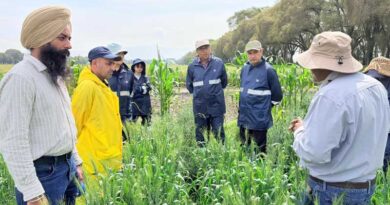
The work is led by Billy Ram, an assistant professor of precision agriculture at SIU, with the robot itself built and operated by Samuel Singh, a doctoral student in the university’s agricultural sciences program who also holds a bachelor’s degree in agricultural engineering and a master’s in remote sensing. Their research was described in an October 13 article distributed by SIU’s public information office.
Frogeye leaf spot is one of several fungal diseases that affect soybean, many of which live in the soil and can persist there for years, reinfecting fields in wet conditions long after an initial outbreak. That persistence, combined with the speed at which the disease can spread once established, makes early detection valuable. If a disease overpowers a field, Ram said, late stage fungicide application is not very efficient, since by the time visible lesions appear on the upper leaf surface, where most routine scouting and aerial imaging focus their attention, the plant may already be too damaged to fully recover its yield potential.
Why the drone approach fell short
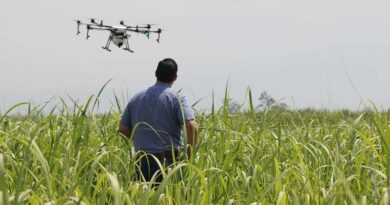
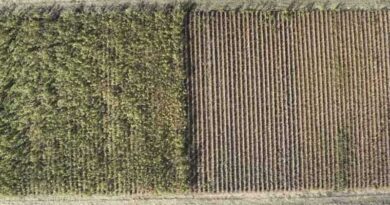
Ram’s team first tried to solve the detection problem from the air, flying a drone equipped with hyperspectral and multispectral cameras over test plots at the university’s farms to build disease maps. Hyperspectral imaging captures light across dozens or hundreds of narrow wavelength bands, often used in plant science to pick up subtle changes in leaf chemistry invisible to the naked eye, while multispectral imaging uses a smaller number of broader bands. Even flying close to the canopy, the drone’s cameras could not adequately capture the undersides of leaves and the lower stems, which is where frogeye leaf spot lesions often appear first. Without a clear view of those surfaces, the aerial system simply could not collect enough data to reliably flag the disease before it became visually obvious from above, a limitation that pushed the team toward a ground based alternative.
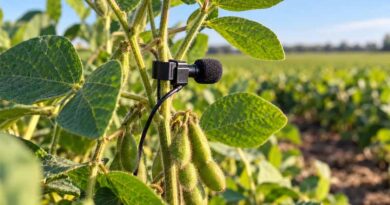
The robot that resulted from that pivot runs on GPS and can operate autonomously once a user uploads a map of the field, following crop rows on its own. It carries multiple cameras mounted to view both the tops and undersides of soybean plants as it moves through the field, a mechanical answer to the blind spot that stymied the drone. Ram described the current phase of the project as primarily an engineering challenge rather than a straightforward agronomy question, saying the team is solving an engineering problem more than an agronomic problem by working through camera placement, navigation and data collection before the detection software is built.
Singh, who operates the robot and designs its navigation, said the aim is to generate field maps precise enough to show farmers exactly where disease pressure is building. He described wanting to design maps that help farmers detect hot spots, the kind of output the finished system would eventually produce for growers.
What is built so far, and what comes next
It is worth being clear about where this project currently stands. The hardware, the camera layout and the autonomous navigation system are built and operating in the field, but the artificial intelligence models that would actually identify disease type and severity from the image data have not yet been developed or tested, so there are no published accuracy figures, detection lead times or trial acreage results to report at this stage. The research is best understood as a methodology story: a documented case of one sensing approach failing in a specific, explainable way, namely leaf underside coverage, and a university team re engineering the sensor platform in response, rather than a finished result.
Also Read: USDA Reports Record Soybean Yield, Bigger Corn Crop in October Forecast
Global Agriculture is an independent international media platform covering agri-business, policy, technology, and sustainability. For editorial collaborations, thought leadership, and strategic communications, write to pr@global-agriculture.com