Spray Drones Defoliate Cotton as Well as Ground Rigs, Auburn Trials Find
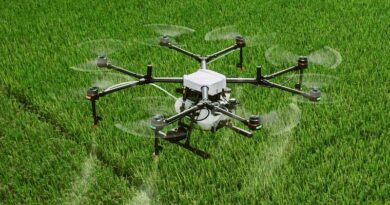
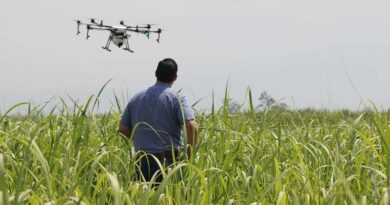
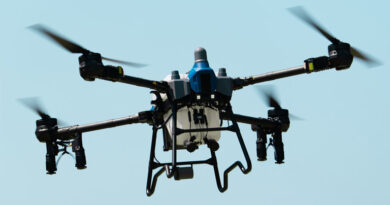
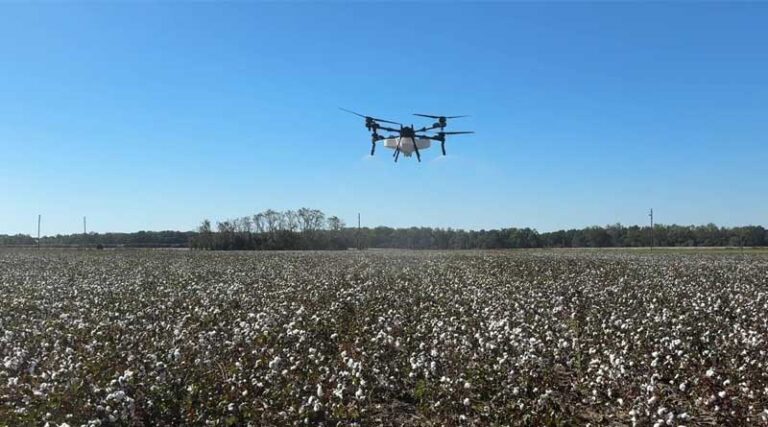
28 November 2026, Auburn, US: Cotton growers weighing whether to replace ground sprayers with aerial drones for pre-harvest defoliation now have several years of side-by-side field data to draw on. A multi-year trial run through Auburn University’s precision agriculture program found that spray drones defoliated cotton just as effectively as conventional ground rigs, even though the drones laid down noticeably less spray coverage in the crop canopy.
The results were published November 9 on Auburn’s AU Precision Ag blog by extension specialist Simer Virk, whose program has been comparing drone and ground-rig defoliation across large replicated blocks in cotton fields over multiple growing seasons.
Before cotton can be harvested by machine, growers apply a mix of chemicals known as harvest aids to strip leaves from the plant and force bolls open, so the picker gathers cleaner, trash-free lint. The Auburn trial used a common three-way blend: Folex (the organophosphate compound tribufos, which kills leaf tissue on contact), ethephon (a plant growth regulator that releases ethylene gas inside the plant to loosen leaf attachment and trigger boll opening), and thidiazuron (another growth regulator used to accelerate defoliation and boll opening). Getting this mix onto the plant evenly and at the right volume matters, since harvest aids only act on the leaf surface they actually reach.
That is where application method comes in. The ground sprayer applied the mix at 10 gallons of carrier water per acre, the standard rate for Southeast cotton. The spray drones applied the same chemical blend at much lower volumes, 3 and 5 gallons per acre, reflecting the lighter payloads drones typically carry compared with ground equipment. Researchers measured how much spray reached the upper, middle and lower parts of the plant canopy during application, then tracked defoliation percentage, leaf desiccation, regrowth and open bolls through to harvest, along with final lint yield and fiber quality, across four site-years of trials.
Coverage trailed, efficacy did not
As expected, the drone treatments left less spray on the plant than the ground rig at every canopy level, and that coverage was also less uniform across the width of the spray swath. Virk’s team attributes most of the gap to the ground sprayer’s much higher water volume and its boom height relative to the crop. Raising the drone’s application rate from 3 to 5 gallons per acre closed some of that gap, improving coverage noticeably in the upper canopy, a practical lever the researchers say growers can pull if coverage looks thin in the field.
Despite the lower coverage, the chemistry still worked. Percent defoliation, desiccation, regrowth control and boll opening came out similar between the drone and ground-rig treatments in every trial year. Only one of the four site-years showed the drone producing higher desiccation than the ground rig, a difference the researchers link to environmental conditions in that particular season rather than to the application method itself. Lint yield came out the same regardless of how the defoliant was applied, and fiber quality measurements showed no meaningful difference between drone-treated and ground-treated cotton.
The practical case for drones
For growers, the finding matters less as a research curiosity and more as evidence supporting wider adoption. Spray drones can reach fields that ground rigs struggle with, including wet soil, rutted late-season ground or irregular field shapes, and they can fly during the short weather windows that often dictate when a defoliation pass needs to go out ahead of an approaching harvest. Labor shortages in row-crop regions have also pushed growers toward aerial application for a range of inputs beyond insecticides and fungicides. Auburn’s data gives that shift an evidence base specifically for harvest aids, a use case that depends heavily on even leaf coverage rather than on the plant absorbing a systemic chemical, which makes the coverage-versus-efficacy question more important here than for many other sprayed inputs. Cotton-growing regions outside the United States, including parts of India, Brazil and Australia, have shown similar interest in aerial application as a way to cut labor needs and improve timing around harvest, making field-validated efficacy data of this kind relevant well beyond the Southeast.
Virk’s team cautions that the gains are conditional on getting the basics right. The blog post recommends growers calibrate and verify actual drone application rates before a pass, choose a swath width that keeps coverage uniform across the boom, follow label-specified volume and droplet-size requirements for the harvest-aid product, and fly only when wind conditions fall within recommended limits. Those steps, the researchers note, matter more for drones than for ground rigs, precisely because the lower carrier volumes used by aircraft leave less margin for error in getting the chemical onto the leaf.
Also Read: BugBiome Raises £2.5 Million to Develop Microbial Insecticides
Global Agriculture is an independent international media platform covering agri-business, policy, technology, and sustainability. For editorial collaborations, thought leadership, and strategic communications, write to pr@global-agriculture.com