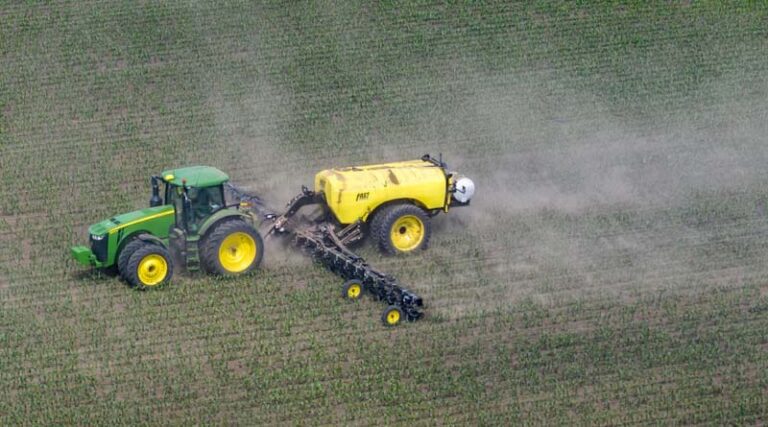
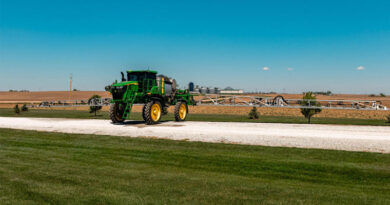
28 November 2026, Tifton, US: Researchers at the University of Georgia’s College of Agricultural and Environmental Sciences (CAES) have field-tested an artificial intelligence-guided sprayer that cut herbicide use by about 60 percent in an onion crop, by opening and closing more than a hundred individual spray nozzles in real time as the machine rolls down each row.
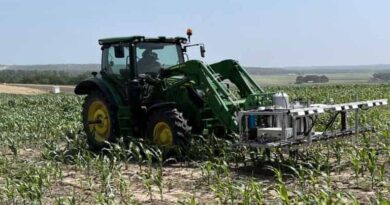
The sprayer was built by the university’s Precision Horticulture Team and is led by Luan Oliveira, an assistant professor and precision agriculture extension specialist in the CAES Department of Horticulture. It carries 156 nozzles spaced about half an inch apart, a far tighter arrangement than the one nozzle every 20 to 30 inches typical of a conventional boom sprayer. Each nozzle operates independently, opening only when a machine vision system, a camera-based technology that uses software to identify objects in real time, spots a weed directly beneath it, rather than spraying an entire bed regardless of where weeds are actually growing.
The team tested the sprayer in a field trial on onions, one of Georgia’s signature vegetable crops, comparing it against a standard broadcast sprayer that treats the full bed width continuously whether or not a weed is present. Oliveira said the targeted approach produced the roughly 60 percent cut in herbicide volume, along with a qualitative drop in crop injury, since chemical no longer lands on onion plants growing between weed patches. The university’s release, published November 25, did not provide a specific plot size or name the exact camera or software model used, though it described the system as relying on cameras mounted ahead of the nozzle bank that scan the bed and trigger individual nozzles within a fraction of a second of detecting a weed.
Herbicide costs and regulatory pressure around chemical runoff have both been pushing specialty-crop growers toward reducing blanket spraying, but most commercial spot-sprayers already on the market work at a coarser resolution, often triggering a single nozzle over a foot or more of row. UGA’s design narrows that resolution to roughly the width of an individual onion plant, which the team argues is what makes it possible to treat a weed without also treating the crop growing immediately beside it.
The same Precision Horticulture Team has also tested a related machine built for tree crops, pairing LiDAR, a laser-based distance-sensing technology that maps the shape of objects in three dimensions, with real-time artificial intelligence to map the canopy of individual pecan trees and spray fungicide only where canopy actually exists, skipping the open row gaps between trees that a standard airblast sprayer would otherwise coat as it passes through an orchard. Oliveira said a trial completed in a prior year using that tool, known as Smart Apply, produced fungicide savings of around 60 percent compared with conventional application, a figure in the same range as the onion result despite the different crop and spray target. The university’s release did not specify the orchard’s location or the exact year the pecan trial took place.
Oliveira’s team is part of a broader push inside CAES to apply machine vision and artificial intelligence across specialty crops grown in Georgia, where UGA has separately run work using cameras and modeling to detect disease in Vidalia sweet onions, though that is a distinct research effort focused on disease detection rather than spraying.
For growers, the practical appeal of both the spot sprayer and the Smart Apply system is the same: cutting chemical volume without cutting pest or weed control, which lowers input costs and reduces the amount of product that ends up on soil or in runoff between plants. Machine vision spot spraying has already been commercialized at a coarser scale by several equipment makers for broadacre row crops such as cotton and soybeans, but specialty vegetable and orchard crops, with their tighter plant spacing and higher per-acre chemical costs, have been slower to get purpose-built equipment. UGA’s narrower nozzle spacing is aimed specifically at that gap.
No numeric figure for the crop-injury reduction in the onion trial has been published, and the Precision Horticulture Team has not indicated commercialization plans or a timeline for broader on-farm testing beyond the completed field trial.
The economics behind the project reflect a wider trend in specialty crop production, where labor and chemical inputs both make up a large share of per-acre costs and where even modest reductions in spray volume add up across a season of multiple herbicide or fungicide passes. Onions are sensitive to several common herbicides at the seedling stage, which is part of why reducing off-target spray contact matters as much to crop safety as it does to the chemical bill. Coarser spot-spray systems already sold commercially have delivered comparable percentage reductions in broadacre row crops, but those typically rely on a single camera and nozzle pair covering a wider band of the row, making UGA’s narrower, higher-nozzle-count design a step toward finer control rather than a wholly new category of technology.
Both systems depend on the same underlying idea: that real-time image recognition can replace a driver’s judgment about where to spray, and apply it consistently across a field rather than only where an operator is paying close attention. Oliveira’s team has framed the work as applied extension research rather than product development, meaning the near-term output is expected to be data and recommendations for Georgia growers and equipment makers rather than a UGA-branded commercial sprayer.
Global Agriculture is an independent international media platform covering agri-business, policy, technology, and sustainability. For editorial collaborations, thought leadership, and strategic communications, write to pr@global-agriculture.com