Inaho Europe’s Harvesting Robot Clears Summer Pilot, Wins 2027 Grower Commitment
28 November 2026, Netherlands: Inaho Europe B.V., a Netherlands-based robotics company with Japanese origins, has completed a summer-long pilot of its autonomous tomato-harvesting robot at two commercial greenhouse growers, one in the Netherlands and one in Belgium, with the robot picking fruit alongside human workers every working day from June through August.
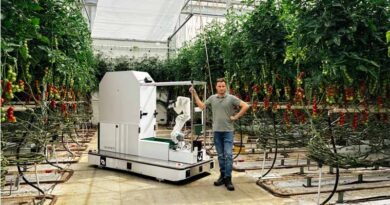
The robot runs on the greenhouse’s existing overhead rail system rather than requiring new infrastructure, is battery-powered, and is compact and light enough that any member of a grower’s team can operate it without specialized training, according to Yu Mizuki, director of inaho Europe. The two pilot sites grew different snack tomato varieties and truss types, and each used between two and three robot units per hectare during the trial. The company tracked harvesting performance through two metrics: hours worked per lane (the term greenhouse growers use for a row of crop) and kilograms harvested per hour, though specific figures from this particular pilot have not been published.
Mizuki said the robot can take on part of the picking workload in a commercial setting, and that results from the pilot were strong enough that one of the two growers has already committed to using the robot through the 2027 season. Inaho has not named either grower or disclosed the exact locations within the Netherlands and Belgium where the pilots ran.
How the System Works
The robot uses an AI-driven vision system to identify ripe fruit and a robotic arm to pick it, moving along the greenhouse’s rail-mounted crop wires much as a human picker’s cart would. Unlike a one-off research prototype, the machine is being positioned as a commercial-ready tool: inaho’s pricing model for the 2027 rollout charges growers per kilogram of tomatoes harvested rather than requiring an upfront equipment purchase, a structure the company says is designed to be comparable to the cost of paying a human picker by output. Availability of the 2027 model will be limited, the company said, and it is being built with improvements over the version used this summer, including better pick precision, a higher rate of correctly identifying ripe fruit, a longer reach range, and a redesigned gripper.
This pilot is not inaho’s first commercial test in Europe. The company has been running trials with Dutch tomato growers since at least 2023, moving from early fixed-cost test phases toward the current fee-for-service, pay-per-kilogram model introduced as the technology matured. An earlier trial phase with a Belgian grower was reported in March 2026, though it has not been confirmed whether that grower is one of the two included in this summer’s pilot.
Labor availability has been a persistent constraint for greenhouse vegetable growers across Northern Europe, where harvest work is seasonal, physically demanding, and increasingly hard to staff, pushing growers toward automation even where the economics are still being proven out crop by crop. Robotic tomato harvesting has drawn interest from several companies beyond inaho; Germany’s Eternal.ag, for instance, has separately been expanding its own autonomous harvesting robot fleet with Dutch greenhouse growers. Inaho’s point of difference is its reliance on the greenhouse’s existing rail infrastructure, which the company argues lowers the barrier to adoption since growers do not need to retrofit their facilities before deploying the robot.
No numeric results from the June through August pilot, including final hours-per-lane or kilograms-per-hour figures, have been released publicly. Inaho has also not said how many additional growers it expects to sign on for the 2027 season beyond the one grower already confirmed.
Greenhouse tomato production is particularly well suited to rail-based robotics because the crop grows on a fixed, predictable structure: trusses hang at a roughly consistent height along wires strung above each row, and the crop itself does not move between visits the way an open-field row crop can shift with wind or growth variation. That consistency is also why rail-guided systems have become a common starting point for greenhouse automation more broadly, from pesticide application to crop monitoring, since a robot that only has to travel along a fixed rail does not need the more complex navigation and obstacle-avoidance systems required by a free-roaming field robot.
The shift toward a pay-per-kilogram pricing model is notable because it removes much of the upfront financial risk that has historically slowed robot adoption in horticulture, where growers have often been asked to buy or lease expensive equipment before knowing how it will perform on their specific crop variety and greenhouse layout. By pricing the service against actual harvested output, inaho is effectively betting that its own technology will perform reliably enough, across varied truss types and canopy densities, to make the arrangement profitable once it scales beyond a handful of pilot sites.
Also Read: BugBiome Raises £2.5 Million to Develop Microbial Insecticides
Global Agriculture is an independent international media platform covering agri-business, policy, technology, and sustainability. For editorial collaborations, thought leadership, and strategic communications, write to pr@global-agriculture.com