25 September 2026, US: A new round of US tariffs on imported drones, aimed primarily at Chinese manufacturer DJI, has taken effect and is beginning to raise costs for the small but fast-growing share of American farmers who use drones for crop spraying and scouting, according to trade press reporting on the rollout.
President Trump announced the tariffs under Section 232 of the Trade Expansion Act on August 13, and the main measures took effect on September 3. Drones weighing more than 25 kilograms, or fitted with thermal imaging capability, are now subject to a 100 percent tariff, along with their docking stations and critical components. Smaller drones that lack what the administration classifies as national security-sensitive features face a 25 percent tariff. Drones imported from the European Union, Japan, Liechtenstein, South Korea, Switzerland and Taiwan face a lower 15 percent rate, while UK-made drones face 10 percent, provided they meet local content rules. Equipment already imported and cleared before September 3 is exempt, as are certain products from close US allies and federally approved systems.
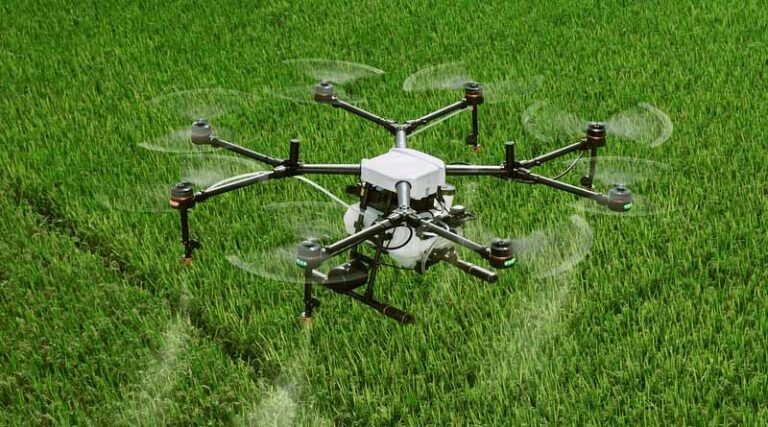
The measure is framed by Washington primarily as a national security and supply chain policy, targeting Shenzhen-based DJI and other Chinese drone makers over concerns about data security and dependence on Chinese hardware. But agricultural users are caught in its path because DJI’s Agras line of heavy-lift spraying drones, widely used for pesticide and fertiliser application on row crops and orchards, generally exceeds the 25-kilogram threshold that triggers the top tariff rate.
Adoption is still uneven across US farms
According to USDA survey data cited in the reporting, drone adoption on American farms remains modest and highly skewed by farm size. About 12 percent of large-scale family farms currently use drones in some capacity, compared with 9 percent of midsize farms and just 2 percent of small family farms. Farmers who have adopted the technology cite a mix of benefits: 40 percent point to higher yields and 40 percent to labour time savings, while smaller shares cite reduced input costs, lower environmental impact from more precise application, and reduced operator fatigue compared with ground or aerial spraying by manned aircraft.
That uneven adoption curve means the tariff’s immediate financial impact will be concentrated among larger operations and custom application businesses that have already invested in drone fleets, rather than being felt broadly across the farm sector. But for those users, a doubling of the landed cost of a replacement drone, battery pack or docking station is a meaningful new expense heading into the next spraying season, at a time when many farm balance sheets are already under pressure from soft commodity prices and high input costs.
A ripple effect for global drone-based spraying
The tariff lands at an awkward moment diplomatically, coming just as US and Chinese leaders meet in Washington this week to extend their broader trade truce, with agricultural machinery and technology trade among the issues on the table alongside soybeans and rare earths.
Global Agriculture is an independent international media platform covering agri-business, policy, technology, and sustainability. For editorial collaborations, thought leadership, and strategic communications, write to pr@global-agriculture.com