Can Shrimp Farming Help Bring Mangroves Back to the Sundarbans?
11 July 2026, New Delhi: The Indian Sundarbans sits where rivers flowing from the Himalayas meet the Bay of Bengal. Shared by India and Bangladesh, it is part of the world’s largest contiguous mangrove forest and one of the most densely inhabited coastal landscapes in the world.
But its islands support farming communities that are highly exposed to climate risk. Inhabitants are constantly facing cyclones and storms, tidal flooding, erosion and sea-level rise which have had adverse impacts on their livelihoods.
Mangroves are central to the Sundarbans.
Their ability to store carbon, protect coastlines from erosion and storm surges, and provide habitat for fish and other species makes them part of the region’s natural infrastructure, but also part of its economy. They sustain fisheries and aquaculture, making them vital to communities whose livelihoods depend on these waters.
But these forests have been under pressure for decades. In many coastal regions, mangrove areas have been cleared or degraded while settlements, farms and aquaculture ponds have expanded. Intensive shrimp farming has been one of the major drivers, especially in parts of Asia where export demand has driven the expansion of brackishwater aquaculture.
In India, the challenge is how to grow the sector without losing the benefits mangroves provide. Shrimp farming is part of the coastal economy, (for many households it is a source of work and income), but poorly managed expansion can weaken the mangrove systems that coastal communities also rely on.
So for places like the Sundarbans, how can aquaculture continue without further weakening the mangrove systems that help protect coastal communities?
One approach being tested is Integrated Mangrove Aquaculture, also known as mangrove silvofisheries. The model brings mangroves into and around traditional aquaculture ponds, allowing shrimp, crab or fish production to take place alongside mangrove restoration.
Similar systems have been used for decades in countries such as Indonesia and Viet Nam. In India, however, Integrated Mangrove Aquaculture is still at an early stage. There are pilots, but not yet enough locally tested evidence to guide wider adoption.
Through CGIAR Climate Action, WorldFish, IWMI and partners are studying whether Integrated Mangrove Aquaculture can deliver environmental and livelihood benefits in the Indian Sundarbans. The work focuses on assessing ecosystem services, farm management, and farmer and community adoption.
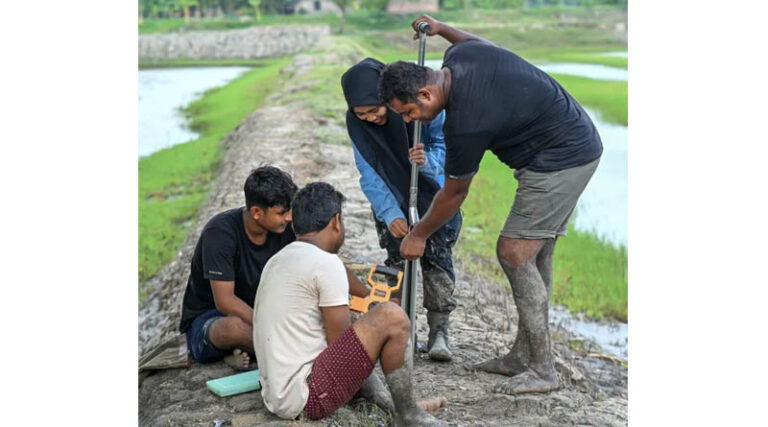
For the field study on blue carbon stock assessment, researchers selected multiple sampling sites across the Sundarbans with diverse aquaculture and natural mangrove landscapes.
The team travelled across islands and tidal channels to reach the sampling sites. In natural mangrove areas, they had to plan fieldwork around low tide, when sites were accessible. Some sampling areas were close to protected forest patches, including areas associated with tigers, crocodiles and snakes, so access had to be carefully managed.
At each site, researchers laid out plots, counted trees, saplings, seedlings, dead trees and roots, measured water quality, and collected soil samples. Some soil cores were taken from as deep as three metres below the surface.
The soil samples are now being processed in the laboratory. Once the soil carbon data is combined with vegetation and water quality measurements, the team will be able to compare how much carbon is stored across the three systems.
The measurements follow established mangrove carbon protocols, with support from CIFOR-ICRAF (now the Landscape Alliance) scientists. Applying those methods to Integrated Mangrove Aquaculture system is still developing, because the system is neither a conventional aquaculture pond nor a natural mangrove forest. Part of the work is therefore to help adapt carbon measurement methods to this kind of mixed production and restoration system.
The study is not assuming that Integrated Mangrove Aquaculture works in the Indian Sundarbans. It is testing what the system stores, how it functions, and what farmers would need if it is to move beyond small pilots.
If the evidence is strong, the model could help reduce the environmental and production risks of traditional shrimp farming in mangrove regions. It could also lead to improvements in pond conditions for local farmers, improve yield and disease resistance, support biodiversity, increase carbon storage and create routes into sustainability certification or blue carbon financing.
But scaling the model will require providing different kinds of evidence and support to different groups:
- Farmers need practical guidance on what species to plant, where to plant it, how to manage pond conditions, and how to avoid losing income.
- Policymakers need to know whether this can work as a serious development and conservation approach. Can it protect mangroves while still supporting livelihoods?
- And communities need to know whether it fits real life in the Sundarbans. Land and labour are limited. So even if the model works ecologically, it still has to make sense socially and economically.
This is the reason why the project also includes farm management guidelines and socio-economic research. WorldFish is leading the ecosystem service assessment and management guidance while IWMI is examining the social and economic conditions that shape adoption.
The question we are testing in the Sundarbans is whether aquaculture and mangroves can be managed together in ways that benefit farmers, coastal ecosystems and help us meet climate goals.
The results are still being analysed. But the work underway could help show whether Integrated Mangrove Aquaculture can become a practical model for restoring mangroves within working aquaculture landscapes
Also Read: UPL Launches New Herbicide Ricebeaux to Tackle Weed Pressure in India’s Rice Belt
Global Agriculture is an independent international media platform covering agri-business, policy, technology, and sustainability. For editorial collaborations, thought leadership, and strategic communications, write